
Rating: NR | Runtime: 107 minutes
Release Date: September 17th, 2026 (USA)
Studio: Abramorama
Director(s): Alex Gibney
Writer(s): Salman Rushdie (book Knife: Meditations After an Attempted Murder)
If you are turned into an object of hate, there will be people that hate you.
When Salman Rushdie came to Buffalo in 2010, the fatwa placed on his head twenty years prior had become fodder for jokes. After twelve years of isolation in London before Iran’s leader lifted the kill order in return for economic relations with the UK, he would spend another decade getting his life back to normal. To live freely, attend galas, and laugh with our audience about his dictator removal service—since three coincidentally died shortly after publicly denouncing him.
Then, in 2022, a man who wasn’t even born when that fatwa was announced, walked on stage at the Chautauqua Institution before the author could even began his scheduled talk. Rushdie’s attacker (who he dubs “The A” as a more civilized stand-in for “The Ass”) stabbed him fifteen times before being forcibly restrained, leaving his victim in a hospital bed in Erie, PA fighting to recover from a lost eye, severed hand tendons, and many other gruesome lacerations.
As stated during Alex Gibney’s Knife: The Attempted Murder of Salman Rushdie, (compiled mostly from video footage Rushdie’s wife Rachel Eliza Griffiths took once they agreed the injuries and recovery needed to be documented), however, “victim” was the last thing he ever wanted to become. It’s why he ultimately ended his exile before that kill order was rescinded. He wanted to take control of the narrative and show how he wouldn’t let them silence him.
It’s this thought that led him to write Knife: Meditations After an Attempted Murder once his recovery was as complete as one could be after such a traumatic event. We hear Rushdie via narration throughout the movie, presumably reading from it to find clarity within the many thoughts he had lying in pain. Ideas that included the duality of the “knife” as a physical object used by his assailant and a metaphorical one that would force him to rebuild himself a fourth time.
Because we do go back into his past and the travels taken from Bombay to London for boarding school. How he rebuilt himself as a Brit before then needing to accept a life as a figurative hostage in hiding to terrorism. His third mode of rebirth was then becoming a free man in New York City before now having to regain his ability to walk and bend his fingers again. It’s a journey marked by violence, but also one filled with love.
It’s that love that the film looks to center above everything—especially via Griffiths on the other side of the camera cheering her husband on or in front of it to deliver tearful confessionals while he sleeps. Rushdie talks about his close relationship with his sister and the other wives he had and children he raised. There’s even a speakerphone conversation with Wes Anderson saying they’ll get a Blu-ray movie festival going for when he finally returns home.
That stuff is cute and endearing and a nice contrast to the bruised, stitched, and maimed figure before us. Not only must we deal with the brutality by seeing his injured eye bulging from its socket before they can trap it behind his eyelids, but there also comes a time where Gibney shows the assault itself. Rushdie isn’t kidding that everything must be experienced if we’re ever to learn from it. This is the violence people inflict on others simply for being offended.
Between the snippets of prose from his novels to read on-screen to the words Rushdie speaks about his thoughts, dreams, and fictional dialogue with his attacker, the real draw is simply listening to a genius wrestling with the imperfections of the world around him. How did it come to this in his mind? How can he overcome it and heal emotionally as well as physically? What has he learned and how can he use that to educate others?
So, while the film itself is hardly groundbreaking in its editing of archival interviews and photographs into Griffiths’ candid account of the murder attempt’s aftermath, it doesn’t need to be. This is neither a biography nor a blow-by-blow account of the inciting event. It’s a companion piece to a book written as a means to contextualize those things together and find the purpose and hope to keep moving forward. To exist outside the chaos foisted upon him.
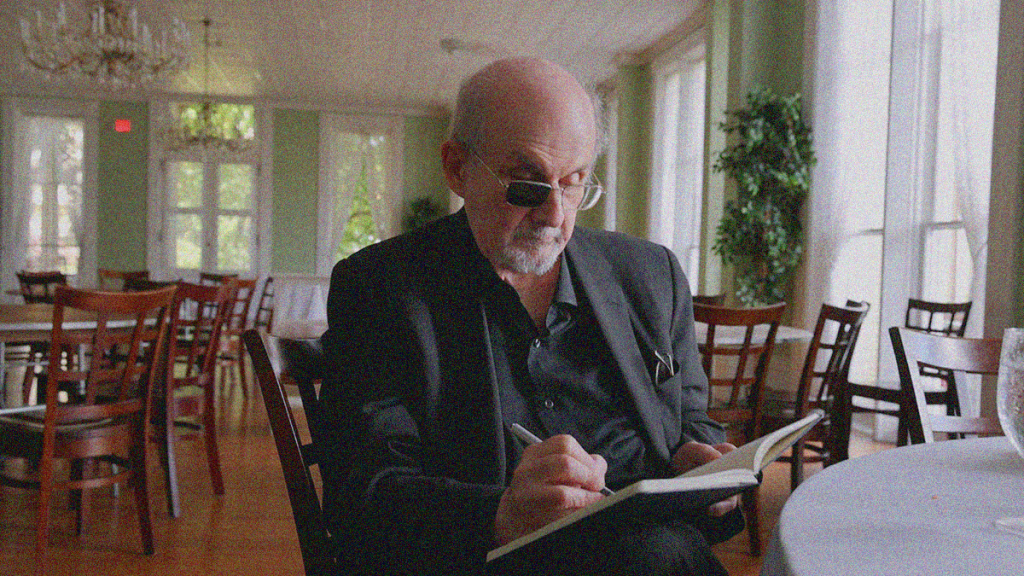
Salman Rushdie in KNIFE: THE ATTEMPTED MURDER OF SALMAN RUSHDIE; courtesy of Abramorama.






Leave a Reply