
Rating: R | Runtime: 164 minutes
Release Date: September 23rd, 2026 (South Korea) / October 23rd, 2026 (USA)
Studio: Netflix
Director(s): Lee Chang-dong
Writer(s): Lee Chang-dong & Jungmi Oh
Smiling when you’re angry makes you sick.
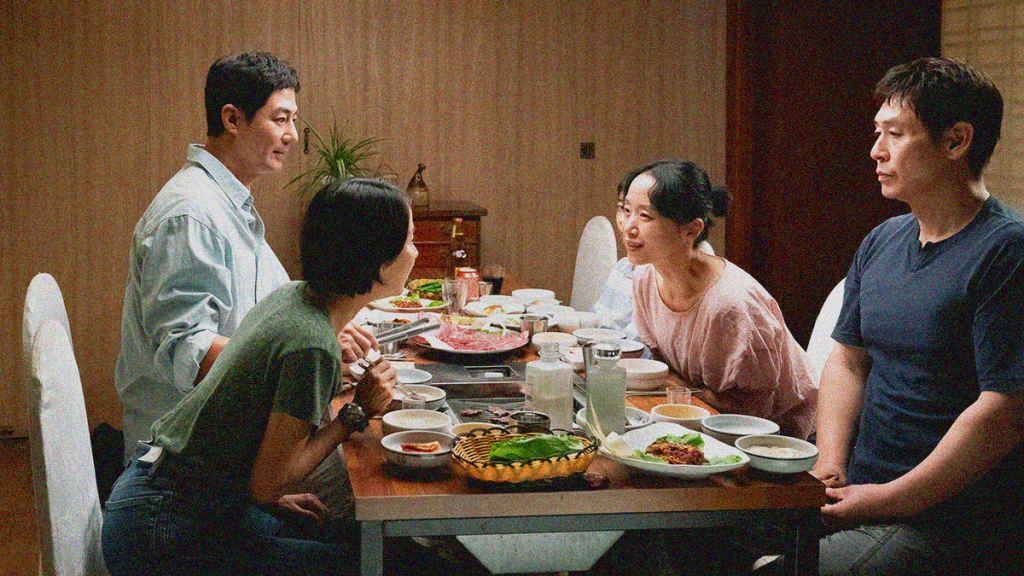
The easy interpretation of the title Possible Love points to Mi-ok (Jeon Do-yeon) and the enigmatic Sang-woo (Zo In-sung). They meet by happenstance at a funeral for a former co-worker of her husband. She’s there to pay respects with him (Sul Kyung-gu’s Ho-seok) and their son (Jung Seol’s Cheol). Sang-woo is there to pick up his wife Ye-ji (Cho Yeo-jeong) who attended to film the event as part of her new documentary about labor rights in South Korea.
Lee Chang-dong and co-writer Jungmi Oh build the blossoming relationship between these two couples slowly through the friendship between its two women. Ye-ji sees Mi-ok as a way to secure the linchpin to her story. If she can open her up to understand what happened during the strike that has left her husband unemployed and drove others to suicide, maybe Ho-seok will finally go on the record too. Sang-woo admires his wife’s initiative and agrees to help.
His kindness shown towards Mi-ok puts a glint in her eye as a result. We can’t begrudge her either since Ho-seok is drowning in depression and refusing to help himself out of it. So, she takes to Ye-ji’s attention and familiarity. Having a new friend excites her and pushes her closer to the freedom she used to imagine as a young girl. This newfound enjoyment of life sparks Ye-ji’s own burst of energy that in turn leads Sang-woo to want to hang out with them all more.
What we see before Mi-ok can, however, is the cost of that freedom. Because what she desires from Ye-ji’s life isn’t merely the money, time, and husband. It’s also the sense of entitlement that comes from the superiority it affords. We want to believe those airs are involuntarily because Ye-ji genuinely loves hanging out with Mi-ok despite their proximity always revolving around the film. I think she believes it is too considering the ease with which she talks about her.
And that’s where the first sign of trouble arises. It’s where I began to realize Ye-ji might be the most intriguing character of the whole considering her wish to keep one foot in two worlds—the one she came from and the one in which she now resides. She’s not so naïve to think her friendship with Mi-ok is more important than the footage, but she desperately wants to trick herself into it. Sang-woo won’t let her, though. Not intentionally. Simply because he loves the game.
That’s what this all is to him. He’s telling the truth when he says he enjoys how Ye-ji is around Mi-ok. It’s just not the reason either of them hopes. They presume Sang-woo adores their candor and laughter. What he actually adores is his wife’s pivot (unintentionally) to the dark side of morality and humanity he embraced from a young age. Ye-ji’s tactics to ingratiate herself in Mi-ok’s life aren’t altruistic to him. They are ruthlessly cutthroat. He’s proud of that.
The “possible love” of the title therefore concerns Ye-ji and Mi-ok. It concerns the potential love between many different platonic dynamics that include Ho-seok and his fellow strikers too. That necessity for implicit trust via an unspoken contract wherein vulnerability and loyalty place you on equal footing. Where words like justice are baked into the fabric of a relationship and not dictated by signatures on a contract. A union devoid of artificial constraints.
Lee and Oh place many such examples of the opposite spanning various levels of intent whether Mi-ok holding Ho-seok to his promise of not drinking outside the confines of their house or a later revelation that a character used to blow a whistle to demand a subordinate his own age play with him. How Ye-ji and Mi-ok met their husbands start out like cute stories of fated love, but future details tend to reconfigure things in positive and negative ways.
It’s not about these women attempting to break down the walls between their two disparate worlds. It’s about that sense of entitlement and how yearning (Mi-ok) and ambition (Ye-ji) sees them forgetting their own morality. What began as a mutually beneficial partnership soon reveals those walls have been reinforced instead. Privacy is erased. Honesty is stolen. Survival and success always have a way of turning good people into monsters.
The journey is long at just under three hours, but the slow burn is crucial to drive home the psychological ebbs and flows of desire, greed, and fear in play. We figure out the big connection (that remains unspoken yet implied) pretty early upon learning Sang-woo’s job, but it’s just one of many truths that force us to better understand the characters. Don’t therefore get caught up in any narrative hypotheses. Plot is secondary to personal growth and/or stagnation.
I fell prey to it myself. All the talk about Ho-seok’s temper. Sang-woo’s steady decline into proving he’d love Ron Livingston in Dinner for Schmucks. I was bracing for fireworks when the obvious and best way to go was a quieter sense of self-revelation. And it does prove the perfect route since it reveals the nuance to these types of power imbalances. To let Mi-ok reclaim her identity and have Ye-ji wondering how anyone could ever leave her on read.
The moment I won’t forget, though, is a shot of Min-sik (Kang Chang-gwon) looking up into the sky as if he heard what he couldn’t possibly hear. It’s such a great callback to a damning bit of knowledge that truly shows Lee and Oh are steering this ship with two hands firmly on the wheel. They walk the line between humorous and vile with expert precision to prove the dedication to Krzysztof Kieślowski’s Dekalog is very apt.

(L to R) Zo In-sung as Sang-woo, Cho Yeo-jeong as Ye-ji, Jeon Do-yeon as Mi-ok, Sul Kyung-gu as Ho-seok in POSSIBLE LOVE; Cr. Joo Jae-bum/Netflix © 2026.





Leave a Reply