
Rating: PG | Runtime: 125 minutes
Release Date: March 13th, 1992 (USA)
Studio: Orion Classics
Director(s): Zhang Yimou
Writer(s): Ni Zhen / Su Tong (novel Wives and Concubines)
There are cats, dogs, or rats.
You can’t help laughing every time The Master (Jingwu Ma) mutters how his concubines should act better with one another considering his familial “customs” are what drive them to continuously lob snarky responses when not also sticking knives in each other’s back. Because it’s not just the red lanterns being lit to publicly show who will have him in their bed that night. It’s also the decision to give the winner a foot massage with the loudest hammers possible.
Zhang Yimou’s Raise the Red Lantern (adapted by Ni Zhen from Su Tong’s novel Wives and Concubines) is “Big Love” on steroids as far as the lengths taken to secure one’s place within an insular world devoid of escape beyond death. The learned indifference from Yuru’s First Mistress (Shuyuan Jin). The perpetual grin on the face of Zhuoyan’s Second Mistress (Cuifen Cao). The overt games played by Meishan’s petty Third Mistress (Saifei He).
It’s why we can never quite get a handle on how Songlian (Gong Li) will respond upon her arrival as Fourth Mistress at nineteen. Will she enjoy the fact that the others are willing to take their Master’s attention away from her? Will she fight to steal him back? What’s interesting here is that sex is almost inconsequential beyond its ability to sway favor. Conceiving a male. Earning the foot massage. Dictating the lunch menu. Lording themselves above the others.
He wants them at each other’s throats. He merely abhors dealing with the fallout of what that means in the moment. Not that he isn’t willing to just swing over to another’s room until they cool down. What he doesn’t see, however, is how that competition has turned these women into ruthlessly conniving lords themselves. The way they treat their servants. The way they use information as bargaining chips. The way human life becomes disposable.
The main dramatic thrust is therefore whether Songlian will see through the ruse and be better than the others or if she will succumb to that same malice. In some ways she acknowledges how wrong it is to use others as pawns—enough to curb her own frustrations with her servant (Lin Kong’s Yan’er) knowing someone else is pulling the strings. In most cases, however, her anger takes control until she can no longer recognize the consequences of her actions.
And looming above them all for the duration is a locked “haunted” room atop the roof of this large estate. A room people don’t talk about because it is the place where two different women from past generations hung themselves. The direr things get once Songlian’s tactics to wrest away some control leave her punished, the more she wonders if that’s a route she will ultimately take to escape the cruelty she’s embraced too easily over a single year.
Each new day brings a new target for the women’s ire. Who is mad at whom? What new secret has been discovered to hold over their heads as blackmail? Sometimes things get worse when The Master is gone because there’s nobody for his mistresses to perform for. Suddenly their deceptions don’t need to be shrouded under false pretenses. They can just walk up to each other and be frank about their intent.
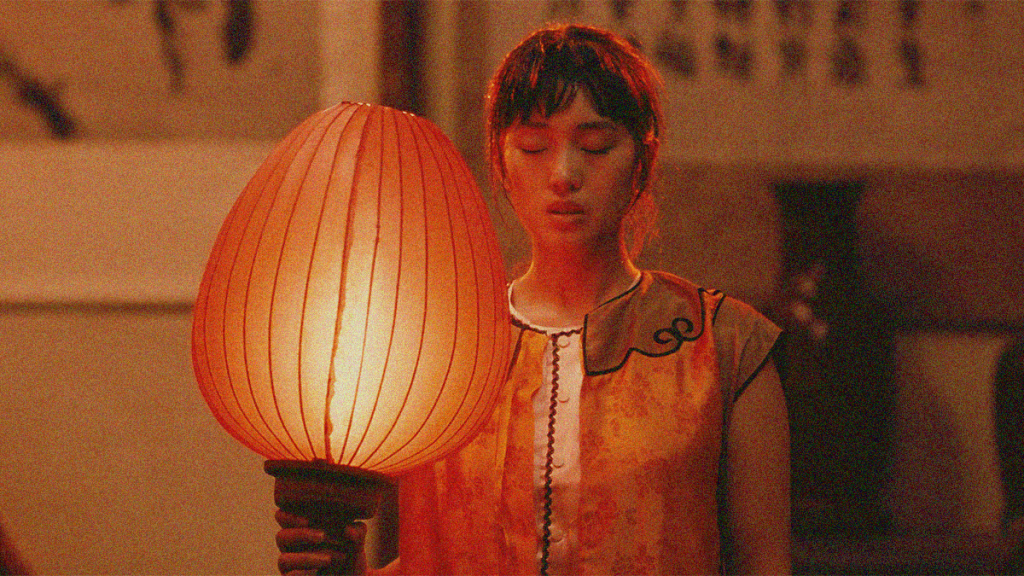
The whole is gorgeously shot and acted with every wide lens waiting for a character in the distance to notice they’re being watched and every smile holding an ulterior motive that’s purposefully visible just below the surface. It’s fun to watch older films through a contemporary lens (this 4K restoration is astonishing) because I get to wonder if Belinda Bromilow was borrowing from Cao with her performance in “The Great” or if it’s just the archetype.
Cao is fantastic as the most obviously interesting character of the group. That doesn’t mean you should sleep on He or Kong, though, since their less elegant machinations are just as effective due to their tortured souls. Even so, it’s Li who shines brightest. It makes sense since she’s a perfect mix of the three—smart like Zhuoyan due to a university education, manipulative like Meishan, and emotionally fragile like Yan’er. Being cognizant of this makes her haunted too.
Those moments are the most memorable. The ones where Songlian is pushed to the edge of sanity, acts on the impulse of rage, and inevitably reckons with the guilt that results. She understands the nature of this poisonous ecosystem well enough to know it’s to blame for most of the horrible things that occur. But you can only use your surroundings as an excuse so long before accepting you’ve become a part of the problem. Do you embrace it or do you crack?
That Zhang and Li keep us uncertain towards the answer for the duration is a testament to the storytelling because it would be just as effective both ways. We either relish in the villainy of Songlian becoming the ultimate puppet master or lament the fact that she’s yet another victim of oppression forced to uphold her own oppression. Neither is a happy ending (few women in this position ever found one), but “happy” is a poor substitution for authenticity in cinema.
Gong Li in RAISE THE RED LANTERN; courtesy of Film Movement Classics.





Leave a Reply