
Rating: R | Runtime: 127 minutes
Release Date: October 30th, 2026 (USA)
Studio: Netflix
Director(s): Peter Berg
Writer(s): Peter Berg and Mark L. Smith / Buzz Bissinger (book The Mosquito Bowl: A Game of Life and Death in World War II)
Everybody wants everybody’s.
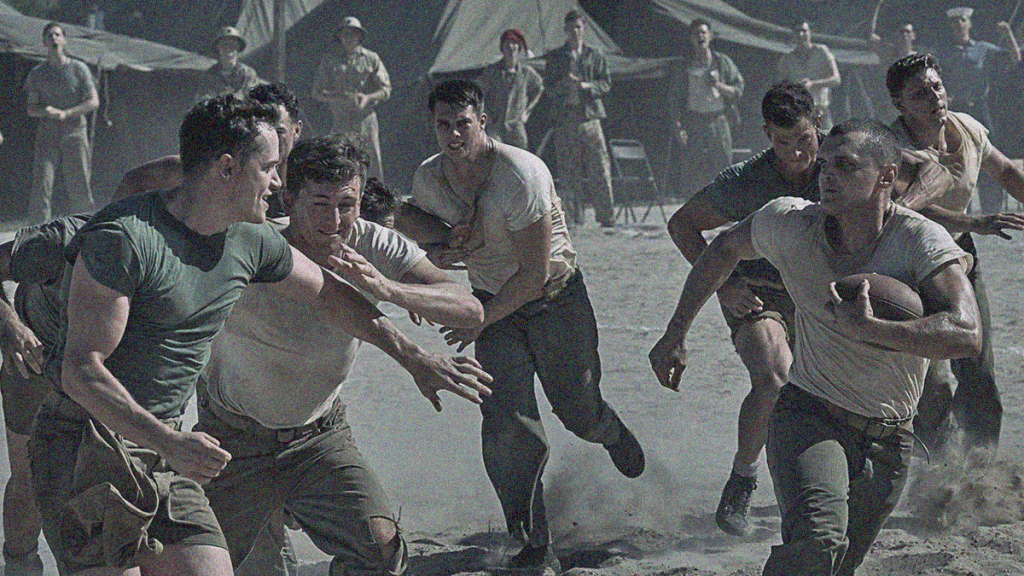
With a story tailor made for Peter Berg, Buzz Bissinger’s The Mosquito Bowl is adapted by the director and Mark L. Smith as a violent, anti-war film where the titular football game is less a central focus than a last hurrah to transport its Marines back to the lives they should have led if not for Pearl Harbor pushing them to forego their professional sports careers and enlist instead. After years of trauma and uncertainty, they’re finally able to smile again.
It’s the context of those smiles that the film seeks to address by rewinding things via bookended footage of John McLaughry (Nicholas Galitzine) back on American soil. Things open with him standing in the bleachers of a football field before images of his final collegiate game unfold. It’s a glimpse into the man he was before he became a veteran and the first of what we assume will be a quartet of similar recollections.
So, when the flashback to a game pitting Tony Butkovich’s (Ray Nicholson) Purdue against Dave Schreiner (Tom Francis) and Bob Bauman’s (Bill Skarsgård) Wisconsin crosscuts back to McLaughry instead of them, we can pretty much guess where this story is going. It’s not a mistake, though. It’s not foreshadowing either. It’s proof that Berg isn’t telling a story of their heroism as much as an all-encompassing story about human sacrifice.
For a guy who isn’t afraid to lay the jingoism on thick through his oeuvre (see Lone Survivor and Friday Night Lights, the two films for which this can’t help but feel like a byproduct), The Mosquito Bowl is actually quite introspective and damning of American exceptionalism. Whether a scene of a sergeant ordering his men to do what he won’t or Butkovich grappling with the horror of watching a Japanese prisoner cry, it’s often a damning portrayal.
The most obvious example of this comes from just how recognizable these four men are to the nation. It’s one thing to have their drill sergeants ride them harder for that celebrity, but it’s another to watch as Marines (who missed the landing and have no clue what their idols went through to survive an unrelenting sequence of blood and explosions) ask for autographs with nary a consideration of the terror on their mud-covered faces.
Add the fact that the Marine Corp used these ex-footballers as a sideshow to boost morale when Bob Hope and Francis Langford couldn’t and it’s not difficult to see the commentary on how our army treats its men and women as disposable pawns serving their whims. The mirror between the violence on the gridiron and battlefield paired with a cameraman documenting their arrival on Tarawa and the Mosquito Bowl is a potent one.
It’s why I’m surprised by the response from many critics I’ve seen calling the film an atrocity. Maybe they’re bringing in Berg’s filmmaking past and not seeing the nuance (no pun intended considering a comedic scene in the movie)? Or perhaps I’m giving him the benefit of the doubt when I shouldn’t? All I know is that the text of the film feels very much like a critique on war. The filmmakers seem earnest in their desire to reckon with the cost of victory.
Look no further than centering a lot of the narrative around that game between Purdue and Wisconsin. How that battle between nemeses eventually evolves into its two stars (Butkovich and Schreiner) becoming brothers. How we are all the same when stripped of our jerseys, uniforms, and borders. How that crying Japanese soldier was just as human as the dead Marine lying in the dirt a few feet away. That our competitive spirit should operate on respect, not hate.
I give all four main actors a lot of credit because they are the emotional core of what is otherwise a bleak series of nightmarish scenarios ending in death and destruction. Whether their shell-shocked reactions in the aftermath or their loving support when witnessing a friend falling apart, it’s their humanity that shines through the chaos. It’s a reminder that some do go to war for the right reasons and not to simply commit government-sanctioned murder.

(L to R) Brent Comer as Murphy, Nicholas Galitzine as John McLaughry, Ray Nicholson as Tony Butkovich and Tom Francis as Dave Schreiner in THE MOSQUITO BOWL. Cr. Kane Skennar/Netflix ©2026.





Leave a Reply