
Rating: TV-MA | Episodes: 8 | Runtime: 60 minutes
Release Date: October 7th, 2026 (USA)
Studio: Amazon MGM Studios / Prime Video
Creator(s): Mike Flanagan
I think it’s better to know.
The crux to why Mike Flanagan decided to adapt Stephen King’s Carrie can be summed up by something Sue Snell (Siena Agudong) says in an interview after everything you remember from the book occurs at prom. She’s talking about the first day she met Carrie White (Summer H. Howell) and how the word that kept coming to her through the experience was “kind.” Because kindness is what this new student exuded with every bone of her body. And they all just laughed.
The goal wasn’t therefore to do what had already been done by Brian De Palma. Flanagan explains that there are two kinds of adaptations: those that look to preserve the source material through the transition to a new medium and those that look to distill the source down to its basic tenets before building something new from its foundation. This is the latter. It’s an attempt to speak to its themes of bullying, isolation, empowerment, and zealotry in a fresh way.
So, while the familiar fire consuming a school gymnasium opens the first episode via a filmed debriefing of the survivors before rewinding to the start of the semester, the how and why behind it won’t be quite the same. The beats are there (like Carrie’s first period, Amber Midthunder’s Miss Desjardin running Alison Thornton’s Chris ragged, Joel Oulette’s Tommy inviting her to prom, and the bucket of pig’s blood), but the pain is no longer just one character’s to bear.
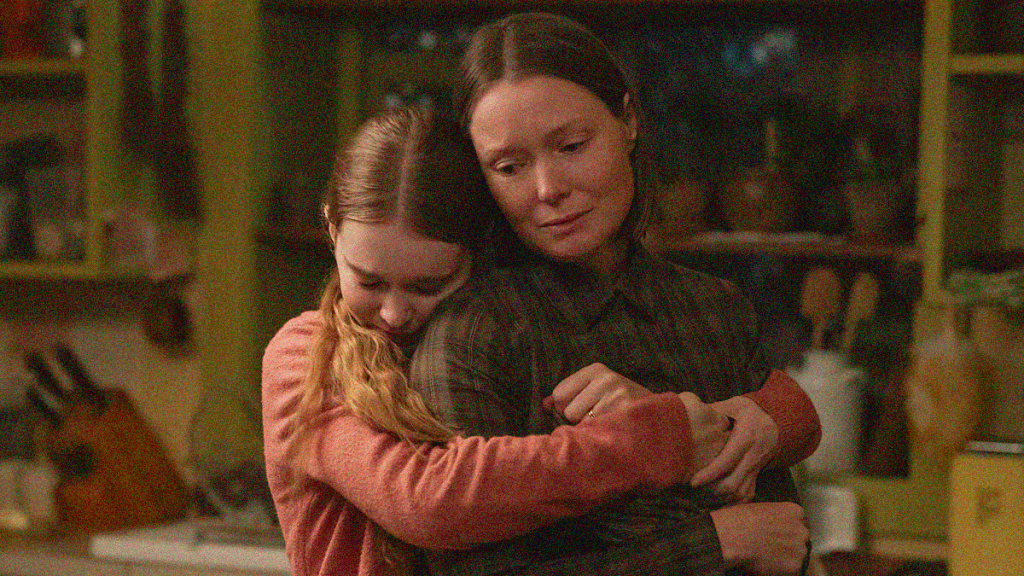
The biggest and most ingenious shift is in Carrie herself. Yes, she is out of her depth and “strange,” but the last thing she wants to do is fade into the background. On the contrary, this Carrie yearns for social interaction. She yearns for friends with the innocence of an extroverted child walking onto a playground and telling the first kid she meets that they’re going to be best friends. Why? Because this Carrie has never existed outside her home.
While not entirely true (shoutout to Naika Toussaint’s next-door neighbor always being a treat whenever she pops up throughout the season), this was her parents’ goal. Dad (Tahmoh Penikett) was a crackpot conspiracy theorist who believed the “deep state” was out to get them, so Mom (Samantha Sloyan’s Margaret) homeschooled Carrie while he worked. Her entire life was prayer, education, and reading until her father’s untimely death changes everything.
Was she a prisoner in her own home? Yes. Did she know it? Not quite. She did, however, wish to see the world. When a social worker demands that they assimilate into society to prove Margaret is capable of maintaining custody, part of the stipulation has Carrie enrolling in school. It’s like a dream for her. Born from a nightmare of her father being gone, but a dream to experience the things she only read about in books. She was ready to finally exist.
What Flanagan and company (I believe the other writers and directors are all women or non-binary in the case of Jamie Flanagan, so don’t fear this project is another man telling a young girl’s story like it was with King and De Palma) do differently here is flesh out how that earnest enthusiasm is absorbed in a twenty-first century marred by school shootings, social media, and political tribalism. How does Carrie’s innocence turn a mirror onto a cynically jaded populace?
The only way to truly dive into the reverberations of that question is to ensure everyone on-screen is a three-dimensional character. So, while Margaret and Chris remain unsympathetic due to their actions, neither has become a villain in a vacuum. Both are driven by fear and a loss of control. A mother’s entitlement over her daughter and a teenager’s entitlement over her “perfect” life. It’s through the punishment of their newfound realities that they seek to punish others.
Thornton’s Chris might be the most compelling piece to this puzzle as a result since she is very much a hybrid of the Whites. She is suffering through the pain of a domineering parent (Michael Trucco) like Carrie and throwing a tantrum about her drastically altered circumstances like Margaret. She’s also feeling her way through a newfound “power” too. Whereas Carrie becomes a God with telekinesis, Chris becomes one with Instagram.
It’s an extremely timely subject with social media bans being passed in many countries and misinformation ultimately corroding the reality of adults by erasing their critical thinking ability. What happens when a meme account that begins as a cruel joke to defame one student becomes a haven for spreading bile about the entire school (students and faculty alike) with total anonymity? Carrie isn’t alone here. The entire district is on the brink of exploding.
That means everyone has their moment in the crosshairs. Adults, whether school employees (Midthunder, Matthew Lillard, Rahul Kohli, and Tim Bagley) or parents (Trucco and Heather Graham), and kids, whether bullies (Thornton, Josie Totah, Arthur Conti) or allies (Agudong, Oulette, and Thalia Dudek as the former “new kid” trying to let Carrie know she isn’t alone). How do they traverse this chaotic moment? How do they hope to take control of their lives?
It’s a welcome update to the material that adds some gray to the mix while also dragging its problematic story points through a more modern lens (see Tommy asking Carrie to prom with intent rather than a prompt). And it looks to open the world in ways only a King fanatic like Flanagan could as far as expanding the scope of what Carrie’s powers mean outside this one specific scenario. But I’m embargoed from giving any more detail than that.
I’m embargoed from many things, including identifying two Flanagan regulars: the narrator (many episodes start with an anecdote about the persecution of women with gifts) and a brief cameo. The former is a vague demand too since it could mean the actor (despite their recognizable voice and guaranteed inclusion) or the character’s place in the story. I’m not, however, embargoed from revealing that Trucco and Penikett aren’t the only “Battlestar Galactica” alums in the cast.
The rest pop up in the penultimate episode with Katee Sackhoff having the only role that appears again. While I love the nostalgia of seeing Tricia Helfer, Aaron Douglas, and Rekha Sharma together, however, I hate that it took me out of the moment because I couldn’t help laughing at the gimmick. But I do get it. What better correlation for the internet’s insidiousness than a sci-fi show that saw its heroes strip their spaceship down to its “vintage” analog functionality?
Many characters on-screen wish they could too. But it’s not about hiding in a bunker to avoid the technology or hiding behind the technology to avoid facing consequences. It’s about the capacity to find the room for empathy and shame in an era where people have been emboldened to believe both are a weakness and target for abuse. Pay close attention to Sloyan’s fantastic portrayal of Margaret and how quickly she falls prey to the allure of the internet’s power.
It’s not surprising considering who has the loudest voices and platforms today. The prerequisite seems to always be a willingness to weaponize fear. The fear of one’s own obsolescence driving them to lash out and deflect their insecurities onto others as a means of self-preservation. Carrie faces it from all sides and it’s a testament to Howell for never letting her lose the desire to be good anyway. To strive to be better. Until she’s finally pushed too far, of course.
Here’s hoping for a renewal because there’s truly no guessing where Flanagan goes next. These eight episodes cover the book. Everything afterwards will be brand new … unless, like his other examples of that second form of adaptation (“The Haunting of Bly Manor” and “The Fall of the House of Usher”), he somehow folds in another King story. Who knows? Maybe “Carrie” will ultimately prove to be a covert entry into his planned “Dark Tower”.

Summer H. Howell and Samantha Sloyan in CARRIE. Credit: Liane Hentscher/ Prime © Amazon Content Services LLC.




Leave a Reply