
Rating: NR | Runtime: 77 minutes
Director(s): James Cullen Bressack
Writer(s): James Cullen Bressack
Let me know you’re alive.
The obvious question to ask throughout James Cullen Bressack’s horror film I Have Proof is, “Proof of what?” Proof of demons walking amongst us or proof that Alex (Larsen Deane) is a paranoid schizophrenic in desperate need of a regimented medication schedule? For its first two-thirds, Bressack lives in the potential of delivering both. There’s just one problem: found footage as a device is antithetical to blurring the line between reality and fantasy.
Sparked by a Letterboxd review lamenting the fact he moved away from his lo-fi beginnings to helm glossier direct-to-video fare like late-stage Bruce Willis flicks Survive the Game and Fortress (both produced prior to the actor’s aphasia diagnosis), Bressack challenged himself to go back and create something in that vein again. To, as he states, unlearn the rules of conventional storytelling, go full analog, and give the audience a purely visceral experience.
Using found footage as his format proves a no-brainer avenue to achieve that. Dig out an old JVC camcorder and used VHS tapes. Construct a story out of “evidence tapes” that simply play without the polish of narrative beats. And let the inherent veracity of the imagery either hook the audience with its intensity or lose them with its absurdity. The risk of the latter is always there since editing a film to not look edited carries the troublesome burden of repetition.
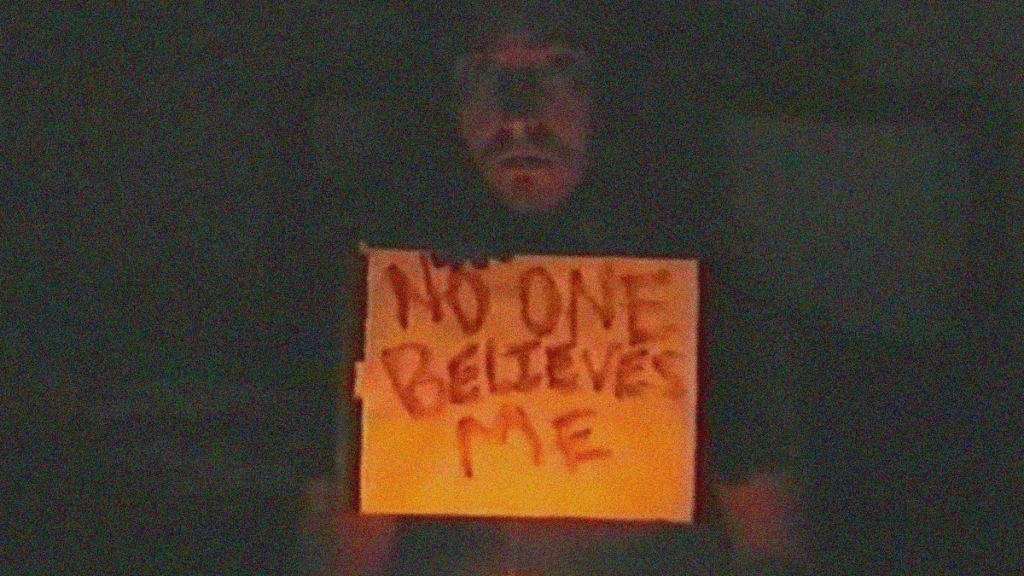
I Have Proof falls prey to this inevitability due to each day in Alex’s life unfolding exactly like the last. He puts on his hoodie, fires up the camera, and follows an attractive blonde (Lilly Van der Meer) from a not so safe distance before retiring to his motel room and pointedly explaining his “rules” to eluding the evil forces around him. The woman is always doing random normal things. Alex is always lifting a notepad with text before pantomiming it to the camera.
I started to wonder if Bressack was intentionally trying my patience by subverting my expectation of horror with the reality of mental illness. Because everything we see can be explained by the latter. Alex’s delusions about needing to stay quiet and using only blood to write to hide from the demons. His fear that a monster is trying to enter his room by parroting his sister’s (Augie Duke’s Bex) voice. It’s quite tragic as someone with schizophrenia in his family.
Would the film have been successful if that’s all he was doing? That would depend on your definition of the word. In terms of putting the sad truth of a disease on-screen from the point-of-view of a person suffering from it? Yes. In terms of entertainment? Maybe not. You must therefore ask another question. Must the truth entertain? It helps to secure eyeballs, but there’s something to be said about an unfiltered look at an unfortunate reality.
That’s why I’m so torn about what ultimately occurs once Alex finally opens that door. As pure enjoyment, the final twenty minutes of I Have Proof are insanely good. The camera tricks Bressack executes to manufacture a surrealist nightmare of evil finally showing its true face had me fully forgiving the slow methodical pacing that preceded it. But then I remembered the reason for that pacing. The conscious decision to play Alex’s diagnosis straight.
It’s why I think I’d like the film more if Bressack didn’t use found footage. The format demands that everything we see is real, so there’s no hypothesizing that the final act was what Alex “saw” rather than what happened. You’ve lost that luxury. And since a lot of it unfolds with dream language visuals, I found myself questioning the logistics of the device rather than enjoying the result. So, the format is simultaneously crucial and detrimental to the content itself.
Does it hurt the final product? Definitely. Does it render the experience any less intriguing? No. Regardless of how much the first fifty minutes eventually tried my patience, those last twenty are undoubtedly invigorating. And the way both merge to provide a cinematic interpretation of schizophrenia is great if the format didn’t undercut why. Found footage is hard because it’s not simply about the aesthetic and perspective. It’s about the implicit authenticity too.

A still from the horror film, I HAVE PROOF. Photo courtesy of Sandaled Kid, JCB Pictures and Robotic Donut.



Leave a Reply