
Rating: NR | Runtime: 141 minutes
Release Date: August 8th, 2026 (China) / October 9th, 2026 (USA)
Studio: Well Go USA Entertainment
Director(s): Muye Wen
Writer(s): Qunli Lang, Muye Wen & Wei Zhong
But I got greedy. I stayed.
The film opens on an aged and scarred Xu Fu (Teng Shen) during a customs interrogation in the fictional Middle Eastern nation of Bahata. He explains that he was invited, but the officials have questions about an investigation twenty years prior where he was accused of assisting in a terrorist attack while living and working in the country as a chef at Loong Restaurant. Xu was exonerated by the Americans, but Bahata wants to hear the full story for itself.
Muye Wen’s Once Upon a Time in the Middle East starts like the comedy you assume it will be from the poster and other marketing materials that had many parents regretting their decision to bring children to the theater. After losing his restaurant in China when a tragic incident left him in debt, Xu stumbles into an opportunity to earn a good salary in Bahata with the hopes of returning in just two years’ time with money in the bank and the freedom to start fresh.
There’s the melodrama of his daughter “hating” him for leaving and a good laugh from his mother telling him to “cut the drama and go” when he tries to give her a hug goodbye. There’s the always smiling and optimistic restaurant manager Ma Junsheng (Qiming Jiang) welcoming him and cautiously serving as translator when Xu decides to stand his ground with the business’s formidable owner (and Ba’athist civil servant) Zaid (Sharif Subhi). And an orphanage of rowdy kids.
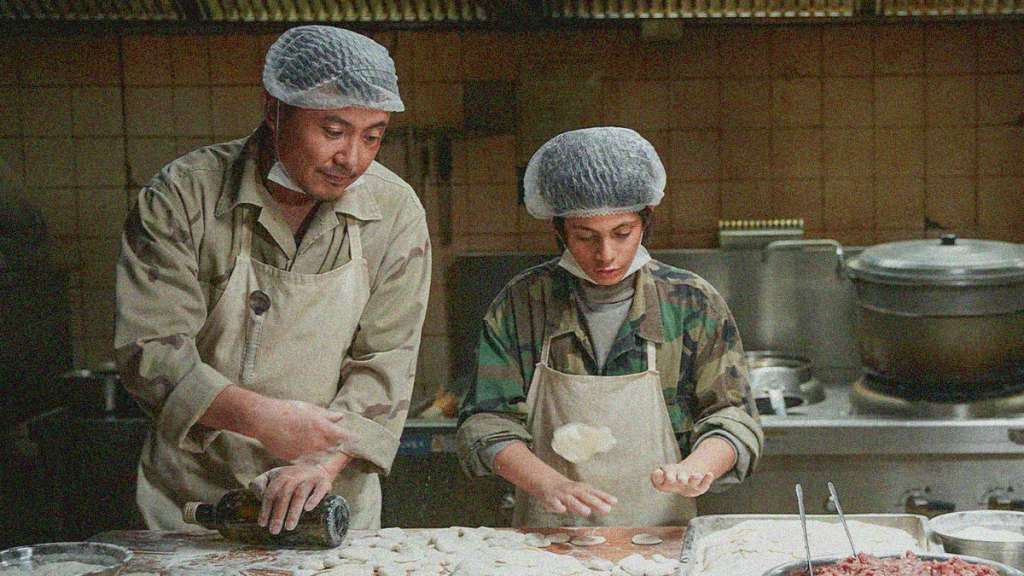
We don’t get to enjoy the light antics of Xu wanting to punt young Seif (Omar Sherif—how can you not want to act with that name?) across the street for causing a ruckus in his kitchen or his declaration that this restaurant will never serve the abomination that is Americanized Chinese cuisine before we begin to clock the talk on the television about threats of an attack. He’s barely in town for four months before the bombs begin to fall.
It’s the first of many intense scenes that lose a little verisimilitude in the act due to decent yet imperfect special effects but more than make up for it with harrowing emotion in the aftermath. Yes, there will still be some more laughs once Xu and Zaid work out a way to profit off the fact they are one of the only restaurants in operation and can deliver to the American base, but this anti-war film quickly embraces that label and never lets go.
I was absolutely enthralled throughout. Even the best American-produced films about the Iraq War have a tendency to fall into jingoism by default, so witnessing that conflict (although never by name besides one mention of 9/11) from an external source is refreshing. Is China the most objective observer to tell the story? Maybe not. But the end credit text speaking on their initiative to secure children’s rights is commendable. And any third-party account holds intrigue.
Don’t therefore assume that casting the United States in a poor light means this is going to cast the Iraqi terrorists in a good one. The former are either blood-thirsty Jack Bauer-types relishing the opportunity to torture prisoners or scared kids with guns who just want to go home. The latter are terrorists—blood-thirsty Bin Laden types who want to exploit America’s presence in the region to recruit disposable pawns (mostly children) to use as weapons.
This isn’t just an anti-war film in name as a result. By focusing on bystanders (whose innocence fluctuates as they sometimes wittingly involve themselves in the bloodshed), Wen and his co-writers Qunli Lang and Wei Zhong can depict this war in all its uncensored brutality. Neither side is depicted as heroic. At best they are misguided, at worst monstrous. So, we aren’t investing in their war. We’re here to see if Xu, Ma, and Seif can survive it.
As cooks (Seif inevitably goes from Xu’s least favorite child to his cherished apprentice), they become pawns on the board too. First, it’s to their own benefit by supplying food and alcohol to the troops at exorbitant prices. Then it’s as suspected terrorists in an American prison camp and slave labor in a Bahata training “school.” Sometimes they are ruled by greed and other times by bad luck. And they always have front seats to the carnage.
Because the Americans are the foreign element here, Wen does well not to vilify every Middle Eastern character as a terrorist. Not only that, but he ensures audiences recognize the complexity of this conflict as more than just two sides implicitly hating each other. Whether a heartbreaking turn for Zaid or the gradual potential of Seif to be radicalized, there’s no hiding the fact that it’s often America’s own actions that turn good people against them.
How Xu and Ma traverse this reality is never without a heightened state of terror as far as whether they’ll make it out of the latest predicament. Who will be lost in the process? When will they reach their own breaking point to no longer be able to watch silently from the sidelines? I really like Jiang’s slowly hardening Ma still holding onto his empathetic heart. And Shen is fantastic as his ever-endearing Xu eventually realizes he can’t talk himself out of every situation.
Yes, the coincidences can make the plotting feel Forrest Gump-like in the way Xu always seems to be in the middle of the action, but the cause-and-effect structure never feels false. A big reason for this is that no character is above a grisly fate beyond our narrator. Someone can be laughing one scene and getting blown up the next. That’s the true face of war. The uncertainty of who will suffer from the certainty of its death and destruction.
The other constant? Our human desire for a good meal. Whether the orphans Xu feeds once the restaurant becomes a sanctuary after the first bombs or the militaries on both sides that keep him alive and in shackles long enough to exploit his talents or the child soldiers unaware that the meal he cooked will be their last, Wen never misses an opportunity for someone to praise the chef. If willing, that food grants Xu unprecedented access to cause trouble too.
Teng Shen and Omar Sherif in ONCE UPON A TIME IN THE MIDDLE EAST; courtesy of Well Go USA Entertainment.





Leave a Reply