
Rating: R | Runtime: 91 minutes
Release Date: August 14th, 2026 (USA)
Studio: Watermelon Pictures
Director(s): Poh Si Teng
You’re not doing a service by not showing them.
The above quote is from Dr. Mark Perlmutter during the opening scene of American Doctor. He’s showing director Poh Si Teng photos taken of Gazan children they were forced to bar from ambulances so those with a chance of survival could be transported instead. Teng’s justifiable reaction is one of horror as she tells him she’ll need to pixelate the images for use in the movie. He quickly rejects that assertion, calling it journalistic malpractice if she does.
It’s not the only instance of Perlmutter using that word. He later tells a group of medical professionals that not treating the Israeli genocide on the Palestinian people as a disease to root out would be medical malpractice on their part. He pulls no punches with his words about this tragedy after having gone to Gaza twice to help the wounded with his orthopedic expertise. The vehemence with which he speaks about Zionism makes Dr. Thaer Ahmad wince with worry.
Not because he disagrees. Ahmad is a Chicago native of Palestinian descent who spends the entire film partaking in a Sisyphean cycle of trying to cross Jordan’s border only to be rejected by the American embassy—not Israeli. He shares these sentiments but knows the color of his skin and religion he practices make it impossible to say so aloud without being labeled an anti-Semite. The line between speaking the truth and hamstringing the cause is a fine one.
Perlmutter can cross it because he’s a white Jewish American. He can let his emotions get away from him. Dr. Feroze Sidhwa toes it closer than most too, but from a place of precise calculation. He doesn’t have a dog in this fight as a Californian of Pakistani descent whose parents practiced Zoroastrianism. His main concern is to educate the country on its own complicity by way of their tax dollars. His mounds of books on the conflict prove he can.
Is it an unlikely trio of doctors that Teng has collected? Not really. Not if you remember that they are all Americans simply doing their damnedest to advocate for children’s lives and the sanctity of a Geneva Convention law that was once unfathomable to ignore: you do not target hospitals, period. It’s succinctly pointed out that the latter war crime began when the first one being hit was met with zero retribution. Israel tested the waters and hasn’t looked back.
So, it means something when an anecdote about the Nasser Medical Complex in Khan Younis being “safe” because that’s where the international community told health practitioners to go is met with a scoff. Netanyahu doesn’t care about that. He’s been laughing at an arrest warrant issued from the International Criminal Court way back in 2024. Maybe you could be optimistic after one was destroyed. Maybe you could delude yourself after three. But now? Nasser would be next.
Perlmutter, Sidhwa, and Ahmad keep going back (or try to) anyway. They see it as their duty to, as Sidhwa describes it, “achieve their moral potential.” In many ways, this is the easy part for them. Working mass casualty events inside a hospital to the best of their abilities with limited resources is what they went to school to do. The more difficult part is the activism back home and becoming official voices for the issue on national television.
But that’s the task they’ve absorbed as three of the very small group of people who are first-hand observers of what’s going on. It’s what the Palestinians they treated and the loved ones of those who didn’t make it asked them to do. And they take it seriously—even going so far as visiting Capitol Hill to reason with republican legislators they know cannot be reasoned with. It’s not lost on them that the conversation around Palestine is much different than Ukraine.
The footage Teng has compiled isn’t for the faint of heart, but it demands to be seen if only to bear witness to what our own government tries to tell us isn’t true. Perlmutter and Sidhwa’s conversations with Palestinian doctors and nurses helps to humanize their terror and prove their heroism while Ahmad travels between protests and lectures to ensure the message never grows silent. And there can be no denying reality when the bombs literally start falling around them.
I think an invaluable part of the whole is also witnessing the lengths they must go to just do their jobs. Yes, the emotion is palpable and the hypocrisy is rampant (good on Sidhwa for calling out that the “video” evidence of tunnels under hospitals is just computer-generated animation devoid of concrete proof), but the bureaucratic hoops they must jump through to provide a basic human right is astounding. It’s a miracle they are allowed in at all.
I also love what Teng says about creating a record. Will this film change hearts and minds of those who refuse to be changed? No. But it documents those who were on the right side of the issue before the (hopefully) inevitable shift to empathetic reason prevails. And it will educate those who are still willing to believe their eyes—like Perlmutter himself. Stem the propaganda, teach the youth, and watch them lead us towards the reckoning we desperately need.

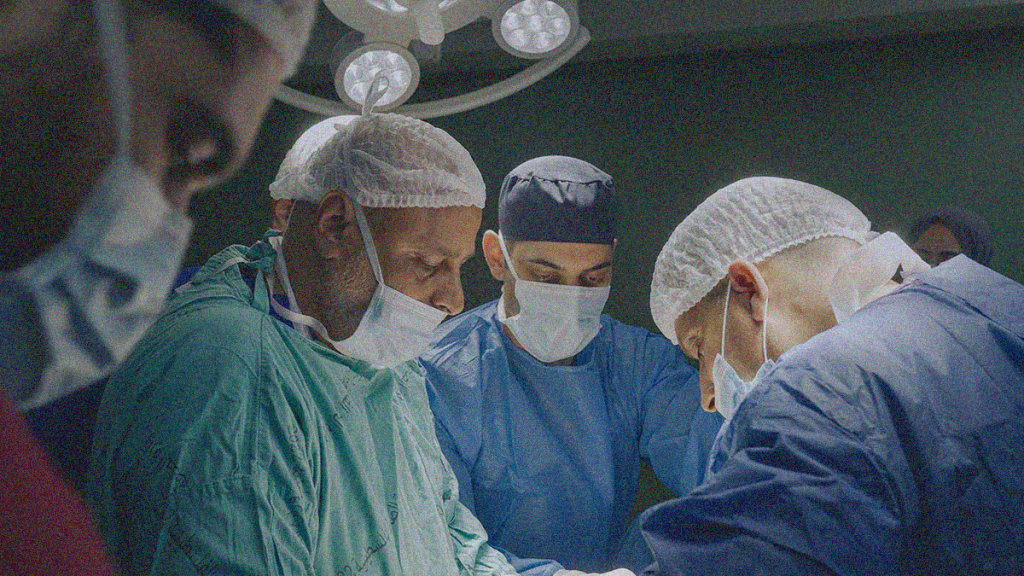
Dr. Feroze Sidhwa in AMERICAN DOCTOR; courtesy of Watermelon Pictures.





Leave a Reply