
Rating: NR | Runtime: 74 minutes
Director(s): Advik Beni
Writer(s): Advik Beni & Lishana Nandhlal
But I keep getting lost in these images of you.
Set in Durban, South Africa, Advik Beni’s Mother, You Have Not Died Yet. But You Will. And When You Do, You Will Finally Be Alive Again. focuses upon Lishana Nandhlal as she simultaneously cares for and mourns her ailing mother Leela. The whole plays like an essay film wherein she narrates her thoughts and ideas to the memory and spirit of the woman who raised her—over home videos, re-enactments with Dolly Bechu playing Leela, and abstract montage.
The film embodies the ways Lishana copes with the reality of her mother’s passing and the ways in which she looks backwards to reminisce both in her own mind and through ephemera left behind. It’s this process of searching old photos that rekindles her own artistic yearning to set-up a portrait studio inside her cousin’s barbershop as a means of engaging with the community and embracing life in the aftermath of death. In so doing, she also taps into her heritage.
Not necessarily her Indian heritage, but that of the only place she’s ever called home. With radio broadcasts calling attention to the one-year anniversary of a riot, Lishana remembers a news article about the violence in Durban circa 1949. Her photography subjects being a mix of Indian and Black neighbors forces her to consider their shared history under white Apartheid rule and the ways in which they’ve allowed themselves to fight each other in the wake of its demise.
Why after joining together to overthrow their oppressors have they lost that common ground of equality? Why didn’t their parents who grew up during Apartheid and their parents who came to this country to be subjugated by it teach them the error of the hierarchal thinking that helped the Afrikaners maintain control? It’s that survival instinct to set yourself apart as different and therefore not as bad as the “worst” breeding more division and rage.
Beni and Nandhlal are therefore looking into a nation’s troubled story through the lens of a woman searching for solace within her familial bonds. They are giving voice to the juxtaposition of mothers teaching their children how to be good within their own walls against their inability to teach them how to do the same outside of them. We see Leela’s beauty of youth in photos and Durban’s bloody scars in newsprint. Time can’t heal all wounds by itself.
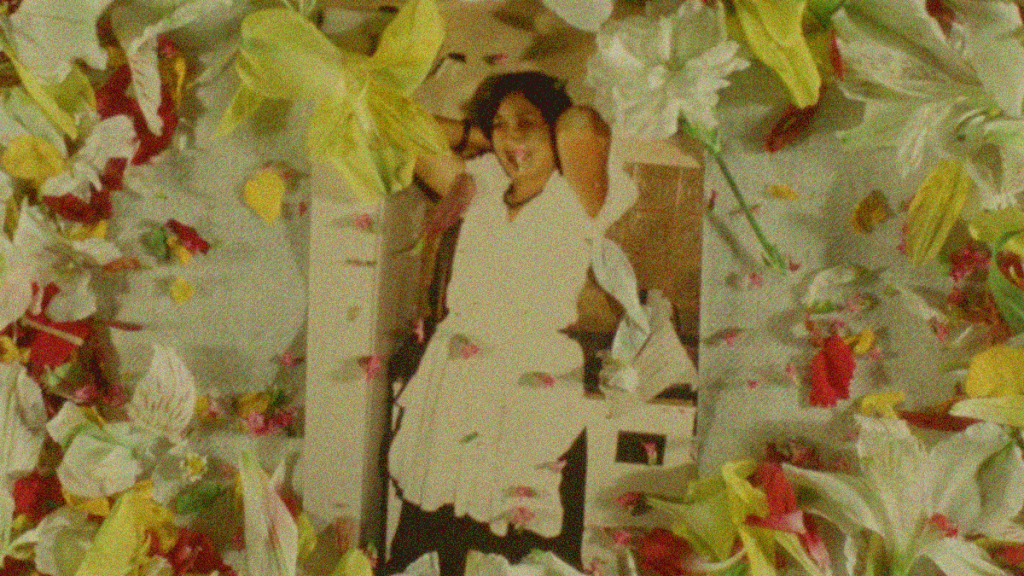
The whole is captured on grainy 4:3 stock with a mix of aesthetics from straight filming to direct animation atop old Bollywood footage to stop-motion animation of flowers atop a picture to a sensory overload of quick cuts between floral close-ups. Accompanied by Lishana’s verbal rumination on past, present, and future, it can seem as much like an introspective dream as a cinematic document of this place. It’s slow, thoughtful, and stimulating.
It’s also not going to be for everyone. The glacial pace meant to give Lishana room to maneuver through her thoughts is just as likely to give audiences the room to checkout. I don’t think, however, that people unwilling to give themselves to this sort of film will seek it out or mistakenly sit down believing it will be something it’s not. Beni is purposefully operating from a very specific place upon the cinematic spectrum and unapologetically stays there throughout.
An image from MOTHER, YOU HAVE NOT DIED YET. BUT YOU WILL. AND WHEN YOU DO, YOU WILL FINALLY BE ALIVE AGAIN.; courtesy of Advik Beni.






Leave a comment