
Rating: NR | Runtime: 87 minutes
Release Date: September 10th, 2026 (USA)
Studio: Assembly Releasing
Director(s): Sam Green
Everyone wants to know their secret.
Still struck by the concept of being the “oldest living person in the world” years after working on a movie about the Guinness World Records, documentarian Sam Green let fate guide him to the public birthday party of Susannah Mushatt Jones in 2015 just a few blocks from where he lived. She was asleep pretty much the whole time, but that’s kind of perfect since a milestone like this proves to be something that everyone else hopes to celebrate more than yourself.
Whether a result of the lack of lucid footage of Jones or an epiphany that would have stuck regardless of Green capturing hundreds of hours of her stories from Alabama and New York City, the idea to keep this train rolling has now ballooned into a ten-year journey with six different holders of the iconic title. That’s why the title The Oldest Person in the World is singular despite the revolving door of faces on-screen. It can only ever describe one at a time.
What we quickly discover, however, is that this film isn’t really about them. Sure, they are the catalysts of its content and the through line to continue for another decade with plans of releasing a sequel, but they aren’t the stars of the show. That distinction belongs to Green himself. Not just as a narrator contextualizing what he shot since so much is silent due to the fatigue of his subjects, but also as the lens from which that context is born. They’re mirrors of his unknown.
Green approaches this realization with full cognizance considering the questions he’s forced to ask are generally boilerplate and human interest-coded for general appeal. The interviewees become objects in many ways. Different versions of a single entity that are as unaware about how they’ve lasted this long as the next. They don’t therefore have answers or insight beyond symbolizing the mystery of life. So, Green must turn the camera on himself for more.
Some of that is contrasting these women (all the titleholders are women after the family of one man who probably should have held the title couldn’t procure the proper documentation to prove it) to his own aging mother. Some of it is using the birth of his son Atlas as a benchmark for how much time passed while his subjects all stay around one hundred and fifteen-years-old. Some of it is his own mortality via a cancer scare and his younger brother’s suicide.
What then is the easier sell? That all these disparate pieces of his life are crucial to understanding the stories that connect Jones, Emma Morano, Violet Brown, Kane Tanaka, Sister André (née Lucile Randon), and Maria Branyas Morera? Or that their presence allows Green to better understand his own life, anxieties, and dreams? It’s definitely the latter because that’s the way you turn a rote exercise into an introspective and emotional journey into the soul.
And that’s exactly what The Oldest Person in the World is. It’s about the smile on the faces of Jones’ niece and Brown and Morera’s daughters. That same pride and love that we see on Green’s face when interacting with Atlas or remembering his brother with his mother. The film becomes less about the subjects (record holders or Green’s family alike) than it is about empathy and joy and embracing the miracle of life when you’re young enough to hold on.
That’s not to say these women aren’t still young at heart—Kane Tanaka is almost never not shown downing a bottle of coke with pleasure. But there’s also Sister André chastising God for letting her life drag on this long. There’s Jones sleeping and Morano quietly watching the excitement surrounding her without the strength to join in. As much as we want to see them as benchmarks of possibility, they’re also the proof that we should give life everything we have when we can.
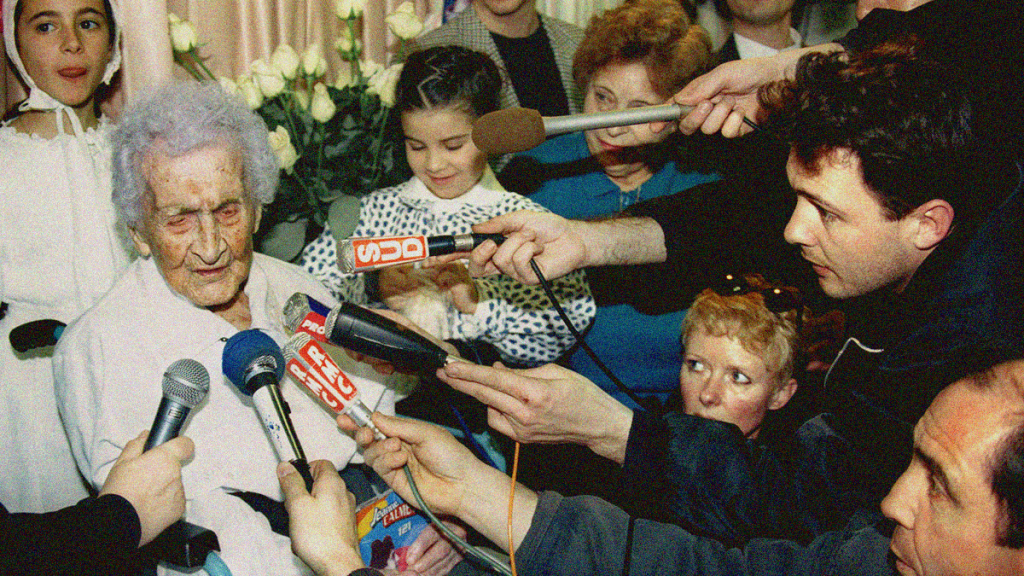
Guinness editor Craig Glenday isn’t wrong for joking that his idea of living is doing what he wants rather than wasting time in the gym for an “extra two days” in senior living. We can’t all be Jeanne Calment chain-smoking until the age of one hundred and twenty-two. We can’t all be as sharp as Violet Brown reciting a poem she learned a century ago. Some of us can only hope to make it to tomorrow and plan for a future with and without our own presence.
What does that say for the inevitable Part Two of Green’s series? I don’t know. Maybe it will show his recovery has been sustained. Maybe it will show a relapse. Maybe his talk about Atlas inheriting the challenge once he passes will take shape. Maybe we’ll hear from the teen that he has no interest in becoming a filmmaker. All we know for certain is that we’ll meet an eclectic bunch of centenarians to better contextualize our own existence and memories.
Jeanne Calment, age 121 in 1996. Photo by Reuters / Jean-Paul Pelissier.




Leave a Reply