
Rating: NR | Runtime: 100 minutes
Release Date: September 4th, 2026 (USA)
Studio: Grasshopper Film
Director(s): Kevin Walker & Jack Auen
Writer(s): Kevin Walker & Jack Auen / Based in part on Robert Burton’s The Anatomy of Melancholy and David Bentley Hart’s The Memory Palace
Father Ernetti never lied.
An academic researching the “historical theories of memory” stumbles upon the mention of an invention able to parse the visual and auditory wavelengths of memory. This “chronovisor” could therefore purportedly project any moment in history. You want to see Christ’s crucifixion? How about an ancient Greek play thought to be lost forever? It would be the greatest scientific discovery in the history of mankind … and, perhaps, the most dangerous.
Why? Because secrets would become a thing of the past. Governments with this power could simply watch their opponents as they plan an ambush. Citizens could turn the dial and see where their spouse was when they said they were somewhere else. It would dismantle the very concept of privacy and replace it with a perpetual paranoia. And yet, you must also wonder if the permanent transparency that results might also foster an era of pure equality.
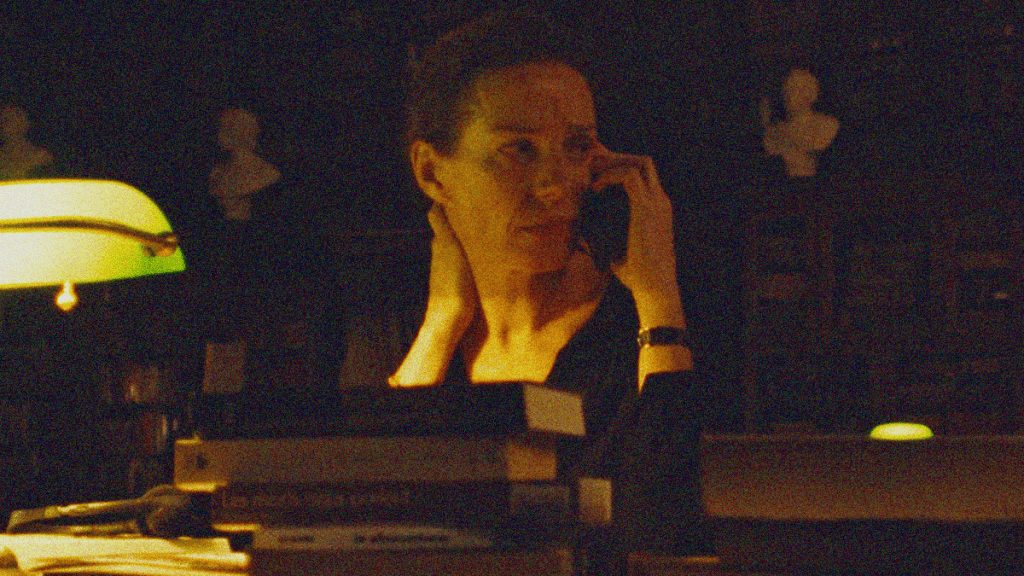
Does Kevin Walker and Jack Auen’s Chronovisor delve into these possibilities? Not really. Their film is less interested in the invention than the compulsive journey taken by Béatrice Courte (played by Anne-Laure Sellier, an actual polyglot scholar who serves as the Cartier-Chaired Professor of Behavioral Sciences at HEC Paris amongst other faculties to study “the area of time perception, creativity, and cognitive biases”) to unearth its existence.
We are quite literally watching this woman get lost in a rabbit hole of research via a sort of forensic investigation into the unknown. Béatrice travels between NYC libraries to unearth a mix of publications and ephemera (most of which is authentic and discovered by the filmmakers themselves during a six-month trek across the internet) while also fabricating titles and awards to endear herself to people who might still have a connection to its inventor over the phone.
That elusive figure is Father Pellegrino Ernetti. While he wasn’t alone in this discovery, he is the one most often caught speaking about the machine on the record. Yes, he never truly presented the necessary evidence to prove his declarations beyond a couple instances revealed as or presumed to be forgeries, but it’s said that he was ordered not to be the Vatican itself. The Pope at the time chose protecting the technology over confirming the Bible’s veracity.
So, most of what’s on-screen are close-ups of these documents with highlighted text translated and superimposed atop the original printed material. It felt like I was back in college with my professors putting transparencies on the overhead and underling the pertinent information we should transfer into our notebooks. Gustav Holst’s score helps invoke a sense of mystery and discovery onto these static screens, but it’s still mainly a glorified lecture.
That doesn’t, however, mean I wasn’t caught up in the investigation. It’s a lot of fun listening to Sellier’s Béatrice alter her tact as she’s passed from one contact to another. First, she’s a professor of philosophy. Next a professor of musicology. Eventually a board member for a prestigious award. Anything that might get the person on the other end of the phone to bite and provide an address or number for acquaintances, family members, or Father Ernetti himself.
Chronovisor becomes a distillation of a psychological thriller wherein the suspense exists entirely in Béatrice’s own mind. No one in the libraries watching her flip through pages would feel anything. Neither would the colleagues she meets for drinks and stale conversation that ultimately has her turning inward in thought as they drone on. Is this obsession hurting her actual research? Maybe. Does it matter if it leads her to the Holy Grail?
It’s the kind of film that will surely find as many champions as detractors due to it being a cinematic representation of researching for your dissertation. As a formal work its objectively fascinating if for no other reason than how Auen and Walker make reading books into a kinetic experience. As entertainment, though, it can prove too dense and repetitive for some to stay locked in until the climactic aesthetic hypothetical of how the device might look.
I land somewhere in the middle. I won’t deny I took a couple breaks to not risk falling completely into the latter camp, but I also won’t deny that the chase had riveting moments. That’s a testament to the filmmakers’ use of archival material and the potential that this might be a fictionalized account of them actually solving the whereabouts of Ernetti’s implausible miracle. We’d already know if it were true, though. So, pretend that it is and go along for the ride.
Anne Laure Sellier in CHRONOVISOR; courtesy of Grasshopper Film.






Leave a Reply