
Rating: NR | Runtime: 109 minutes
Release Date: September 4th, 2026 (USA)
Studio: Vertical Entertainment
Director(s): Aaron Harvey
Writer(s): Aaron Harvey & Jonathan Croom
There is no truth.
Simon Ward (Theo Rossi) is like many working class Americans who try to keep chugging along the path fed to them by societal pressures despite a world falling apart. He goes to work every day despite a confrontational boss (Michael Sirow’s Dave) who wields his foreman power as his identity. He drinks a beer with his best friend (Ronnie Gene Blevins’s Gary) to wind down. He goes home to relax on the couch with his longtime girlfriend (Kate French’s Becca).
Should that be enough to survive the chaos stemming from an insane wealth disparity, partisan politics that have rendered debate impossible, and the paranoia resulting from a lack of ownership in your own life? No. But it’s what we have. It gets us through the day. Most of us turn to hobbies to provide our happiness. Others lean on parenthood. Simon, unfortunately, gravitates towards talk radio with his shock jock of choice: Dalton Kirby (Ron Perlman).
Aaron Harvey’s Come with Me, co-written with Jonathan Croom, could have been many things. Erroneously pitched as an “incel horror” despite Simon being in a committed relationship with someone who wants to have his children, I braced for Kirby’s rhetoric to spew forth like Alex Jones (I’m sure Perlman, a staunch democrat, would have reveled in the opportunity). That’s not the case, though. On the contrary. Some of what this character says makes sense.
And therein lies the danger at the film’s heart. A lot of the troubles we ascribe to external forces are actually born from within. You can argue that the way Kirby orates is part of the issue since his cadence and demeanor plays like a cult leader riling his flock, but the words themselves could feasibly be weaponized by either side of the aisle. It’s not a mistake that he’s constantly prefacing with disclaimers and backtracking before he even gets to his point. He’s playing both sides.
At one point we watch Simon engaging with Becca’s co-workers at a BBQ in their backyard. The topic of Kirby comes up with the guests pointing to his inflammatory speech as “crazy” while their host walks up. We brace for the impact of what we assume will be a defense only for Simon to flip the interaction on its head by using Kirby’s words in a way that makes them seem like an attack on him. It’s possible because they’re hollow until heard.
Harvey hasn’t created a polemic against MAGA or “coastal elites.” Just as Kirby vilifies both extremes as one villain wearing different clothes, Come with Me blurs the line to focus on their shared victim. How does someone like Simon fall prey to the charismatic evil from the right that tricks him into voting against his own self-interests? The same way the left tricks him into pretending its different despite fighting against the exact same progressive policies he craves.
In that respect, Kirby is correct. We do need to tear the system down. We do need to hold the one-percent accountable. But his lack of actionable ways to do so beyond simply fomenting fear and rage only exacerbates the problem. Why? Because it proves his agenda is the same as those politicians. He cares only about the ratings and clicks he hypocritically rails against to provide his own self-enrichment on the backs of the poor souls he indoctrinates.
One could therefore hail Simon as a hero. Yes, he’s a troubled man who needs help. Yes, this is another case where therapy should probably be mandated for all men. But his confusion never usurps his humanity … at least not fully. He feels the walls closing in with struggles at work. He worries that he’s about to be the next victim of America’s corrupt system after a break-in reminds him how renters are second-class citizens. He’s susceptible to parasocial sympathies.
Simon watches the health care industry strip Gary of his humanity. He feels as though he’s being silenced when he meets Becca’s conversation about kids with an honest assessment of the world in which they’d be bringing that child into. He experiences the electric energy of holding a handgun for the first time and embraces its potential to shift the power dynamic he sees as always being stacked against him. So, we anticipate his inevitable break from reality.
But Harvey still relents. Rossi still leans into his character’s humanity. Neither is interested in making Simon into a monster to be dismissed. They understand that his worth is in the complexity of the contradiction between his soft and caring heart and his tired and impressionable mind. He knows the people he’s mad at aren’t the real problem despite wanting to make an example of them. He knows “they” want him to turn on his neighbors instead of them.
Now I’m starting to sound like Kirby with his euphemistic pronouns letting his listeners fill in the blanks before tossing him a few bucks for the trouble. That’s how “they” get you. That’s how “they” turn decent men and women into unhinged lunatics who’ve lost the ability to modulate their real issues away from a constant scream of off-putting aggression. And it’s how “they” create the very things “they” tell us to fear. It’s a self-perpetuating profit cycle.
So, I cheered when the climactic gunshots blare because it felt earned. Does that make me any better than “them”? Probably not. Some of my enthusiasm is because sane viewers see the opportunism. Some is due to Harvey intentionally building the film to put us inside Simon’s head, aligning us with his cause no matter how wrong his actions are. Reality soon prevails, though, to show spin is everything. One man’s martyr will always be another man’s pariah.
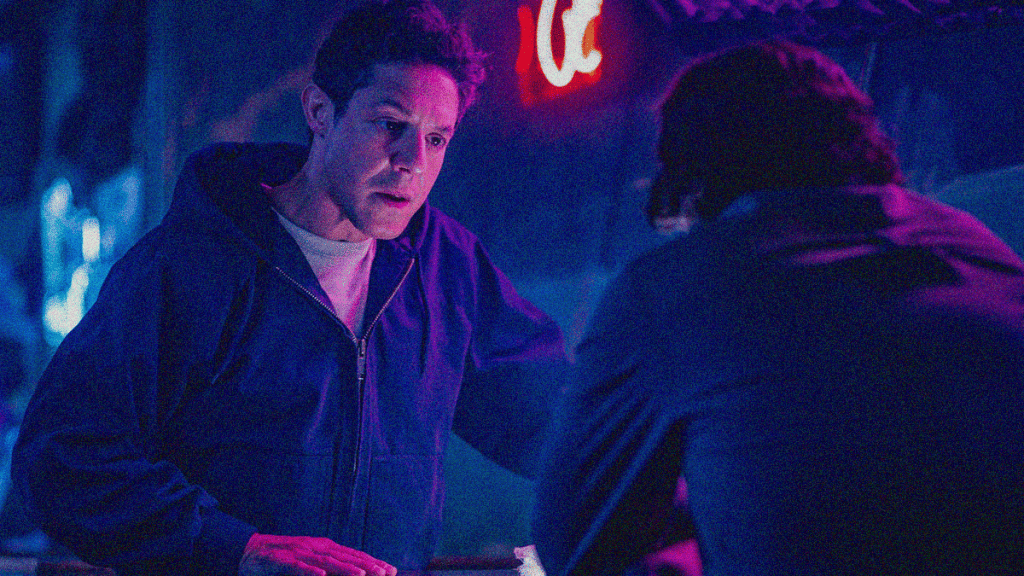
Theo Rossi and Ronnie Gene Blevins in COME WITH ME; courtesy of Vertical Entertainment.






Leave a Reply