
Rating: NR | Runtime: 102 minutes
Release Date: November 27th, 2024 (France) / August 21st, 2026 (USA)
Studio: Diaphana Distribution / Greenwich Entertainment
Director(s): Emmanuel Courcol
Writer(s): Emmanuel Courcol & Irène Muscari
This lad needs you.
Director Emmanuel Courcol and co-writer Irène Muscari could have made a film about a renowned conductor who discovers he has a brother he never knew while searching for a marrow donor after being diagnosed with Leukemia. They could have also written a script about a small factory town on strike joining together through the communal magic of music via their “miners band” to keep spirits high and hopes higher. But why choose just one when you can do both?
More than simply combining these ideas, however, The Marching Band proves to be a third entity all its own that uses them for its foundation. Thibaut Desormeaux is the conductor (Benjamin Lavernhe) who finds Jimmy Lecocq (Pierre Lottin) to ask him to save his life. Jimmy is the trombone player of that miners band when not serving food at the local school cafeteria. The two men couldn’t be more different on the surface nor more alike beneath.
Music struck both in their younger years with a formidable potency. Thibaut had the means to pursue it thanks to the posh family that adopted him. Jimmy could only enjoy it from afar via his record collection after having been adopted himself once their mother passed away. Neither the former’s silver spoon nor the latter’s poverty allowed or prevented them from both having perfect pitch. Those things merely inferred upon what they could do with it.
So, while the cancer and strike color the worlds set on this collision course, they don’t really play a major role in the plotting. Yes, they each come back into focus to augment the drama that unfolds, but our intrigue lies in the relationship these men cultivate. Thibaut’s guilt for having “drawn the long straw” and his fury for having missed the chance to know his brother. Jimmy’s anger at having had the “short straw” drawn for him and the proof he could still aim higher.
These are the sort of knee-jerk emotional impulses that ensure both ultimately get themselves in trouble. Thibaut projects his ire onto his mother for daring to give him this life and not extend it to Jimmy. Thibaut’s sister Rose (Mathilde Courcol-Rozès) is sadly placed in the crossfire as though she’s a consolation prize despite having literally grown up with him as his sibling. I would have loved a bit more meat on this point, but the film spends its time elsewhere.
It’s for good reason considering Jimmy’s dynamic to this revelation is the more interesting half. His attempts to shoot for the stars inherently demands that the life he has now (and the friends and family who share it) is disparaged as “less than.” That leaves his romantic interest Sabrina (Sarah Suco) in a similar position as Rose once the haves and have nots come into conflict. And since she and the miners are crucial to the story beats, Courcol must devote his time there.
So, while Rose and Thibaut’s mother are often positioned as afterthoughts to the whole, Sabrina, Clémence Massart-Weit’s Claudine (the woman who raised Jimmy), and the band are never far-removed from the action. They are just as much connective tissue between the brothers as the music itself, so we learn more about the factory and the strike while we all but forget the cancer even existed. As such, it’s ultimately Jimmy who becomes the star.
Is he the lead? No. Lavernhe is the focal point. He’s the one in need of saving to spark everything that follows. He’s the one who was nominated for Best Actor at last year’s Césars. He’s the established face of the film. But that doesn’t mean he isn’t very quickly pushed into a mentor role generally reserved for a supporting cast member guiding the true lead. Thibaut endures an ordeal, but who he is never really changes. Jimmy, on the other hand, experiences a transformation.
Lottin is fantastic in the role. He’s been working for almost fifteen years and yet his César nomination was for “Male Revelation.” Newcomer. It’s a necessary distinction to ensure the veterans and faces everyone knows don’t blind voters from looking elsewhere, but he deserves a lot more credit. His Jimmy has his entire life upended by Thibaut. He’s forced to run the gamut of emotions as his expectations catch up with his ambitions. It’s not an easy part.
Not only must he deal with the potential to better his lot and learn that doing so doesn’t mean becoming someone he’s not in the process, but he’s also confronting the ways in which he has contributed to the mess his life has become. Thibaut can be used as evidence for the possibility of where he can go, but he shouldn’t be used as a crutch to believe he can introduce a hard reset without acknowledging the straws can’t be redrawn. He already has everything he needs.
Now it’s a matter of accepting that. Accepting he’s good enough to be a father, husband, and brother. Accepting the work he puts in now to pursue a new career or relationship isn’t beholden to the mistakes of his past. Yes, Jimmy steps up to save his brother from disease, but he’s the one who needs saving from himself. In many respects, Thibaut proves a guardian angel of sorts. For Jimmy and the town itself. Because it’s never too late to dream.
Can The Marching Band get schmaltzy at times? Sure. But it never detracts from the authenticity of the characters or performances. The same goes for the heavy drama on the periphery as far as a potential relapse or the strike getting busted. Both can punch us in the gut, but only to push Jimmy and Thibaut forward rather than usurp our attention. This is a film about brotherhood, first and foremost. It’s about love, vulnerability, and letting your truth sing.
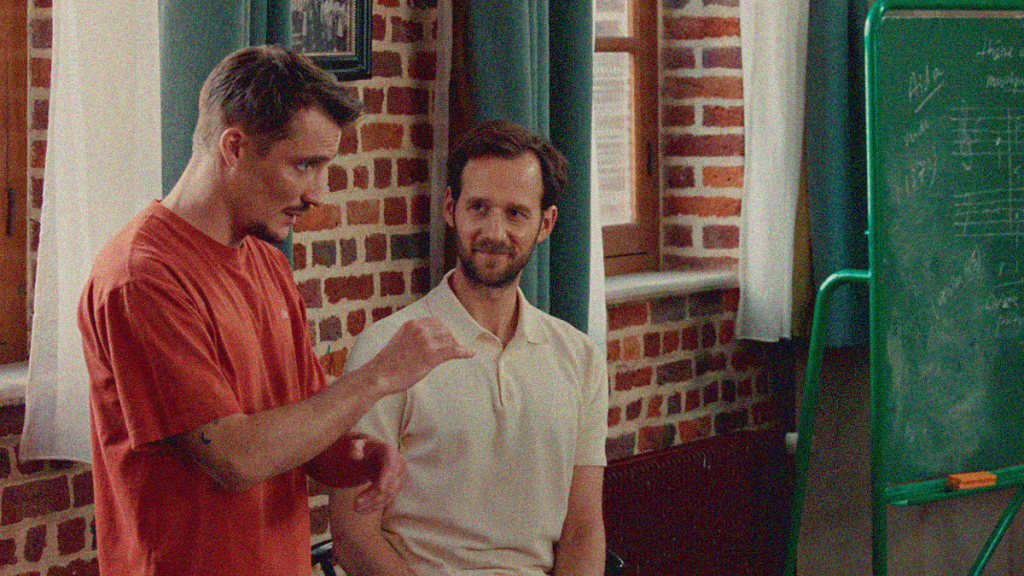
Left-to-right: Pierre Lottin and Benjamin Lavernhe in a scene from Emmanuel Courcol’s THE MARCHING BAND; courtesy of Greenwich Entertainment.






Leave a Reply