Rating: NR | Runtime: 127 minutes
Release Date: September 22nd, 2025 (Czechia) / August 21st, 2026 (USA)
Studio: Bioscop / Cohen Media Group
Director(s): Agnieszka Holland
Writer(s): Marek Epstein
They stole my silence.
We hear the voice of a phone service twice during Agnieszka Holland’s Franz. It either is or serves as an approximation of the extension list provided upon calling the Franz Kafka Museum in Prague. Do you want to buy tickets, souvenirs, or … a personal meeting with the writer? The first instance never receives a response, but the second is followed by a “Yes” before Idan Weiss’ face appears and smiles as the screen fades to black for the end credits.
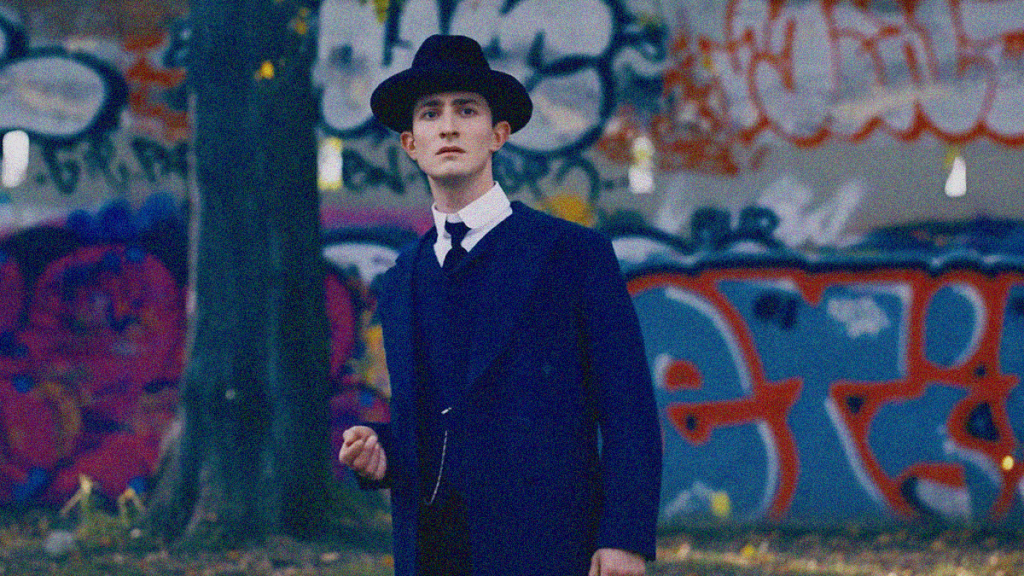
It’s the perfect representation of what a personal meeting would be if we’re to believe the version of the artist that Holland presents. Weiss’ Kafka is often found to be distracted in thought or frozen with anxiety throughout the course of the film, so maybe the silence on the other end of the phone truly is him. You wouldn’t want to mess with genius by interrupting it with the demand of him putting on a show anyway. Let his mind wander. Let him cook.
This device isn’t the only unorthodox moment that takes us out of the fiction of the biopic by placing us in the reality of his legacy. Holland brings us to today’s Prague to listen as a tour guide leads fans from a gigantic rotating mirror bust to a restaurant serving Kafka’s own recipe for “vegetarian” burgers. She shows us a group of Japanese tourists appreciating a spot by the water he used to swim (while Weiss swims it). And she even takes us into that museum.
That last moment is the one that sticks out most because it films a docent dropping the insane factoid that the ratio between words written about Kafka and his work to the words Kafka published is now ten million to one. How could you not therefore consider him one of the most influential minds our world has ever seen? Especially since he only lived forty years and was only actively writing for twenty-five of them. Well, add this script’s words amongst the ten million.
Holland admits Kafka is one of the writers who inspired her most. He was the reason she studied in Prague, and she even produced an adaptation of “The Trial” for television back in 1981. He was an artist that spoke to a growing unrest around the time of World War I. His humor and pointedly bizarre metaphors still speak to the present with that same docent relaying how his prolific letter writing as a replacement for face-to-face conversation was akin to social media posts.
So, why wouldn’t his biography prove just as bizarre? Yes, Holland uses Weiss and Daniel Dongres as seven-year-old Franz to tell his life story, but those sprinkles of anachronistic vignettes provide a glimpse at his impact. And rather than simply film her actors reenacting what might have been, she thrusts them into an exhilarating mix of eternalism, fourth wall breaks, and impossible interviews. Kafka begs the audience for silence as he’s transported through time.
Sometimes it’s with a cut that swaps Dongres for Weiss. Sometimes it’s Weiss getting lost in one of those robotic-like reboots of his own system before being jogged out of it by another version of himself. Sometimes it’s the character imagining a reaction that’s at once more violent and satisfying than the logical one that follows. And all the while his friends and family comment and hypothesize about his state of mind in the moment and/or years later.
The latter examples often provide the most devastating results considering they all outlived him to experience even more chaos and tragedy as Europe fell into World War II and the Holocaust. Here they are smiling for the camera to talk about Franz one second and then despondent the next as their harrowing reality takes over to switch the camera from interviewer to omniscient spectator. It’s some truly bold filmmaking that won’t be for everyone, but I loved it.
I haven’t read Kafka in about twenty years, but you can tell Holland is interested more in honoring his style and demeanor than presuming to know what it is he felt. Sure, we can approximate the facts from his letters and interpret his mindset from his work, but there’s something uniquely fresh in the way she’s willing to present differing possibilities as equally relevant and important to his identity. That’s part of the fun. To write your version through the filter of his words.
Franz is therefore as much a biography as it is a cinematic adaptation of the process of critical commentary. Holland is showing her work by imagining what the other characters would say based on what she knows they did say. She’s taking aspects from his prose and putting them into his life to infer upon his own inspirations and motives. Why did he write that? Why did he enlist to fight? Why did he sabotage his relationships to pursue unattainable women?
Weiss plays it all perfectly. The aloofness. The innocence. The inscrutability. The charm. The frustration. I really enjoyed Peter Kurth and Sandra Korzeniak as his unable to please father and empathetic mother too—two portrayals that speak to why Franz was who he was. But there’s also a lot of Katharina Stark (his sister Ottla) and Sebastian Schwarz (his friend Max Brod) as the two who knew him best. Their insights always entertain … and their ends are chilling.
In the end it’s an audacious entry into the genre that wields artistic license to embody the spirit of its subject. As proven within the film itself, there are countless other resources to dive into the minutiae of facts and assumptions. So, why not use the medium’s strengths to push further? Why not have fun via formal ambition while staying true to the drama and horror of the era and the context of the characters being Jews in Prague during Hitler’s rise?
Idan Weiss in FRANZ; courtesy of Cohen Media Group.



Leave a Reply