
Rating: NR | Runtime: 97 minutes
Release Date: August 14th, 2026 (USA)
Studio: Oscilloscope Laboratories
Director(s): Adam Meeks
Writer(s): Adam Meeks
It’s people, places, and things.
It’s tough to know when the thing you think will help most ends up being the thing that prevents you from healing. Because the idea is sound. Putting Cody (Will Poulter) together with his brother Jack (Noah Centineo) in the same Adult Recovery Court is meant as a positive force of support. Two men who want to see the other get healthy striving towards the same goal. But there’s more to their story. For Cody, the guilt and shame will always overpower the love.
Writer/director Adam Meeks does well to avoid this truth for the first third of Union County. Rather than hide it, he’s merely biding time before it shows itself through their actions. The camaraderie of being reunited. Jack’s penchant for sliding back into drug and alcohol use despite the program’s rules. Cody’s inability to say “No” as he decides to join in the self-destruction. One could say their bond starts and ends with heroin. They can’t exist together without it.
So, when their actions force the court (led by Judge Kevin P. Braig and licensed chemical dependency counselor Annette Deao, both playing themselves) to pull them apart, you can begin to see through the anger and fear. Because there’s a real sense that it’s more than simply their separation that’s eating at him. No, his understanding that the distance is crucial to his recovery is nothing compared to the realization that he’s ostensibly stealing Jack’s spot to achieve it.
The result is a poignant journey towards internal acceptance. By doing the work, we watch as Cody reevaluates the past to see it as others did. His corrupting influence. His betrayals. His blame. When Cody goes back to his sister’s (Emily Meade’s Katrina) home to apologize for everything he put their family through, it’s less about needing her to hear it than it is him needing to say it. Her forgiveness won’t excuse it, but his acceptance might move him forward.
And that’s all someone in his position can hope to do. Find purpose in sticking with the program. Not waste the seemingly bottomless pool of empathy that Braig’s court supplies participants within it. Go to the meetings and talk to better process the thoughts that hearing everyone else’s shares and sharing yourself conjures. Take a purely objective look at why you did the drugs and what their effect proved outside the haze of the high.
The film becomes evidence of that potential. More than Cody’s story, Union County is a movie about the possibilities of programs that truly seek to reform their participants by doing the work and walking the walk. That was what Meeks sought to deliver after embedding himself into this world and being granted access to put it on-screen in as authentic a form as fiction can allow. Because most of the other addicts shown are actually battling those demons.
Comparisons to Debra Granik’s Leave No Trace are therefore obvious and apt. I don’t think it’s as successful of a whole as that one, but you can’t deny the potency of its parts. Being so self-contained and needing certain elements to occur for the endgame to reach its apex of catharsis does make it feel like the script is stuck to its rails rather than capable of surprising you. While we want to experience each moment with Cody, we’re constantly left on the outside waiting for the result.
Being kept at arm’s length doesn’t diminish the performances, though. Poulter is at his quiet best with a superficial posture of anger that can’t help but make way for the sorrow he’s so desperate to hide. Both Meade and Elise Kibler (as a recovering addict, friend, and mentor to Cody) provide equally complex roles that serve as examples for the tough decisions one must make when they’re truly ready to stop putting others (including the drug) ahead of themselves.
There’s something to how it all unfolds at a careful pace with few outbursts of emotion to ensure those rare instances hit hardest. It captures the feel of its central Ohio setting and the opioid crisis’s ripple effect as more than a soundbite or statistic. Because it’s not all doom and gloom even if not everyone can be saved. As Annette later explains, these tragedies are no one’s fault. Your culpability is reliant on the drug. Remove it from the equation and anything is possible.
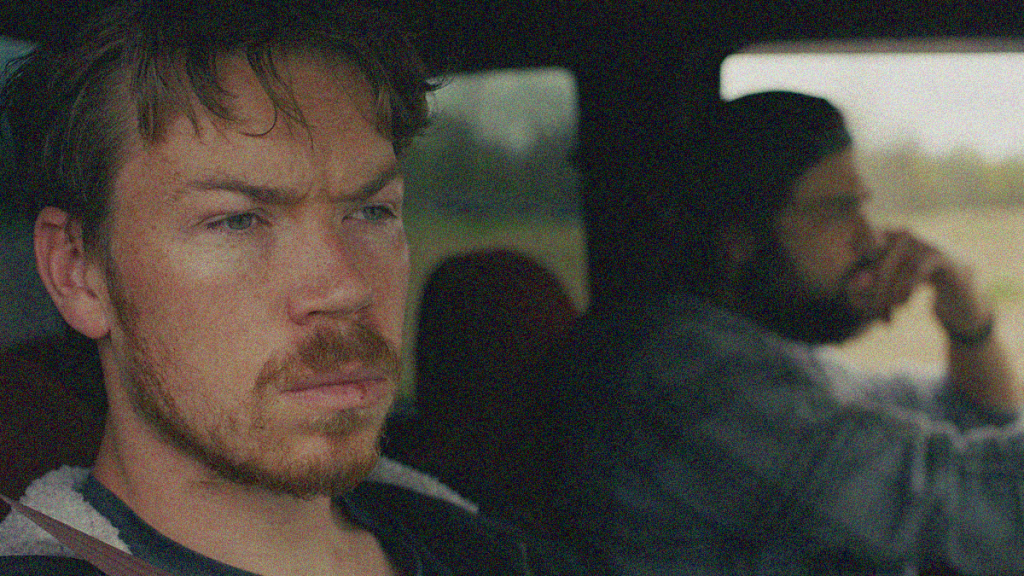
Will Poulter and Noah Centineo in UNION COUNTY. Photo by Stefan Weinberger, courtesy of Oscilloscope Laboratories.




Leave a comment