
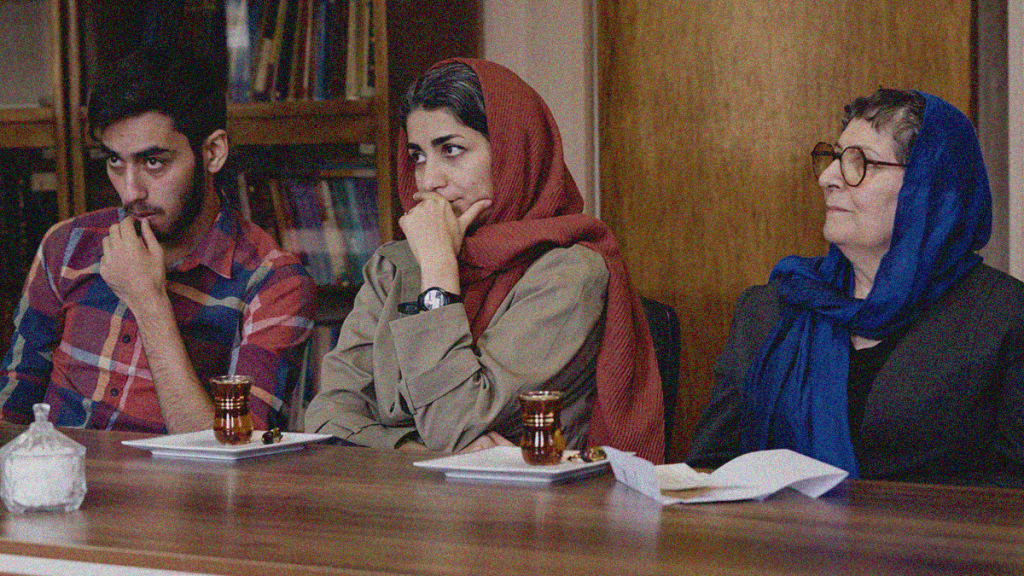
Rating: NR | Runtime: 84 minutes
Release Date: August 12th, 2026 (USA)
Studio: Jolt.Film
Director(s): Tanaz Eshaghian & Farzad Jafari
I killed him once. He killed us a thousand times.
Tahereh never said she didn’t do it. On the contrary, she readily admits she has no remorse. It took five months from the time she and her daughters murdered her husband Hossein to their apartment’s subsequent inhabitant finding the body and Tahereh is quick to describe that period as “fifty years of joy.” That’s the effect Hossein had on his family’s lives courtesy of his drug addiction and abusive nature. If they had it all to do again, they would.
I wonder what an American lawyer would say about this case. Not that I think directors Tanaz Eshaghian and Farzad Jafari should have brought in a talking head to contextualize a hypothetical. This investigation would have unfolded differently, the lies Tahereh’s own lawyer infers were told wouldn’t have been needed, and she would have been granted a divorce. If Iran’s laws weren’t written to ensure this was Tahereh’s only recourse, Hossein might still be alive.
That’s the real intrigue at the back of An Eye for an Eye. Strip away the emotion inherent to the reality that Tahereh’s freedom—despite serving fourteen years in prison—remains in the hands of Hossein’s family and the story on-screen becomes a dissection of a broken justice system born from religious intolerance rather than logic or morality. When a man is allowed to act with impunity while women are told to “deal” with the cost, what choice do they have?
Everything that occurs on-screen is therefore filtered through a lens of hypocrisy. Tahereh tried to stop her husband from using drugs. He refused. She tried to leave him and escape the abuse. Both he and the state refused. Her children (now grown) all declare through tear-streaked eyes that she saved them. An Imam tells them that the Quran explicitly states you cannot admit your life is better without your father because you owe your existence to him.
Black and white rules necessitate black and white action. Unfortunately, that also means those black and white actions necessitate more black and white responses. It’s why the phrase used as the title is so often marked by a doom and gloom ethos. It’s why we’re supposed to read it as a warning for the never-ending darkness that consumes the world when it’s followed without anyone having the courage to break the cycle. You killed my brother? Now I kill you.
It’s a harrowing predicament for this family. Not only is there the decision on behalf of Hossein’s brother Bashir (their mother wants retribution with every fiber of her being) to provide leniency—if not forgiveness—as Mohammad’s lesson teaches, but there’s also the opportunistic impulse to sell that leniency for a price. That’s where things get muddied since Bashir feels the pressure of tainting his own soul. His son, Saeed, however, does not.
This is why my intrigue was never higher than when I could look at the situation through purely pragmatic eyes. Much like Tahereh’s advocate, Ms. Jabarzadegan, we’re asked to consider the difference between what’s “right” and what’s “law.” The fact that Iran puts that differentiation into the hands of the victims rather than the court is insane since there’s no chance for impartiality. If one side isn’t selling their forgiveness, the other is trying to buy their life.
And it makes sense when Sharia Law is literally a transactional set of rules. Women have no autonomy because they are considered property. So, if their life was already forfeit at birth, why should anyone think twice about forfeiting it again as an adult? Throw out all the other details (Was there another man? Can a celebrity help fundraise the ransom?) and this whole ordeal becomes a game of guilt chicken. When does your shame outweigh your pride?
It’s therefore also fascinating that both sides of the ordeal allowed cameras to capture everything since one would assume that exposure would tip the scales. Maybe it did for Bashir. Maybe he realized he didn’t want the world to know he was willing to sell his own soul like Tahereh. But when the decision falls to Saeed, all bets are off. He’s younger, stubborn, and beholden to his grandmother’s rage. He wants those cameras to turn his ruthlessness into strength.
Everything about the case becomes an exploitative show from the police knowing something wasn’t quite right with the confession to Saeed’s desire to prove himself a “man” regardless of a life hanging in the balance. Eshaghian and Jafari are filming a delicate moment in this family’s life, but they’re also exposing the injustice of a patriarchal system hellbent on preserving a sense of superiority over women no matter what.
If Tahereh presumably choosing between the murderer or adulterer labels isn’t enough to prove it, her selection surely is. And when all is said and done, the resulting contrition and thanks remain more about custom than honesty. It’s impossible to ignore how this whole charade is an intentional tactic by the government to maintain control. It forces them all to constantly fear for their lives and reputations no matter which side of the wrongdoing they’re on.
So, don’t assume An Eye for an Eye is solely about exonerating Tahereh. The filmmakers are very intentional about hearing all sides of the case to present an objective look at why the result could truly go either way. It reveals the lies we tell others and ourselves for survival and sanity. And it exposes a culture of misogyny that would probably erase women from existence if not for needing them to continue giving birth to their own oppressors.

A scene from AN EYE FOR AN EYE; courtesy of Jolt.Film.




Leave a comment