
Rating: R | Runtime: 98 minutes
Release Date: May 15th, 2026 (USA)
Studio: Vertical Entertainment
Director(s): Bobby Farrelly
Writer(s): Thomas Moffett
Maybe we don’t know why we go anywhere.
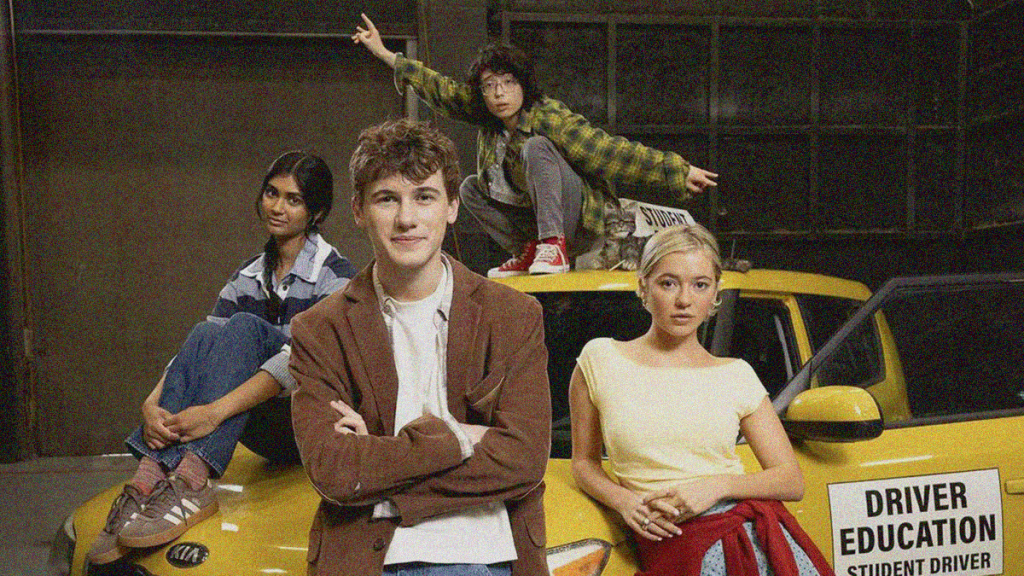
A moment of opportunity arises when eighteen-year-old Jeremy’s (Sam Nivola) substitute driver’s ed instructor Mr. Rivers (Kumail Nanjiani) realizes he forgot his coffee. Despite having both arms locked in shoulder-length casts, no one else volunteers to fetch the drink. So, when he’s far enough away from the car, Jeremy hits the gas with three classmate hostages in the backseat. He’s desperate to save his tenuous romance with college freshman Samantha (Lilah Pate).
Director Bobby Farrelly and writer Thomas Moffett take extra pains to remind us three or four times that these teens (Sophie Telegadis’ Evie, Aidan Laprete’s Yoshi, and Mohana Krishnan’s Aparna eventually evolve into accomplices) are “of age.” It’s okay that Jeremy is still dating Sam. It’s okay that they eventually crash a sexualized frat party. Just because they’re still in high school doesn’t mean they’re minors. So, nothing that might happen can be construed as statutory rape.
The funniest part of this obsessive bit of narrative caution (besides being fully out of character for a filmmaker who made a name with movies that intentionally sought to cross those exact lines as a badge of honor) is that Driver’s Ed doesn’t ever overtly place these characters in situations where it matters. We can infer that sex is happening in the background considering a liberal use of the word “cheating,” but there’s no risk of being brought up on decency charges.
It’s further proof that the whole conservative movement against “woke”—a term they appropriated incorrectly to feign outrage—is a manufactured soap box floating in the air without a foundation. Farrelly talks about wanting to homage classic John Hughes coming-of-age films, but he and Moffett don’t seem to be able to comprehend that doing so should mean reinventing the mold for today’s generation rather than just adding a contemporary filter to tired humor.
Because the moments on-screen where emotion and vulnerability are highest often prove to be the ones that feel the most inauthentic. It’s not just the “you can’t sue us because the characters are eighteen” energy that’s more about being afraid comedy truly is “dead” than trying to conjure humor. I get it, though. Farrelly and his brother made their careers from punching down. That ablism and bigotry is so ingrained that he’s adding disclaimers instead of growing.
Don’t therefore be surprised that Driver’s Ed is much closer to a Dumb and Dumber than a The Breakfast Club (both classics in their own right). Sure, the stars are teens and Principal Fisher’s (Molly Shannon) murder board puts Post-Its by her AWOL students that read “Hopeless” and “Basket Case,” but this is a road trip. The fact we keep going back to the adults at all is honestly weird. Shannon and Nanjiani get their John Kapelos/Paul Gleason moment, but why?
The moment you segregate your cast by having the kids drive to Chapel Hill while the adults stay home, the latter automatically become vestigial limbs. This is especially true when you also have Security Guard Walsh (Tim Baltz) actually chasing them on the road. He’s in the action. He and his ex-partner Lee (Bri Giger) are actually interacting with the main cast. Shannon and Nanjiani should have just disappeared like Alyssa Milano’s cameo as Jeremy’s mother.
Lean into the road aspect and turn this into Adventures in Babysitting instead. That’s kind of what they do anyway as Walsh and Lee’s chase stays one-step behind if not diverted off their trail completely. That’s where the real fun is. The teens taking this opportunity to escape the constraints of their own expectations and desires to discover what they want amongst likeminded yet superficially different peers. Where did things go wrong? How can they get on track?
It’s the dynamic between Evie and Jeremy as they obviously start falling in love while also providing the other an example of the person they wish they could be rather than the one they think they are. It’s learning about Yoshi and Aparna’s past friendship and what pulled them apart to prove how important it is at any age to check up on people and see how they’re doing. It’s the reality that experiences are much harder to fall on deaf ears than words.
So, there is a lot to like here. I’m just not sure Farrelly was necessarily the right person to execute its intent or that Moffett’s script was solid enough to allow him the chance. Too much felt stilted and unsure—a stark contrast to the young cast who do a wonderful job imbuing innocence, uncertainty, and sorrow without falling into depression. By comparison, Rob Grant’s This Too Shall Pass (ironically also starring Laprete) achieves the same goals with confidence.
If nothing else, though, Driver’s Ed does advance the Farrelly Brothers’ “Seabass” lore by enlisting another former Boston Bruins icon to the big screen. I fell victim to a double take when asking “Is that Cam Neely?” back in the 90s and Bobby got me again thirty years later when Patrice Bergeron, Mr. Selke himself, arrived to spout French at the front of a classroom. It might not be as insane of a film debut as his former president of hockey operations, but it’s just as surprising.
Mohana Krishnan, Sam Nivola, Aidan Laprete, and Sophie Telegadis in DRIVER’S ED; courtesy of Vertical Entertainment.






Leave a Reply