
Rating: NR | Runtime: 116 minutes
Release Date: October 9th, 2025 (Denmark) / May 29th, 2026 (USA)
Studio: Nordisk Film / Samuel Goldwyn Films
Director(s): Anders Thomas Jensen
Writer(s): Anders Thomas Jensen
People are more than one thing.
It starts with a children’s story. A dark children’s story. It’s an animated tale of a Viking clan and its leader’s unorthodox psychology when it came to equality. Rather than lift his young son up after losing his left arm during a fight, this father decides to take everyone else’s left arm too. Because “if everyone is broken, no one is broken.” Sure, it’s a twisted take on disability that wields an irreverent humor, but you’d expect nothing less from Anders Thomas Jensen.
When The Last Viking shifts from this illustrative prologue to Anker (Nikolaj Lie Kaas) shoving a duffel bag of cash into a public locker, I half expected to discover he too only had one arm. That we were perhaps being ushered into an alternate universe wherein those descended from that Viking clan now populated the world with a custom of amputating their babies upon birth. Jensen takes a less literal approach instead, but one that remains just as tragic.
No, Anker and his brother Manfred (Mads Mikkelsen) didn’t lose any limbs in their youth. Their father (Lars Ranthe) was less about helping a son feel equal to those around him than beating what made him different out of him so as not to be seen as different himself. Manfred’s childhood was therefore a tough existence full of violence and abuse on multiple fronts. Bullies at school attacked him for wearing Viking attire and Dad did the same at home.
Anker was inevitably caught in that wake too—punished for not protecting his brother how their father demanded. He wasn’t asked to bully the bullies, though. He was ordered to ensure Manfred didn’t do anything that warranted being bullied. That’s a lot to put on a kid’s shoulders. Especially one with a kind enough heart to choose to wear a helmet so Manfred didn’t feel alone instead. Anker chose acceptance over ridicule. He chose Manfred over the world.
But that was then. This is now. Both men are adults living with their older sister Freja (Bodil Jørgensen) and just trying to get by—not an easy task when Manfred’s eccentricities often ensure that they all are seen as pariahs. Anker took to crime, stole that cash, and now tasks his brother with hiding it minutes before the police arrive. He believes he’ll get out of prison in fifteen years and simply dig the money back up, but a lot changes while he’s away.
I honestly wasn’t sure where Jensen would go with this story upon Anker’s return. Sure, it’s funny to watch Manfred hurt himself whenever his brother calls him by his name since he’s actually “John Lennon” now, but was the film really going to go down the Dissociative Identity Disorder (DID) route? It’s even funnier when Anker’s old partner Flemming (Nicolas Bro) punches him in the face before apologizing for the aggression. But is the irony the whole point?
A lot happens in a little time as a slew of characters get introduced to help move this journey forward on parallel tracks. The first is trying to unlock Manfred’s fear and discover why he’s retreated into another identity by way of listening to a psychiatric doctor’s (Lars Brygmann’s Lothar) insane idea to find a Ringo (Peter Düring) and a Paul/George (Kardo Razzazi) to reunite the band. The second is forcing Anker to confront how his love for Manfred warped into resentment.
Both paths lead them to the country home where they grew up that’s currently owned by Margrethe (Sofie Gråbøl) and Werner (Søren Malling). These two are bizarrely offbeat in their own way and therefore more than happy to let this wild collection of mental patients into their home. Lothar wants to help them all and make a name for himself in medical journals. Anker merely wants “John” to go back to being Manfred so he can tell him where the money is.
Jensen thankfully doesn’t delve too far into the DID of it all (Ringo is mute and Manfred may or may not be faking it). He instead uses that notion of multiple personalities and the fluidity/absurdity of identity to get back to the Viking allegory and dig into what it means to be equal and/or different. Is Manfred really that different than the rest of the world? And, if so, is that necessarily a bad thing? After all, everyone wears masks. Everyone misjudges themselves.
Anker thinks he’s a bad man and therefore doesn’t need to care about his brother anymore. (He also pretends to be reformed to earn parole.) Werner considers himself a fashion designer and children’s book writer despite never succeeding in creating anything. Margrethe fancies herself a model who married him because having an “ugly” husband was a way to earn respect. Flemming thinks he’s a nice brute because he warns people before doing horrific things to them.
Why do we lose ourselves to labels with no bearing on reality? It’s often the same reasons why a DID patient retreats into another identity as a means for survival against whatever triggering scenario it is they find themselves facing. Margrethe must hold onto her looks to maintain a sense of value. Werner does the same with his dreams to manufacture relevance. Manfred becomes “John” to better handle how alone he’s felt since his brother went to jail.
There’s also a through line wherein this notion of escape is about more than just playing. Manfred became a Viking as a boy to better deal with an abusive household and Anker followed suit to better protect him from that isolation. So, maybe this is all a way for Manfred to coax his brother back into that mindset of a time when they were inseparable. Perhaps Anker won’t just leave him again now that he’s finally back.
Anker might rediscover that love he once felt in the process. It won’t be easy considering the frustration of dealing with Manfred only makes him angrier than he already is, but it proves even more difficult after realizing this “tough guy” exterior is its own survival mechanism. What made Anker so afraid that he needed to shield himself from a long-lost truth that made it so he forgot how to play with his brother and have fun without consequence?
The answer to that question is as dark and violent as you’d expect considering their childhood and it ultimately carries many more. Jensen has never shied from heavy subject matter and he always finds a way to make you laugh out loud amidst the sorrow regardless of how dry or uncomfortable the delivery of the joke proves. I honestly couldn’t wait for the next person to call “John” by his real name so I could enjoy his next surreal suicide attempt.
Mikkelsen is truly never better than in Jensen’s films because of the freedom to be weird and funny as opposed to stoic and menacing (Bryan Fuller finds that sweet spot in-between). His Manfred is heart-breaking but also inspiring in an ability to never give in to what society demands. And Kaas is right there with him—not always the straight man, but excellent filling that role like he does here. These three know how to bring the best out of each other.
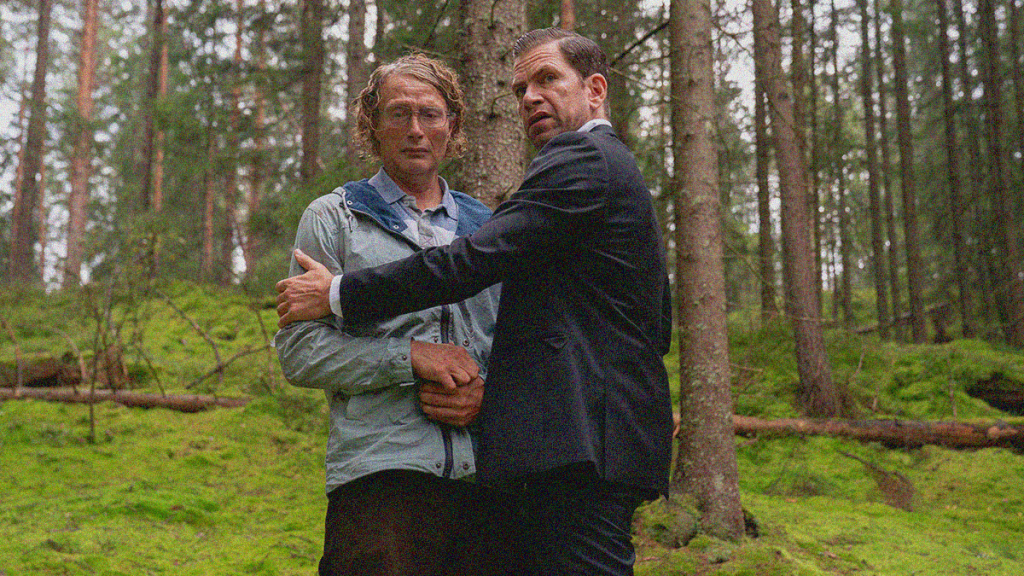
Mads Mikkelsen and Nikolaj Lie Kaas in THE LAST VIKING. Photo by Rolf Konow; courtesy of Samuel Goldwyn Films.





Leave a Reply