
Rating: R | Runtime: 108 minutes
Release Date: May 15th, 2026 (USA)
Studio: Focus Features
Director(s): Curry Barker
Writer(s): Curry Barker
Inside joke!
All I really knew about Curry Barker’s Obsession was that someone makes a wish. Beyond the hype surrounding its TIFF debut (enough that it seemed I waited too long to request a screening link as the publicists pulled availability once the bidding war for this $750,000 film gained the momentum that earned it a $15 million payday from Focus), I tried to steer clear of trailers and simply found myself laughing whenever I saw images of a One Wish Willow sans context.
So, my main thought upon sitting down was that Barker had spun his own version of W.W. Jacobs’ The Monkey’s Paw wherein a lovelorn introvert (Michael Johnston’s Bear) finds that the love spell he places upon his crush (Inde Navarrette) doesn’t quite manifest how he hoped. What I didn’t expect—especially with the misogyny debates that followed its release—was Barker infusing a bit of Get Out into the mix to really drive home the consent angle.
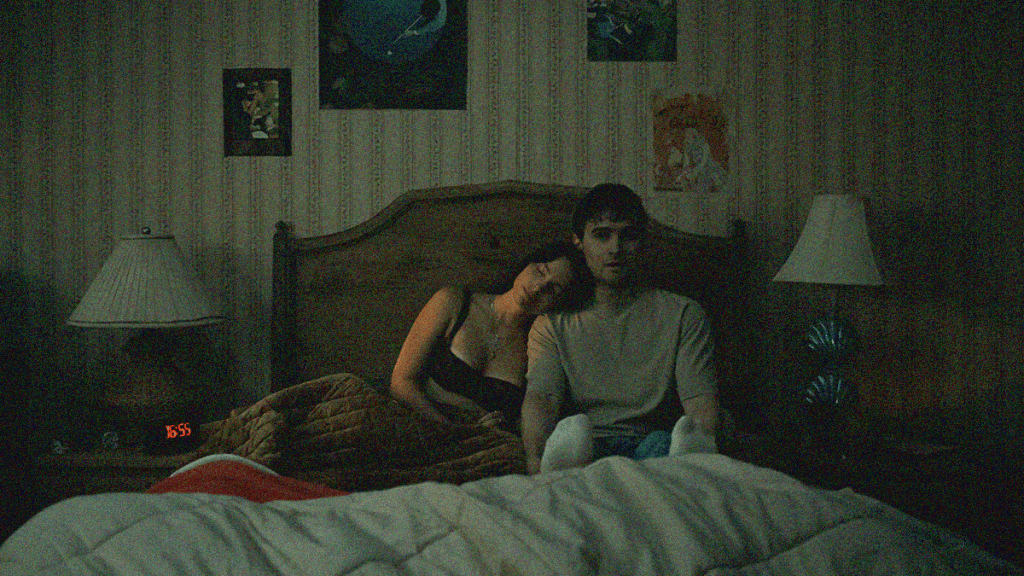
It leads to some of the most disturbing moments you’ll see in a cinema all year thanks in large part to Navarrette’s unforgettable performance. I’m not talking about the funny faces, loud outbursts, or jump scares either. Those lend it a nice horror (and, because we all laugh when nervous, comedic) slant, but it’s the way she turns on a dime from enthralled and doting girlfriend to terrified captive that makes this movie succeed. The first instance had me audibly saying, “Oh, no.”
Because you don’t have to be a student of the genre to understand that look or the reason why it disappears so quickly. This is more than just forcing someone to believe they want to do something they don’t. This is someone being possessed to do those things while being forced to endure it with no control over stopping or appreciating it. Those moments aren’t an escalation of the insanity. They are very brief glimpses of clarity within the insanity. They are cries for help.
As such, Obsession is intentionally subverting the assumption that Bear is the protagonist because the Bears in so many movies that do treat them like the hero are very obviously born from an era that refused to consider the power dynamics at play. This isn’t about Nikki violently terrorizing Bear when he actively works against the wish she’s desperately striving to follow to the letter. It’s about Bear taking advantage of her and being too much of a coward to stop.
The smartest thing Barker does (and this is a major step up narratively after his debut Milk & Serial didn’t quite get how to expand a short concept to feature length) is ensure that everyone else on-screen implicitly understands what’s happening without knowing the full details. They’re all worried about Nikki. They acknowledge this whole situation puts Bear in the bad light. Every single action by every character but Bear proves that he’s the villain.
And there’s only one thing he can do to stop it. Because stopping it is all he can do. There’s no path to redemption here. This isn’t even really a Monkey’s Paw type scenario since the result is less of a curl than it is an authentic depiction of what a “love wish” truly means outside of the usually male-centered fantasies of the 1980s and 1990s that ultimately helped normalize rape culture by presenting the sexual objectification of women as a “manly” rite of passage.
This film tears down that veneer to reveal how the reasons you like someone (beyond superficial attraction) are because of who they are outside of what you want them to be. The moment you become an external means of altering their desire to stop being themself is the moment you start to realize the difference between receiving love and taking it. So, we aren’t scared for Bear when he recoils in fear from Nikki. We’re hopeful he’ll finally grasp how he’s at fault.
The fact that he simply keeps trying to sweep it under the rug and think that he can make it work only makes us despise him more. Especially after he’s explicitly told what he must do to end her suffering. Yes, we feel his pain when he asks, “What’s so bad about being with me?” But we also pity him for being unable to ask himself that same question. Because he doesn’t even have the right to ask her since it goes beyond her not having a choice. She’s literally not with him.
It’s why Ian (Cooper Tomlinson) is justifiably pissed off (beyond a later reveal adding some additional context). He loves his friend, but he knows something is wrong because people don’t flip a switch like Nikki has to go from sisterly confidant to Cupid’s arrow crazed. And it’s why Sarah (Megan Lawless) might be the most meaningful character on-screen. She’s in love with Bear like he is with Nikki, but she doesn’t hold the toxic masculine entitlement he does.
That Barker can conduct this takedown of that entitlement while also providing genuine fits of discomfort and terror is the cherry on top. He’s using the horror gore and creepy monster movements to augment the very real emotional upheaval. Sometimes these movies use aesthetics to bury metaphors or hide them when they aren’t confident enough in their efficacy, but Obsession knows from the opening frame that its cinematic layers are in concert.
And let’s not kid ourselves. This is a legitimate feat for Barker as a filmmaker, but it’s more so for Navarrette as an actor. So much of that metaphor hinges on her ability to shuffle through the expressions of three distinct characters: Nikki the victim, Nikki the fantasy, and Nikki the wish. It’s a truly staggering performance that will have you laughing, cringing, and praying in equal measure. Because she’s the lead. This is a survival horror once you know where to look.
Inde Navarrette stars as Nikki and Michael Johnston as Bear in OBSESSION, a Focus Features release. Credit: Courtesy of Focus Features / © 2026 FOCUS FEATURES LLC.





Leave a comment