
Rating: NR | Runtime: 90 minutes
Release Date: April 17th, 2026 (USA)
Studio: Janus Films
Director(s): Sophy Romvari
Writer(s): Sophy Romvari
I think there’s a lot of things you don’t remember.
The film opens with a voiceover—a woman speaking about her past and memory and a figure she never truly understood. So, when we suddenly move backwards in time to find a car winding down a long road coupled with a young girl’s laugh, we can easily piece together that we’re about to witness her story. It’s a crucial bit of narrative foreshadowing because most movies with this subject matter would look to focus on its troubled soul rather than the people impacted by them.
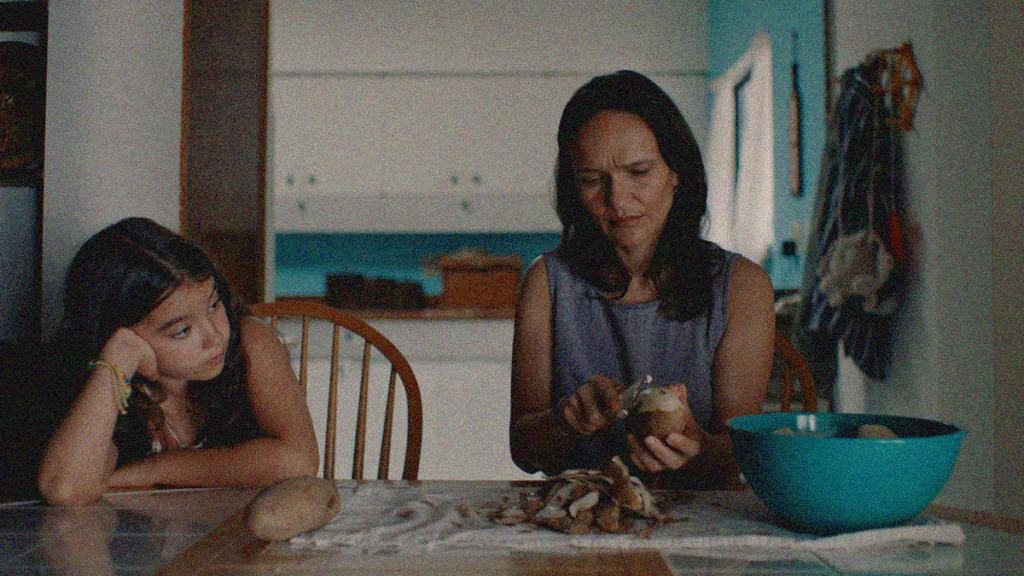
Sophy Romvari’s feature debut Blue Heron isn’t therefore Jeremy’s (Edik Beddoes) film despite it being about him. He’s the central piece to its puzzle and catalyst for everything that follows, but the camera never places us in his head or through his eyes. It uses young Sasha (Eylul Guven) instead—the teenager’s half-sister who’s always watching and listening and trying to comprehend the chaos as her parents attempt to figure out what Jeremy needs to quiet his demons.
The reason is simple: the film is semi-autobiographical. Jeremy is based on Sophy’s brother and Sasha on her. It could have feasibly been an essay film with Romvari talking about her tumultuous childhood and the process of going back and mining down to figure out what was real and what was imagined, but she chose to put it through a fictionalized lens instead. To bring out the emotions of grief, guilt, and sorrow felt by everyone rather than only herself.
Sasha is therefore our entry point into a summer that ultimately changed everything. She’s peeking through windows, cracking open doors, and holding her father’s camera whenever he (Adam Tompa) and her mother (Iringó Réti) are forced to leave her and her other two brothers to deal with Jeremy’s latest antics. It’s a confusing position to be in for both the character and us because we’re never given the full picture. Just fresh snippets of frustration and helplessness.
Romvari really captures the conflict inherent to surviving such an ordeal for two parents stuck between wanting to do everything they can to help their child and knowing that they must protect their other children from him. The way she and cinematographer Maya Bankovic place the camera at Sasha’s level or from her vantage to lend a voyeuristic feel to the drama centers the stillness of the reaction above the motion of the action. We’re observing a series of responses.
Mom telling Sasha not to invite friends over because of the uncertainty of what they might witness. Dad trying to tell Mom about a good day wherein Jeremy was engaged and playful only for fatigue to cause her to see it as undermining her pain that he gets to be the “hero.” Mom venting on the phone only to presumably be told by the person on the other end that they want to just pretend everything is okay. Jeremy’s silent smirk or tense terror after the latest outburst.
It’s a potent recipe for authentic drama—the sort that more or less promises to be heading towards an inevitable tragedy. Romvari realizes that this fact is often what undoes this sort of film despite any prior effectiveness. It either undercuts that authenticity by revealing a miracle turnaround (true story or not) or devolves into miserabilism. But she avoids all that via her decision to make this Sasha’s journey of understanding. It’s not about what happens. It’s about the impact.
So, when a critical development threatens a point of no return, we’re suddenly thrust into the present. Now we meet the owner of that opening voiceover (Amy Zimmer’s adult Sasha) and her quest to remember, perceive, and solve the many questions swirling around her brain concerning her brother. It’s an utterly transfixing bit of cinematic magic that reshapes everything we’ve seen twice. Once through a lens of a forensic autopsy and another through her heart.
I don’t want to ruin the devastatingly cathartic experience that results, so just know that its bid to exorcise those demons is accomplished even if it was only able to occur retroactively. And Romvari handles the transitions with expert formal and visual precision so that she never needs to explicitly explain where or when we are or what’s happening. Everything we need to know is in a keychain hanging from Sasha’s ignition and the tears in Zimmer’s eyes.
Blue Heron isn’t an easy watch by any sense of the word, but it’s an important one to reduce the stigma associated with the torment of people like Jeremy and the anguish of those who love them. My cousin battled schizophrenia most of his life and the sentiments shared in a letter at film’s end reminded me how sweet he was despite what would happen whenever the hurt and confusion proved too much. As Romvari exposes, it’s just as hard to remember as it is impossible to forget.
Eylul Guven and Iringó Réti in BLUE HERON; courtesy of Janus Films.




Leave a Reply