
Rating: R | Runtime: 112 minutes
Release Date: May 22nd, 2026 (USA)
Studio: Independent Film Company / Shudder
Director(s): Natalie Erika James
Writer(s): Natalie Erika James
Exxxy, but worth it!
The spam links at the bottom of online articles these days love to spout how “thin is in” again. To see the imagery, however, shows that “emaciated” might be a more apt term. We are in an age of GLP-1 agonists now—medications that work wonders for those who need them and seem to suck the very life out of those who want them. That’s what happens when sound science is appropriated as the next weight loss miracle drug.
Natalie Erika James’ latest feature Saccharine isn’t a horror story about Ozempic, though. No, its lead character Hana’s (Midori Francis) cross to bear is less the number on her scale than the compulsion behind it. She’s not alone. Her friend Josie (Danielle Macdonald) abuses ketamine (and screentime). Her crush Alanya (Madeleine Madden) obsesses about exercising. Her mom (Showko Showfukutei) is always cleaning. And her dad (Robert Taylor) is eating himself to death.
Hana’s compulsion isn’t the same as her father’s per se. Yes, she finds herself gorging on sweets when anxiety and stress run high, but it’s often a product of her inability to stop studying in medical school. Work is the addiction. Eating is the escape. Partially because she’s grown up watching her dad destroy himself. Partially because her mom is always commenting on her weight. The self-loathing and insecurity are never far behind.
That’s when an old friend arrives (Annie Shapero’s Melissa) with talk of a new, unapproved pill called Gray. She shed everything in an insanely short period of time and wants to help Hana do the same because she was one of the few people who treated her like a human being rather than a pariah. Ever the scientist (and unable to afford the medication’s exorbitant price), Hana attempts synthesizing her own. It’s surprisingly much easier than she thought.
Why? Because Gray isn’t some chemical compound. It’s ash. Human ash. It obviously makes no sense on a practical level (what?!) or a scientific one (the sodium alone should make her want to eat more), but she’s working on a cadaver in class and therefore has access to human remains to cremate and swallow. What’s even crazier, however, is that it works. The weight is melting off even as her craving for food grows. There’s just one dangerous side effect.
James does well to maintain a shroud of mystery where this issue is concerned. Is the woman Hana sees in the reflection of concave mirrors really there? Is she a “Hungry Ghost” like the ones her mother tries to ward off with an altar and offerings? Is it the psychological manifestation of a mind losing its grip on reality? While we’ll eventually discover the answer, knowing it isn’t necessary for “Bertha” to wreak havoc on Hana’s daily life.
Blurring that line also helps drive home the fact that how issues like eating disorders and body dysmorphia manifest is less important than their cause. Sure, “Bertha’s” presence allows for some truly creepy moments (when her form is visible) and impressive special effects (when it’s not), but giving it a name won’t alleviate the problem. Hana was suffering before the ash and she’ll be suffering long after she stops. Healing is a process. There’s no switch to flip.
Don’t therefore get lost in the obvious genre trappings James uses to craft her horror. It’s all extremely effective visually and thematically, but I’d be lying if I didn’t say a lot of it was convenient insofar as giving Hana a target with which to fight. No, it’s what happens around this main battle that sheds light onto deeper levels of understanding. Mom falling right back into routine upon returning from vacation. Dad’s act of kindness making Hana angrier than before.
The sentiment at the center of Saccharine is that you “can’t love someone into getting better.” James talks about her own father’s fight with demons that led to his health problems as a result of weight gain, so this is very personal to her. You can feel it in the details and examples of silent struggles throughout the film. And you must give Francis a ton of credit for portraying it with complete authenticity. Her shaky arm apology to Alanya towards the end is devastating.
And, speaking of that end, I did not anticipate where things ultimately go. I should have, though, considering all those markers showing how the issues on-screen aren’t the kind that can be solved with a simple fix. Because it was never about “Bertha.” She is simply the latest form of Hana’s cope. Until she’s able to understand and treat the root cause, something else will take over. Work. Food. Sex. Drugs. Ghosts. In the end, you’re often harming yourself the most.
The film nicely balances its messaging with its theatrics to excite audiences with its gore and surrealism while also giving voice to pain that so many endure in silence. While there’s no trigger warning on the film itself, the filmmakers do caution potential viewers in the press notes and encourage the media to list support contacts on their behalf. Because, regardless of the spiritual, literal, or figurative causes for Hana’s actions, the impact is inevitable.

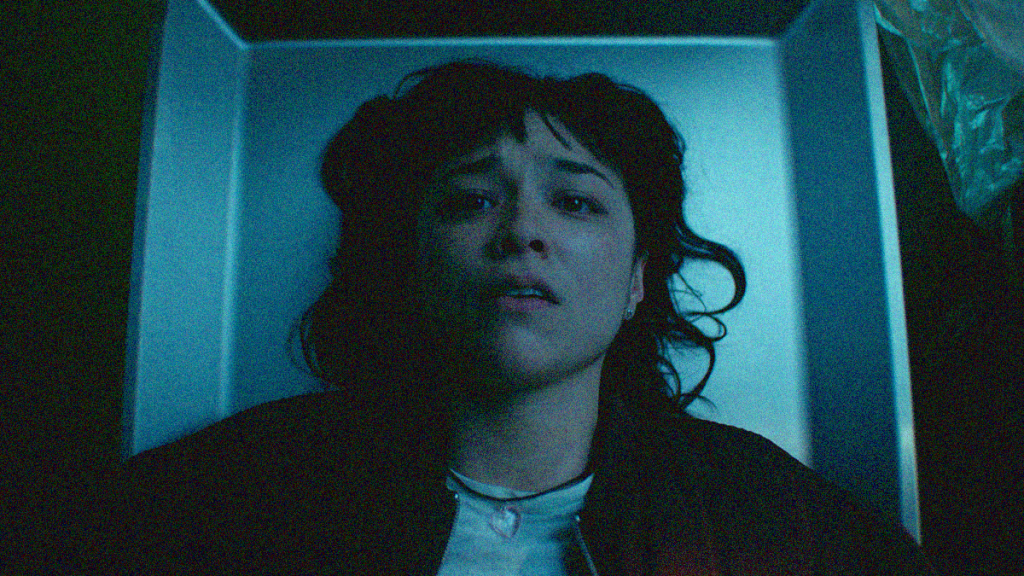
Midori Francis in SACCHARINE; courtesy of Independent Film Company.






Leave a Reply