
Rating: NR | Runtime: 96 minutes
Release Date: August 7th, 2026 (USA)
Studio: Magnolia Pictures
Director(s): Kent Jones
Writer(s): Samy Burch / Arthur Schnitzler (novella)
Sure, I knew them all.
You can never tell which way Kent Jones’ Late Fame is going to go. Adapted by Samy Burch from Arthur Schnitzler’s unpublished 1895 novella (which was ironically rediscovered itself), the film follows a former New York City poet named Ed Saxberger (Willem Dafoe) who’s lived a simple life as a postal worker these past thirty-odd years. Until, of course, the Silver Spoon-fed, self-important young Meyers (Edmund Donovan) plucks him out of obscurity.
It’s a heart-warming meeting that starts with Ed’s neighbor joking about him having an admirer patiently waiting across the street like it was prom night. Meyers’ enthusiasm about the work is genuine. Ed’s pride in learning his words still hold meaning is too. But that’s when a touching moment of mutual respect turns purposeful. Meyers refuses to take “No” for an answer when inviting Ed to dinner with his ragtag bunch of bygone intellectuals.
We cannot help but wonder what the angle is—both because of Burch’s writing and Jones’ direction to constantly show the expressive reactions of a cast that is obviously not as enamored as Meyers. But there’s also Meyers himself and his inability to stop needling Ed as though a literary agent blowing wind in his sails and making suggestions that tend to skew towards guilt tripping. And, finally, there’s Ed giving himself over to the adulation and possibilities.
So, where is the line? Who is using whom? It’s a question I kept trying to wrap my head around before coming to the realization that the answer is inconsequential. Why can’t they both be using each other? And who’s to say that doing so must be purposeful? Late Fame is less about exploitation than it is desire. Meyers yearns to be impressive and having Ed’s ear cultivates that reality. Ed yearns to tap back into his former artistic purpose, and these kids help him do exactly that.
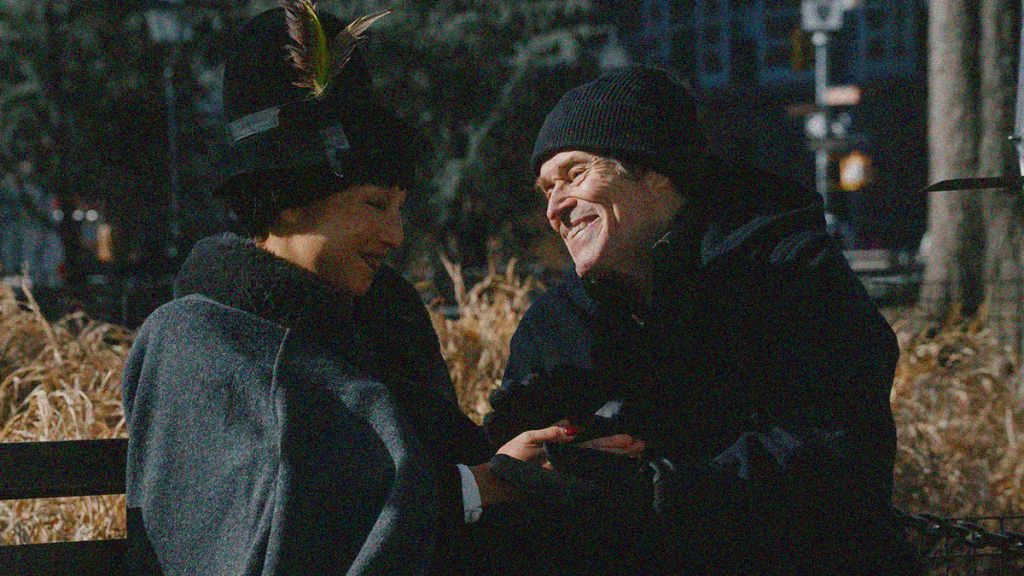
Add the life of Meyer’s collective’s party in their actress friend Gloria (Greta Lee) and the demarcation between reality and fantasy blurs even more. Because the difference between the men believing their feigned importance and her very conscious act is large. They don’t see it because doing so would dissolve their own image of themselves, but we do. Not just via her mask to escape troubles yet to be revealed, but also via the way she looks at Ed.
Their moments together could easily be dismissed as an extension of the act by her and the delusion of possibility for him, but it’s so much more complex than that. Because he doesn’t see her as an object like the others to parade around and provide value to themselves. He sees through the mask. He inquires about her involvement with them being that he knows she doesn’t come from their same affluent backgrounds. She knows he’d understand everything.
Ed has been there himself. That’s not to say he put on airs to exist amongst more famous contemporary poets during the 80s or that his current blue-collar ethos isn’t real either. No, he simply understands the difference between true interest and friendship and the allure of celebrity proximity. Back then, that art life was blue collar too insofar as everyone was broke and working simply to survive. Ed didn’t need to fake anything. He never changed. Only his career did.
So, we wait to see when the other shoe will drop. When he will finally have enough of these posers who spend their days calling other people posers as though they have a leg to stand on. I loved the tiny throwaway comment Ed makes when Meyers goes too hard into pretension at his apartment. His, “Yes, you’ve said that before.” is simultaneously an effortless means to change the subject and a scathing indictment of the artifice on display.
And yet Ed does much the same as Meyers in the very next scene when shutting down his actual friends because he’s begun to drink the Kool-Aid of his own misunderstood genius. The whole film is full of these mirrors to reveal just how fragile our egos are—even when we’ve lived an entire other lifetime since that ego actually meant something. Is it wrong to do what Meyers, Ed, and Gloria do throughout? No. Hypocritical? For sure. But that’s life.
The drama and comedy are therefore built from the contrasts. Gloria using “the boys” (rounded out by Luca Padovan, Arthur Langlie, Clay Singer, and others). Meyers using Ed’s name. Ed using their youthful energy. It’s all ultimately a means towards finding the confidence to try whether for the first time or last. To hear an outsider perspective about their work and souls. To realize praise and ridicule is noise once you’re able to find comfort in yourself.
That’s the real lesson here. Gloria needing to get out to give herself respite from the New York character she has cultivated to stay sane. Ed needing a reminder of why he couldn’t make it (his temper and stubbornness) and never wanted to try. Meyers and the group needing to discover their bubble is nothing more than an echo chamber if they aren’t willing to truly embrace critique and the sobering acknowledgement that they just might not be talented enough.
So, it comes down to where you go after those realizations. Do you just disappear because you can’t trust your friends to let go? Do you discover you never had any friends to begin with because you were all embroiled in a cycle of sycophancy? Or do you go back to the life that never cared about that nonsense anyway? Donovan and Lee expertly show the duality of artifice and vulnerability while Dafoe magnificently embodies the war between the safety of contentment and danger of joy.
Greta Lee and Willem Dafoe in LATE FAME, a Magnolia Pictures release. Photo courtesy of Magnolia Pictures.





Leave a Reply