
Rating: PG | Runtime: 105 minutes
Release Date: June 8th, 1984 (USA)
Studio: Columbia Pictures
Director(s): Ivan Reitman
Writer(s): Dan Aykroyd & Harold Ramis
Back off, man. I’m a scientist.
With all the recent talk about a third installment/reboot of the franchise, it’s not hard to forget how timeless the original Ghostbusters is. Rumors swirl and Bill Murray’s soundbites mislead almost monthly now, but you must only pop open your DVD case and let the magic crescendo of Ray Parker Jr.’s classic theme play to revisit the comical science fiction stylings of this paranormal-infused New York City. It’s even easier when Sony re-releases the film in select cities nationwide to counteract the present-day Halloween penchant for torture porn blood. Because for a guy like me—who could barely walk without falling on his toddler face over twenty-five years ago—catching one of the best comedies in cinematic history on the big screen surrounded by die-hard fans cannot be beat.
Conceived by Dan Aykroyd through multiple iterations after director Ivan Reitman helped hone the project’s budget, original co-star John Belushi passed away as the likes of John Candy and Eddie Murphy declined roles due to previous engagements. Ghostbusters was never supposed to be the semi-improvisational showcase for Murray we therefore assume. Putting heads together with co-writer Harold Ramis, the duo created something we rarely see anymore: a bona fide uniquely original work. Aykroyd’s own interest in the paranormal sowed the seed, but it was the character development of their team of misfits volunteering to ensnare and imprison ectoplasmic transients that truly makes the whole an astronomically successful combination of its eccentric parts. A trio of scientists strapping on unlicensed nuclear accelerators to chase after unexplained entities means they must also be insane with misguided hero-complexes to boot.
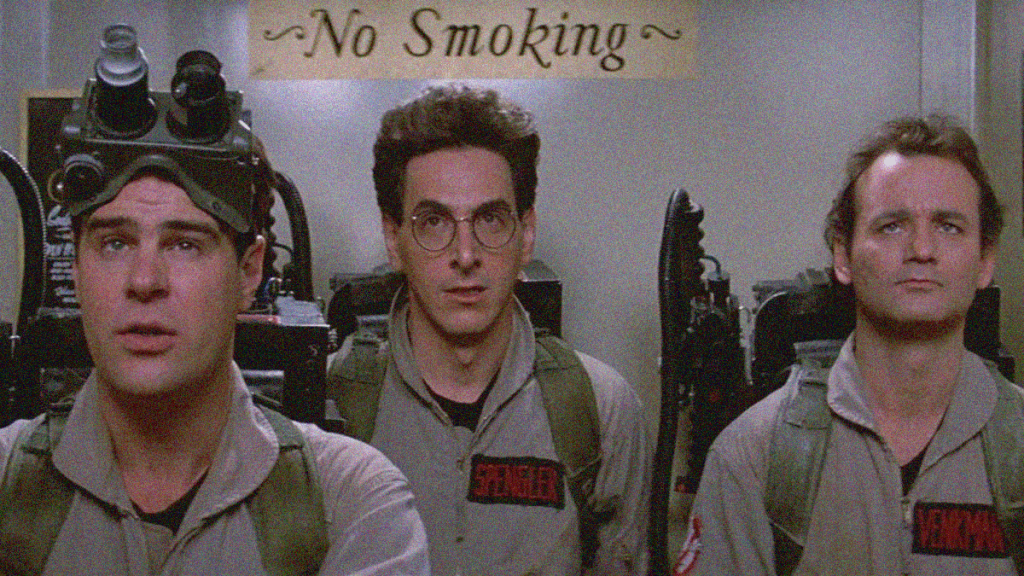
This motley crew consists of brains (Ramis’ Egon Spengler), enthusiasm (Aykroyd’s Ray Stantz), and charisma (Murray’s Peter Venkman). Each piece is crucial to the job and dynamic we learn to love early on. Aykroyd overflows with glee at the discovery of a ghost in their public library and Ramis is fully engaged in the scientific research and development of capturing it—both true believers beyond a doubt. Watching Murray con a couple Columbia University students in order to inflict pain on one and sleep with the other, however, allows us to discover a playful adoration for his antics. Venkman appears to merely tag along to coast through his professorial career without ever achieving results or using his degrees as more than an excuse to snidely make people he dislikes call him “Doctor.” But the game changes once he sees the damage wrought and slime left by the translucent apparition hovering between bookshelves. Stantz and Spengler see the possibility for real journalistic integrity and Venkman eyes the fame and multitude of potential perks.
What makes Ghostbusters still feel fresh over two decades later is its competent construction. Rather than a mish-mash of skits like one would expect to come out of “Saturday Night Live” performer-scribed work today, Aykroyd really outdid himself creating an entire world. He brings in the ancient Sumerian destroyer Gozer and its lackeys “The Gatekeeper” and “The Keymaster,” doesn’t shy from the political ramifications of storing highly volatile paranormal materials by letting the EPA put their hand into the mix, and he lets the charm of haunted hotels and houses become fodder for tamer creatures needing capture rather than make ghouls manifest via Spengler’s “giant Twinkie” prediction. I love the fact that their first real customer is a ritzy hotel whose owner acknowledges the fact that staff has always talked about the disturbances on floor twelve. What would eventually be named Slimer didn’t therefore just arrive out of the blue. He’d always been there wreaking havoc with his iconic brand of mischief.
But there does need to be a major event to raise the stakes and vault these man-children to heights above and beyond the public’s buzzworthy attention spans. The maleficent Gozer needs vessels with which to enter our world and a vehicle to harness its power. So, Aykroyd and Ramis turn a real life apartment complex into a tuning fork for the paranormal—a beacon for malicious energy to gather and possess two unsuspecting residents. For Dana Barrett (Sigourney Weaver) and Louis Tully (Rick Moranis), their daily dance of her fighting off his advances and his fantastic attempts to bolster an ego weighed down by a geek’s physique and droll tales of accounting victories is soon thrown into the fire of hellish dog-like beasts and a sexually-infused forum of world domination. Their characters align with the Sumerian legend as Egon and Ray do their best to discover how to save the city from Biblical destruction.
William Atherton’s smarmy pencil pusher Walter Peck helps expedite things with his bureaucratic shutdown of the Ghostbusters’ containment unit—the sheer magnitude of evil released becoming the catalyst for Gozer’s entry into New York. A lesser villain of the tale, Peck may also be its most crucial cog due to his character’s ability to naturally fit the puzzle despite the potential of being a horrible contrivance in service of the plot. But this is where Aykroyd is at his best. His ability to mask all the strings and give this implausible tale an air of authenticity. We accept the science as well as the supernatural elements because the script allows us to invest in the characters and their journey from crackpots to superheroes. Just as New Yorkers chant their names while Murray’s Venkman riles them up like a flashy wide receiver jumping into the stands for adulation after scoring the winning touchdown, the audience is caught in the fervor.
And all along the way are brilliant sight-gags (the art direction on Barrett’s apartment’s spiral staircase is superb), memorable one-liners (Murray is a bottomless wealth of them), and pitch-perfect comedic nuance (Ramis’ discomfort when their receptionist Janine (Annie Potts) turns up her sexy librarian vibe is hysterical. Laughs abound to temper the rather dark subject matter at its core via an odd couple camaraderie that’s been copied countless times. The starkly different personalities of Stantz, Spengler, and Venkman can’t be beat and the inclusion of Ernie Hudson’s blue collar convert Winston only brings one more disparate opinion for insight and comedy. Even the special effects work complements the action with impeccable creature design that culminates in the large-scale kaiju fight with the 100-foot tall Stay-Puft Marshmallow Man. In what should be the campiest bit of the bunch, this monstrous creature has its own personality and charm. Nothing in Ghostbusters is ever two-dimensional or arbitrary as the script and performances gel to form one the greatest comedies to ever grace the silver screen.

Nominee:
Visual Effects, Original Song
Dan Aykroyd, Harold Ramis, and Bill Murray in GHOSTBUSTERS.





Leave a Reply