
Rating: NR | Runtime: 86 minutes
Release Date: January 26th, 2011 (USA)
Studio: IFC Films
Director(s): Gregg Araki
Writer(s): Gregg Araki
Are you, like, gay or whatever too? Or, like, normal?
Using a soundtrack as the score to a generation’s penchant for drugs, sex, and enlightenment, Gregg Araki’s Kaboom portrays a college of liberated psyches running wild to the sounds of The Pains of Being Pure at Heart, Cut Copy, The xx, and Interpol. It’s a collection of music that can define the new century’s beginning—one ruled by a youth without borders, limitations, or fear.
But the songs don’t blare over the visuals. The characters don’t make blatant reference to them either (besides an Explosions in the Sky mention culminating in a birthday gift no one but a fan of the band will understand). They just exist as a backdrop to this trippy story of sexual creatures and the mysteriously chaotic apocalypse forewarned. Not until I heard Paul Banks’ voice emanating behind the dialogue did I realize how impressive the soundtrack was. How is it not available for purchase yet? Luckily the film is an intriguing enough journey to risk falling into its colors, orgasms, and noir to listen again.
Only knowing Araki through the fantastic Mysterious Skin, this new work is an interesting departure into a stylized world of artifice. The characters inhabiting it are all real enough, but, with glimpses of the weird and unexplainable above the simple fact each is exploring his or her sexuality for both teams, their appearances or preconceptions never deceive. After commencing with an odd dream on behalf of Smith (our guide into the insanity played by Thomas Dekker) about a long corridor leading towards a black door, important figures in his life along with two girls he’s yet to meet, the appearance of witchcraft, telepathy, and cryptic riddles shouldn’t surprise.
Smith is unceremoniously thrust down a rabbit hole orchestrated by powers he has yet to fathom let alone understand. As his stoned RA The Messiah (James Duval) humorously relays from another dream: the world is about to explode in a massive nuclear cleansing and both Smith and best friend Stella (Haley Bennett) will be there. Mushroom clouds of toxic energy loom as explosions of pleasure erupt in the present with Smith’s forthcoming nineteenth birthday and the nineteen on that black door proving an unavoidable marker for the end.
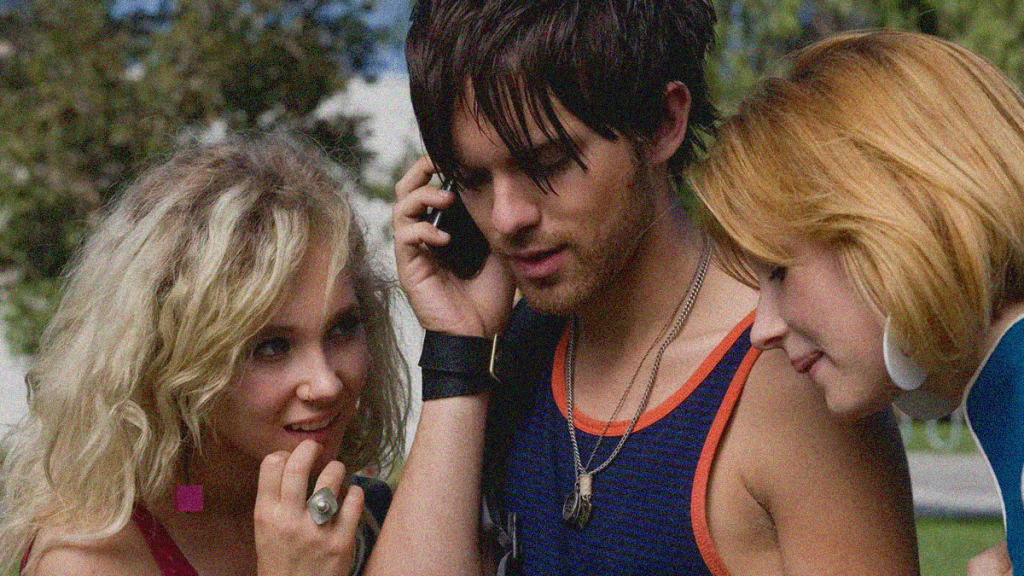
The visual style set forth will arouse your senses and put you in proximity with beings stuck in an intermission via a four year hiatus to screw around and make mistakes before life begins on the other side. Stella finds a lesbian soulmate of pleasure in Roxane Mesquida’s supernatural Lorelei. Smith pines over his surfer roommate Thor (Chris Zylka), desires the shy Oliver (Brennan Mejia) after crossing paths at a party, and finds a surprising connection with British enigma London (Juno Temple) and her utter candidness with the cathartic powers of sex.
It’s a fashion frenzy of hats, colors, and “beautiful people” existing to hook-up and attempt to finish school with a modicum of educational success. The use of high-style sarcasm in the witty banter and insults like, “Wow, next to putting a dick in your mouth with Lady Gaga playing in the background, that’s as gay as it gets,” as well as mind-altering effects work when Smith is under the influence or black magic is performed is very cheesy, but it’s somehow subverted by our absolute believability in the environment created. Besides bad Powerpoint-esque transitional wipes, the director’s hand welcomely enhances the story.
It fits, though, since that story does surround a young man who’s troubled trying to find something besides a yearning to make his sexual partners melt in his arms while becoming embroiled in a mystery that may or may not be playing out in the delusional landscape of his mind. After receiving a note with the words “You are the chosen son” printed on it, his every move begins to hold a chilling weight of lingering doom.
He witnesses a murder, is chased by an animal mask-wearing trio of thugs, and keeps seeing the face of a stern older man in his dreams—a man who appears to wield the power to be behind everything. And the detective work to solve this unknown thread of danger runs parallel to the usual clutter of an eighteen-year-old’s ups and downs. Friendships, casual encounters, and sexual trysts would normally hold more importance than they are worth to people with a lack of having truly lived enough to open one’s eyes to the more intellectual side of being, but here they are mixed with the occult and fantasy.
So, as the story unfolds, you begin to question which half of the tale is more important before later discovering that both exist in tandem thanks to stunning revelations uncovered while the line of absurdity being straddled is obliterated and replaced by Araki’s dark psychotropic trip. And that is Kaboom‘s greatest success: its fearlessness to go towards territory that risks turning off a majority of the population. Except I doubt mainstream society would give it a chance anyway once they read about its homosexuality, glorification of promiscuity, and recreational drug use.
Those are definitely traits targeting a specific demographic willing to put aside societal constraints and moral codes of decency for the chance to go inside an artistic mind’s tapestried pleasure center. The performances all seem to agree with each actor adding a tinge of parody to their roles to exist in the film’s not-so-real setting. But within that strangeness also lies a truth—a common ground anyone of college age at present or a decade removed can relate to. It’s a paranoia-induced emblem of a generation that sits nicely beside other such opuses like Richard Kelly’s Donnie Darko and Southland Tales.
Juno Temple, Thomas Dekker, and Haley Bennett in Greg Araki’s KABOOM. Photo by Marianne Williams. An IFC Films release. Courtesy of the Sundance Film Festival.





Leave a Reply