
Rating: R | Runtime: 104 minutes
Release Date: November 25th, 2005 (USA)
Studio: Laemmle/Zeller Films
Director(s): Debra Granik
Writer(s): Debra Granik & Richard Lieske
What do you think about these tiles?
I remember watching 15 Minutes back in 2001 and thinking Vera Farmiga’s captivating foreigner played quite well off Ed Burns and Robert De Niro. It wasn’t until five years later after a spate of high profile films leading to A-list status that I learned she was an American born in New Jersey. I therefore had no knowledge of independent film Down to the Bone either despite it proving to be a Sundance-winning piece for both her and director Debra Granik amongst a slew of other nominations on the festival circuit to assist her rapid ascent in Hollywood.
Yes, there are many films dealing with drugs and addiction that mostly utilize stylistic artistry in their depiction of the kinetic/slomotion roller coasters associated with the habit. Few, however, allow themselves to delve into an addict’s upside down world for an up-close-and-personal view. Requiem for a Dream melds the two schools. Trainspotting shows how style can excel on its own. And a film like Rachel Getting Married subtly infuses the blanket affect addiction has on a life. Granik’s debut goes for the vérité angle by utilizing Farmiga’s performance to paint the depths we must plummet before beginning to lift ourselves up.
It all started seven years prior with short film Snake Feed, directed and co-written by Granik. I haven’t seen it, but the inclusion of the titular reptile in Down to the Bone shows how the metaphor ported over into the feature version as Farmiga’s Irene allows the Devil that is cocaine to overtake her entire existence. Working a dead-end job as a supermarket cashier, she comes home to two young boys and a husband trying to stop her habit by using their money to remodel the house … and buy pot. She therefore looks for any opportunity to hide and snort whatever she can.
But the bottom comes quickly once the Halloween season brings her to a point of no drugs and no money to acquire more. After cutting her coke straw to lick whatever granules stuck to its inside, Irene knocks on her supplier’s door late one night despite being denied an ‘advance’ earlier—this time with her son’s birthday check. Kudos to the drug dealer for refusing to let her become the type of person who hocks her child’s happiness for her own escape. All the kid wanted was a pet snake and she nixed the idea due to the costs of tanks and heat lamps before leaving the pet shop to score more powder he waited in the car.
The whole endeavor of living with the drug controlling your every move is like a snake’s dinner. Helpless to get up, the addiction pounces before coiling itself around you to suffocate any attempts at stopping it while your breathing slows and quiet floods. No matter how gentle the beast proves by never biting its handler and pulling away when flesh is placed at its mouth, a snake will never pass up an opportunity for a kill. And that’s why kicking the habit is so hard. Irene has tried and failed before.
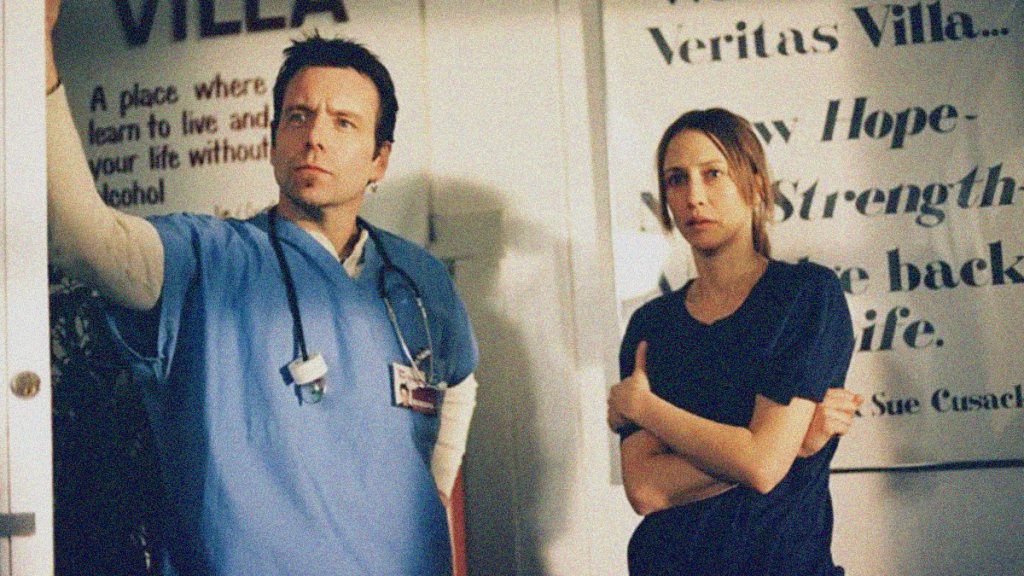
This time is supposed to be different. She says she’s doing it for the kids, but it’s really for herself. She’s no longer able to live with the fact cocaine has overtaken all other aspects of her life. Change begins with rehab—even if only for a week due to still needing a paycheck. And Hugh Dillon’s Bob makes things easier after befriending her as both the nurse on duty and a reformed addict himself. He lends his services as a helpful hand, but one’s own strength is all you can truly count on. Because cooking Thanksgiving dinner for friends and family only distracts you so much when a dealer at the door sells to a guest who then cuts it on the table with her husband Steve (Clint Jordan).
Granik has an eye and feel for letting her actors run with the material. Jordan is great as the caring husband with his own unsavory addictions, albeit tamer in comparison. Dillon excels as the recovered junkie unable to stay sober once a woman enters his life to stimulate his libido. How can he enjoy her completely without taking a ride on the H-train again? But the film really revolves around Farmiga’s portrayal of Irene during the good times, bad, and all those ups and downs in-between.
She’s an attractive woman with two well-behaved boys who know they’re seeing their mother gradually disappear. Each injection of drugs (whether coke, her boys’ happiness, or sexual arousal from Dillon) takes control, inhabiting her every expression, movement, and sound. Even those blank stares and short temper with the litany of grocery customers resonates with complete authenticity because we’re watching her wither away. No matter how much love is at home, though, Steve won’t stop his own drug use. No matter how great life is with Bob, his ability to lie and watch her slip can’t be forgotten. Irene must save herself.
Obviously shot on the cheap, most of the action is hand-held and captured close-up. Down to the Bone becomes an edited together mix of moments full of emotion. Shots linger on faces of heartbreak and defeat until you believe these actors are caught up in this world, living day-by-day in the full knowledge that the next could be their last. It becomes a question of what will make you stop? When will the stakes get too high to roll the dice again?
Knowing Granik used many Ozarks locals for her sophomore gem Winter’s Bone, it wouldn’t surprise me to learn the Narcotics Anonymous members here are real addicts. Their actions and mannerisms speak volumes about the crushing weight of addiction and Farmiga squeezes right in as if she’s been a user her entire life while Granik films everything. While it doesn’t provide easy answers or even hint at whether Irene’s strides might work, it does tell one woman’s journey to Hell and back with the hope born from kindred spirits who understand exactly what she’s experiencing. While rehabilitation may be up to you, the path there doesn’t need to be a lonely one.
Hugh Dillon as Bob and Vera Farmiga as Irene in DOWN TO THE BONE.






Leave a Reply