
Rating: R | Runtime: 92 minutes
Release Date: February 1st, 1977 (Italy) / August 12th, 1977 (USA)
Studio: Produzioni Atlas Consorziate / International Classics
Director(s): Dario Argento
Writer(s): Dario Argento & Daria Nicolodi / Thomas De Quincey (essay Suspiria de Profundis)
You have just watched Suspiria.
One of the characters sums up Suspiria quite concisely at the start of the film. She says “It’s all so absurd, so fantastic” and I can’t think of a better way to begin describing it. Sure the gore factor is fake and overkill, the horrible dub job is laughable, and the story is a jumbled mess that gets loosely tied together by a witch subplot with fifteen minutes left, but there’s a lot to like regardless.
The absurdity works by creating a dreamlike state and journey through an otherworldly German dance school. Its fantastical elements allow us to become absorbed in its lush settings and help to forget the overall incoherence. The cinematography is quite stunning at times and the use of color and light is magnificent. Add a killer synth soundtrack from Goblin and you have some very unsettling stuff. Can one appreciate a film for its artistic merits despite its crude script and performances? I say yes.
With a plot concerning an American girl arriving in Germany to be educated at a prestigious dance academy only to find money-hungry women and grisly murders, you can expect over-the-top craziness. When the darkness between two Greek-inspired monuments can cause a dog to bite a man’s jugular and a girl can jump out a window in hopes of safety before falling into a pit of barbed wire: there are no rules.
Writer/director Dario Argento seems to use his fantasy theme as an excuse to show he can creatively kill characters without being held realistically responsible. The occult plays a huge role and all the weird deaths are easily linked together as events caused by an evil force emanating from the coven of witches that occupy and run the school. Dark magic has no bounds and it will inhabit whatever necessary to inflict the desired action. Whether the wind, a yellow-eyed snake creature outside a window, an otherwise benign seeing eye dog, or one’s own body, anything can become a vehicle for homicide.
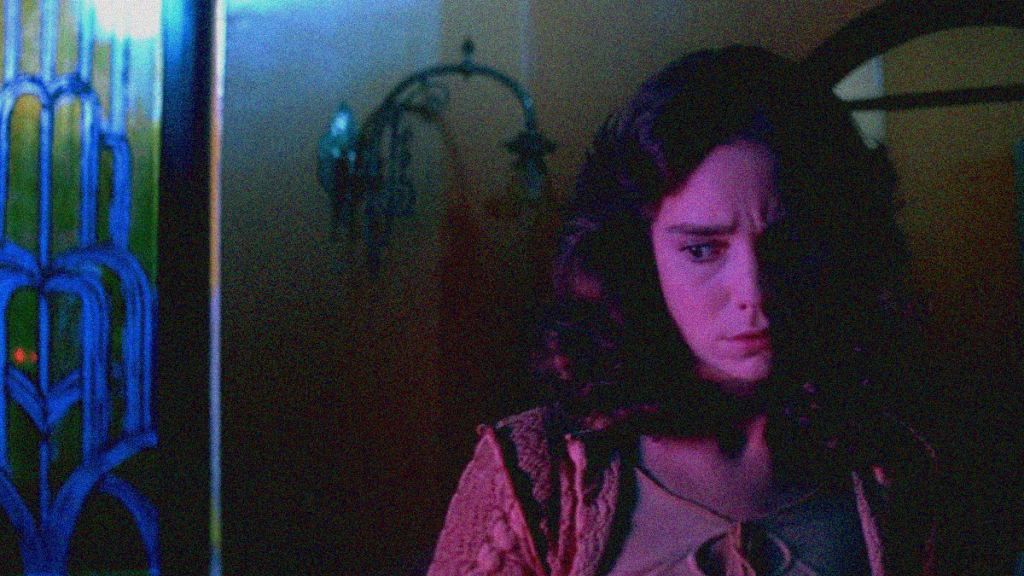
The end of the film delves into the nightmare/dream state set forth from the start that reminded me a lot of “Twin Peaks” and Lynch’s Black Lodge with the Red Room. Every architectural setting utilized seems to be a labyrinthine puzzle box to explore. Our lead Suzy (Jessica Harper) eventually finds herself searching through the passageways and hallways to finally get some answers about what’s happening around her. Turn the purple iris, open the door that holds the living dead, count the footsteps of the instructors to gauge where they’re going—Suzy sets her mind to this quest without fail. Unafraid to talk back to the headmistress about wanting to live off-site and praised for her strength by the militant Miss Tanner (Alida Valli), she won’t be stopped or scared away from finding the truth.
Played with just the right mix of naïveté and power, Harper does an admirable job holding the film up. Her Suzy is caught in the middle of a struggle against dissenters at the school. No one can just leave because glimpsing the truth of this place means they already know too much. So, she’s drugged nightly and manipulated into staying, constantly experiencing the death and disappearance of those around her. Effective as the innocent waif, she also makes her horror movie cliché actions appear thought out and plausible due to curiosity rather than stupidity and plot progression like other genre work. She opens a door because she wants to, not because that’s what’s expected.
The rest of the acting is effective, but the performances that stick out are unfortunately because of their horrible over-dubbing. Udo Kier—Mr. Thick German Accent himself—is dubbed over with flawless speech devoid of any accent. You could tell me that it’s actually him dubbing his own lines, but I wouldn’t believe you. And then there’s Rudolf Schündler as his professor colleague. His words are so off track from his mouth movements that I wouldn’t be surprised if he was speaking German on set. I guess it’s all part of the charm and cult quality people have come to love.
Despite all that, though, I must praise its artistic merits. The set designs are sumptuously ornate—each room painted with a unique pattern and bright, bold colors. Whether an organic flowery motif or geometrically sharp angles, the camera tends to always settle for a brief moment to show off the artistry. The apartment building that becomes the setting for our first murder is gaudy to perfection with its symmetrical design and colored overhead window—even the shards of glass sticking out from a woman’s body have a sense of beauty to them. But it’s the use of light that truly warrants accolade. Red is very prevalent with its obvious connotation to blood and the lights and shadows complement it to help set the mood against the loudly jarring soundtrack.
Composition is carefully planned to treat us with some stunning visuals via close-up. The long depth of focus shots are my favorite whether one of a maid and the headmistress’ nephew shrouded in bright light reflected from a knife or the view of the entranceway as we await Miss Tanner to walk through and storm into the rehearsal room. But nothing compares to the very first sequence. Commencing with Suzy in white against the crowd’s sea of red, her approach to the exit is set to the overpowering score as the camera moves sharply to her face before a foreboding cut back to the door opening exposes the storm brewing outside. All the safety and security of her once simple life is about to be subjected to the tempest that will threaten to consume her.
Jessica Harper in SUSPIRIA.





Leave a comment