
Rating: PG-13 | Runtime: 96 minutes
Release Date: June 27th, 2007 (France) / December 25th, 2007 (USA)
Studio: Diaphana Distribution / Sony Pictures Classics
Director(s): Vincent Paronnaud & Marjane Satrapi
Writer(s): Vincent Paronnaud / Marjane Satrapi (comic)
ABBA is for wimps.
France’s official entry for foreign film at the Oscars this year is the animated feature Persepolis. This intrigues me for many reasons. One: it’s almost destined to get an animated nod, regardless. Two: it’s a story about Iran from an Iranian who was taken in by France during her 20’s. And third: the wonderful The Diving Bell and the Butterfly had a real shot at winning the award, let alone just earning a nomination (even if it was directed by an American).
By no means is this film unworthy of the praise or accolades, though. It’s extremely well done. And that’s coming from someone for whom this isn’t usually the type of film I normally seek out due to its almost documentary-like biographical and historical nature. Strictly as a visual piece, one can’t complain about its success. As a piece of history portraying the pain and horror that went on in this Persian country, it’s quite shocking and informative.
Despite multiple sequences that prove as powerful as any I’ve seen all year, it’s all delivered through the naïve immaturity of a young girl dealing with adolescent relationships and an unavoidable depression. The weight of what’s happening on a global level is so strong as a story thread that the “little” things in her life can take you out of the movie if you aren’t ready to appreciate that lens.
Marjane Satrapi lived a very interesting life. Her family included many important members in Iran whether a Prince, numerous revolutionaries, imprisoned and killed Communists, and two strong-willed parents fighting the good fight while maintaining the balance necessary to keep them alive. The film is a very personal piece of work that follows her life from childhood to her mid-20’s as this precocious youngster wishing to be the last prophet of the world becomes a cynically jaded survivor of physical and emotional strife.
Her outspoken demeanor leads to some tense moments that almost seem to be diffused too easily when put in context with the bigger picture. In a country that proves so repressive against women, it’s surprising that so many men allow her to say what she does before cowering in embarrassment. It’s a miracle she survived long enough to turn twenty with the way Iran is portrayed. And it shows how much of the patriarchy is ruled by insecurity.
As a fictional remembrance, liberties were surely taken. Much like American Splendor a few years back, Persepolis is based off a series of autobiographical comics created by Satrapi. In that regard, the tale is infused with comedy and fantasy throughout to help maintain interest while countering the heavy subject matter at its center.
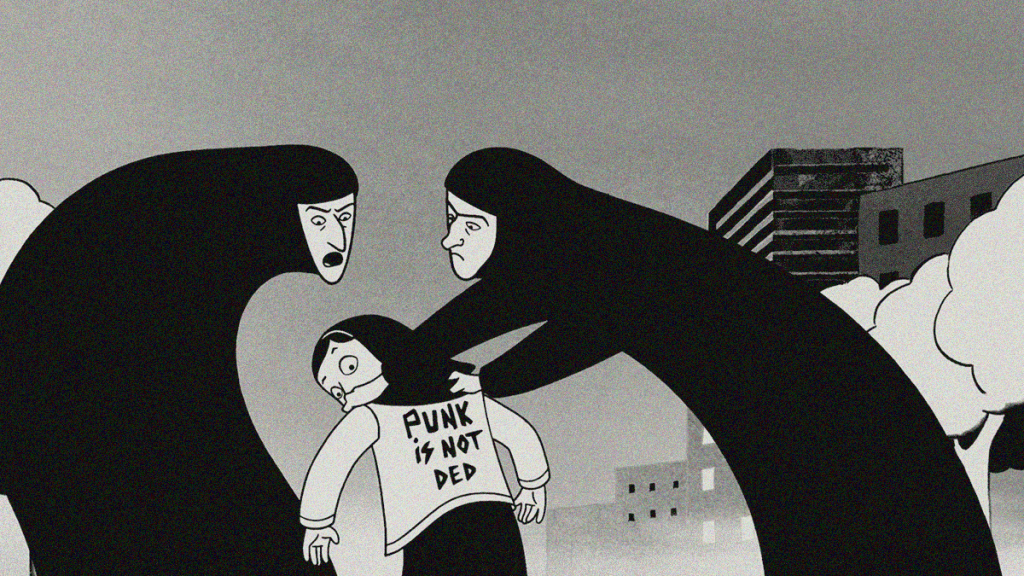
So much of this humor works perfectly. The figure study model posing under a cloak. The “Punk is Ded” jacket. Early Bruce Lee moves leading her to kick another youngster in the head at a party. There are a few times where it can be somewhat cringe-inducing too, though (see the hokey “Eye of the Tiger” montage). Marjane’s vocal outbursts to put people in positions of power in their place help shape her character and show how someone can fight back against a country that gave up on its people without resorting to physical violence.
The animation is often breathtaking. Using color to delineate between the present Marjane and her story’s black and white counterpart is well utilized, but the movie truly succeeds in its heavy/dark moments. The stark contrast of the monochrome really brings weight to the proceedings with somber music overlaid on moments of battle and oppression. Many events will stay with you well after the film has finished.
The initial siege after the fall of the Shah is fantastic with its black, silhouetted soldiers combining into a massive blob that advances on innocent civilians. Atmosphere is added with smoke and fog too via a nice depth of field trick that’s completely two-dimensional with overlapping layers showing the space between. My favorite part, though, is a rooftop chase after an illegal party is broken up by the Guardians. We watch the pursuit right until its inevitable conclusion in almost complete silence—it’s heartbreaking.
Give Satrapi full credit for having the fortitude to not only survive this life at such a young age, but also to tell the world about it. I’m sure her stories have served as a catharsis for herself as well as others in exile (especially after seeing her Uncle Anoush tell his tales of persecution so the family’s story can be known forever). She seems to have taken everything very seriously and put it upon herself to not let those who’ve suffered and died be in vain.
Always strong-willed and unafraid to speak her mind, she becomes a true revolutionary. Learning from experience and the many mistakes made along the way, Marjane grew up fast without ever forgetting her heritage or home. Even years later since the last time she stepped foot on Persian soil, she still answers a cabbie asking where she’s coming from with “Iran.”

Nominee:
Animated Feature
Marjane with two guardians of the revolution. Illustration from PERSEPOLIS by Marjane Satrapi and Vincent Paronnaud; courtesy of Sony Pictures Classics Inc. © 2007/ 2.4.7. Films. All Rights Reserved.





Leave a Reply