
Rating: NR | Runtime: 82 minutes
Release Date: June 19th, 2026 (Poland) / October 23rd, 2026 (USA)
Studio: Kino Swiat / MUBI
Director(s): Paweł Pawlikowski
Writer(s): Paweł Pawlikowski & Henk Handloegten
He’s been writing his farewell note for years.
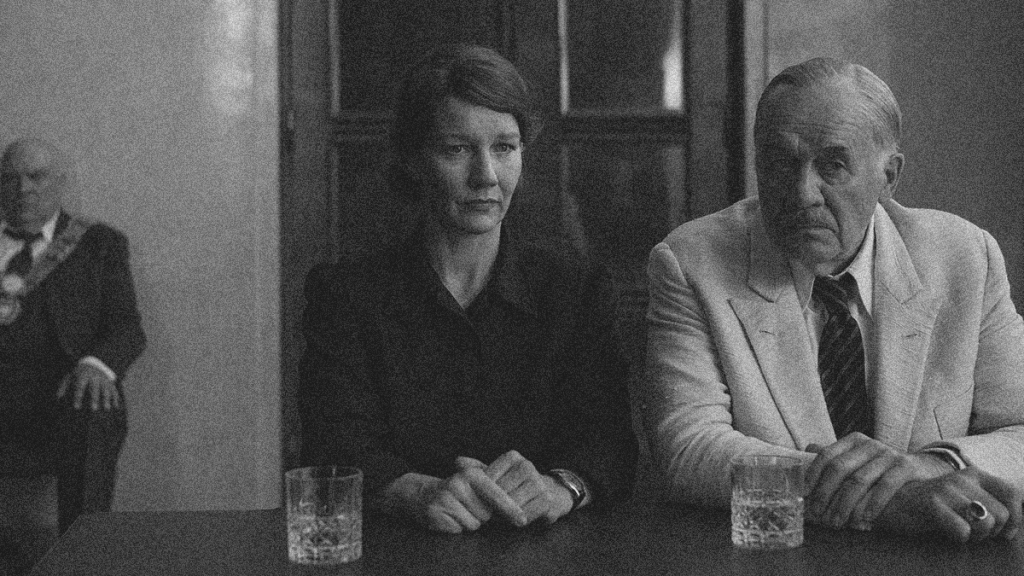
There’s a scene in Paweł Pawlikowski’s Fatherland where Thomas Mann (Hanns Zischler) politely listens to Richard Wagner’s grandsons as they proposition him for support before quietly eviscerating them and bidding them farewell with a smile that will live in my mind forever. Couple it with Erika Mann (Sandra Hüller) enduring an unexpected reunion with her ex-husband Gründgens right after and you can see why Pawlikowski was drawn to this specific moment.
Because he was approached to adapt Colm Tóibín’s biography of the Nobel Prize-winning writer and declined before enlisting Henk Handloegten’s help to flesh out a fictionalized version of this one event within. Its complexities are hard to ignore considering what Germany was post-WWII. The idea that accepting a Gothe award in one part meant accepting it in both. The reality that the country that exiled him suddenly hoped to fete him as an icon.
There’s the political dance of playing that role while instilling some of his hope for the future. Mann is depicted here as an optimist who truly believes his words via these speeches can change minds and spark a rebirth. It’s in stark contrast to his daughter Erika whose pragmatic realism sees it as little more than a charade. Is reality somewhere in the middle? Of course, but that push and pull allows for some excellent juxtapositions leading to unforgettable drama.
It’s all augmented by a familial tragedy looming large above the proceedings with Thomas resolved to keep going regardless. There’s the emotional cost of his decision where it concerns Erika reconciling her devastation with her duty to continue chaperoning him across Germany in their Buick, but also the thematic through line of broken people to a broken nation—each trying to put themself back together in a way that moves them forward without ignoring the past.
That’s why that aforementioned scene is so great. It truly distills everything from their love of their homeland to their hatred of what it became to the justified skepticism towards what comes next. One cannot answer a simple question about “home” when that place was corrupted to the point of needing to find another. And when that corruption is as vile as the Holocaust, you cannot pretend there aren’t any scars. That those who stayed wouldn’t let it happen again.
So, even though Klaus Mann (August Diehl) receives far less screen time than his father and sister, his inclusion is crucial to the whole as the third leg of this unit being forced to confront what Germany is now. Thomas might not be willing to be on the ground to rebuild what was lost, but he does believe it possible. Erika might be cynical about that potential, but she doesn’t feel the need to be invested in it. Klaus, however, cannot cope. Hitler stole Germany from his identity.
Pawlikowski is therefore using this family as a conduit to speak about the war rather than the other way around. What they’re going through in this moment on a national and personal level is as much about the narrative on-screen as it is a metaphor for what so many went through in the aftermath. It’s about legacy and shame. It’s about pride and vitriol. And it’s about the privilege of choice—to have been able to leave in the first place and to bear the pain of returning.
With gorgeous black and white, full-frame cinematography by Łukasz Żal once again, this might be my favorite of Pawlikowski’s recent trio of acclaimed dramas about life post-war. It has a breeziness about it that allows for laughs even as the subject matter finds itself wading through sorrowful waters of grief and introspection. Thomas and Erika have a mission to fulfill and thus are very rarely not shown holding back their anguish to keep soldiering on.
Hüller is allowed a cathartic outburst towards a fitting target, but she’s at her best when Erika must quietly escape the moment. Zischler is at his when responding to those escapes via a realization that his brave face has a cost. That the work he’s putting into this trip might be better served on his family. Only when it’s done can they both finally lament what’s been lost and never coming back as Bach is played on a church organ … one last symbol serving a dual purpose.

Sandra Hüller and Hanns Zischler in FATHERLAND; photo by Agata Grzybowska, courtesy of MUBI.




Leave a Reply