
Rating: PG-13 | Runtime: 100 minutes
Release Date: October 16th, 2026 (USA)
Studio: Neon
Director(s): David Greaves
Writer(s): William Greaves (conceived and filmed by)
You’ll never put a hand in a pocket on me.
A scene towards the end of Once Upon a Time in Harlem sees Ida Mae Cooper, widow of poet Countee Cullen (who earlier chastised this collection of Harlem Renaissance figures at Duke Ellington’s home in 1972 for not mentioning his name yet), stands to thank William Greaves for collecting them to document their memories and insight on a crucial moment of Black American history. I wonder whether Greaves would have kept it in had he finished the film.
That wry uncertainty is this project’s most significant moment for me because it exposes the fact that, despite orchestrating the event and conceiving its purpose, this result isn’t exactly what William sought to accomplish. While not in a literal sense, however, it does in an artistically thematic one since that scene actually epitomizes his goal … just a generation later. Its inclusion is David Greaves placing his father’s legacy onto the same pedestal he had placed his guests.
Since they (Aaron Douglas, Arna Bontemps, Richard Bruce Nugent, George Schuyler, Noble Sissle, Leigh Whipper, John Henrik Clarke, Nathan Huggins, Ted Poston, Regina Andrews, Jean Blackwell Hutson, James Van Der Zee, and others) speak about hindsight, “now” sight, and foresight, it makes sense to draw that line further forty years removed from filming and ten from William’s death. Because David was there too. In his eyes, his dad was always one of them.
So, we’re watching through multiple filters. The first-person accounts recorded. William’s coaxing both when the group is seated by a fireplace and when he gets them on camera individually in a side room. And David’s fresh perspective on the whole that’s as dependent on his own thoughts as the notes his father left behind and his stepmother Louise’s dedication to seeing her husband’s “most important film” completed. It’s as much an education as a labor of love.
Who better to discuss the 1920s in Harlem than the ones who lived, worked, and embodied it? It’s an absolute joy to listen as they reminiscence about each other and those no longer alive. It’s fun to see a few of them speak about others in the room by name as though they aren’t there. And how can you not savor the very animated expressions of Douglas, Cooper, and Nugent when something is said that strikes a chord? The latter can’t help interrupting everyone too.
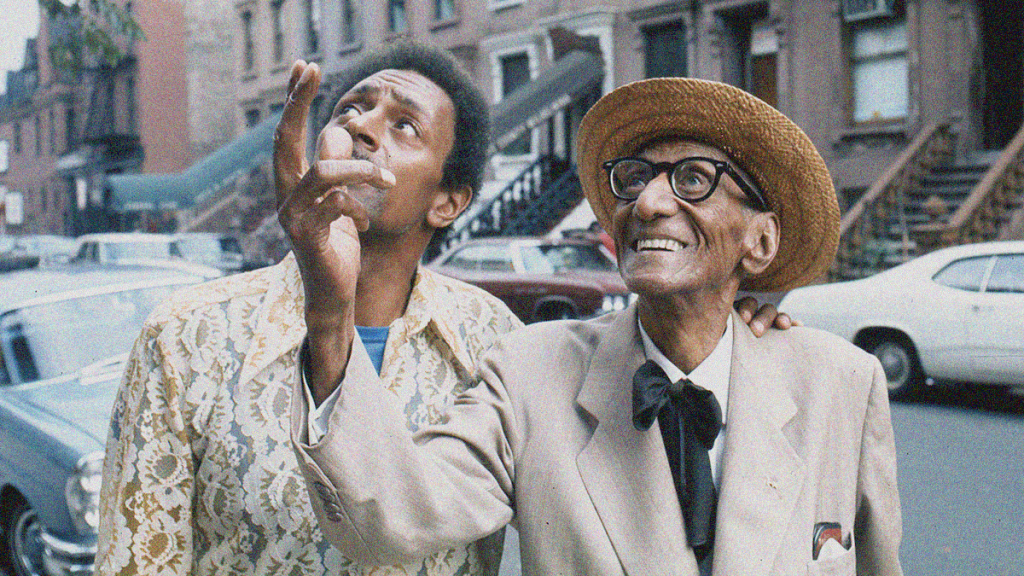
They talk about their personal origins (Whipper is ninety-six and still reciting monologues and poems from memory with the gravitas only an actor of his stature could), the movement, the art, and the politics. For every anecdotal tale comes an exploration of process (Douglas coming into his African-inspired art style). Every “attack” is met with a passionate rebuttal. And nothing gets them all going more than the topic of Marcus Mosiah Garvey.
Shot on 16mm via multiple cameras that surely captured hours of footage between all the rooms of Ellington’s home despite unfolding in one afternoon, I would have been just as engrossed at triple the runtime. I think Greaves’ decision to leave in quick glimpses of the filmmakers working (clapping hands to sync sound or testing microphones) helps because it reminds us how candidly unscripted everything is. This isn’t a lecture. It’s a literal party.
So, we float through the space courtesy of Greaves’ camera choices (sometimes paired in a split screen to show real-time responses or to crosscut between the full group and a solo session when pertinent information on a topic is split). It’s like we’re inside a Robert Altman film wherein everyone must be on at all times because no one knows where the focus might pull next. Add inserts of archival photos, artwork, and poetry reads and it’s impossible to disengage.
Especially because their views are not all the same. Nugent agreeing with someone on their larger point but not their specific one or an argument about the usage of “Negro,” Black, or Afro-American as adjectives when artist will suffice. Some are modest to a fault. Some show pride in their talents. Some refuse to apologize for their greatness. And all of them are putting crucial context on film to ensure no one gets their trauma, motives, or achievements wrong.
Leigh Whipper in ONCE UPON A TIME IN HARLEM; courtesy of NEON.





Leave a Reply