
Rating: NR | Runtime: 85 minutes
Release Date: October 5th, 2026 (USA)
Studio: Independent Lens / PBS
Director(s): Nick Beaulieu
Writer(s): Nick Beaulieu
A shared experience. That’s what really changes the world.
Nick Beaulieu’s goal with My Omaha was to capture the sense of his hometown being a “tale of two cities.” The one that speaks in large terms about community and safety and the one that proves to be the deadliest place for its Black population in America. The reason for this divide is obvious: segregation. The political arm spouting off about the former does so from a position of white privilege. The world of the latter exists precisely because of the former.
That’s the answer. That’s what Nick discovers about that topic. Sure, it’s exactly what drove him to tackle the subject in the first place, but that doesn’t mean the journey isn’t worthwhile. What it means is that the film doesn’t end up being about Omaha. It becomes about him. How he engages with his city. How he takes it upon himself to recognize that he sees it through the eyes of white privilege and empathize with the fact his Black neighbors can’t. How he hopes for better.
Nick explains his moment of “radicalization” away from the very Christian conservative republican filter he grew up under courtesy of his father Randy was the documentary A Time for Burning directed by Bill Jersey and Barbara Connell. It exposed him to the reality that solving racism isn’t the responsibility of those being persecuted. It’s up to people like Nick to educate the oppressors and reveal the strings guiding them to commit such atrocities.
So, between that movie, a series of meetings about the concept at a local Methodist church, and one of Nick’s own subjects, Malcolm X Center lead organizer Leo Louis II, the filmmaker decides to try and put this duty into practice. Because one of those minds in need of this exact education is Randy—the epitome of the hypocrisy inherent to every Trump supporter who still calls themselves a practicing Christian.
The result is a fascinating look at what it means to have the type of “shared experience” Leo believes is crucial to creating any meaningful change. Are answers to Omaha’s systemic racism found? On the contrary, we actually see how that hate remains alive and thriving during the course of the film. Does Nick reach his father in a way that deprograms him from the propaganda he has allowed to rule his life rather than acknowledge his privilege? That’s a no too.
Don’t go in expecting an education or proof that a “colorblind” world is on the horizon for anyone alive today to experience themselves sometime in the future. This is an essay film about a young man desperate to connect with a father who (in not so many words) began to resent him for making him feel he was a bad parent because he couldn’t open his eyes to “the truth.” The message is then less about understanding than acceptance.
I won’t lie. It’s a tricky revelation. One I’ve learned to live with myself having a staunchly tribalistic republican father (albeit without the religious aspect that makes Nick’s situation a lot messier). Sure, I poke back when he parrots asinine talking points from Fox News, but we mostly steer clear of politics altogether to maintain some semblance of decorum. And that’s ultimately where Nick and Randy end up too. Unfortunately, choosing to ignore it is also about privilege.
The success of My Omaha isn’t therefore the result of its tough conversations, but that they are being had at all. So, I do find the ending less an epiphany than a feature of the central issue. This idea that Randy, despite all his heinous verbiage online and refusal to admit we don’t all come to the “American Dream” from equal starting spots, is still a good man who helped someone in need actually makes it worse by showing he willfully chooses not to do so with others.
It reveals the very real disconnect between how someone acts with people they personally know and how they act with everyone else. It comes back to one interviewee’s blunt sentiments to the effect of: How is the Black part of town worse than the white part when the former welcomed Nick with open arms and latter reaches for a phone to call the cops when he steps foot in it? Nick vs. Randy isn’t the same as West Omaha vs. North.
While this makes the connection flimsy insofar as holding the film’s parallel narrative arcs together, however, it does show that progress being slow is better than progress that never begins. That Randy agrees to be filmed and have these tough conversations (even if they gradually thaw after his cancer diagnosis) is a victory. It doesn’t change his views, but the act itself rehumanizes Nick in his eyes from “liberal demon” to “confused son.” It creates a bridge.
The propaganda disseminated by Fox News and Twitter, etc. is most effective on those for whom its topics exist outside their vantage. Nick chose to meet the people he’s been told to fear and discovered they weren’t scary. Ghost felt Randy’s compassion because he entered into Randy’s space. We need the Randys of the world to stop watching editorialists with a fiduciary stake in hate and meet new people who don’t look like them. It’s the only way to see through the lies.

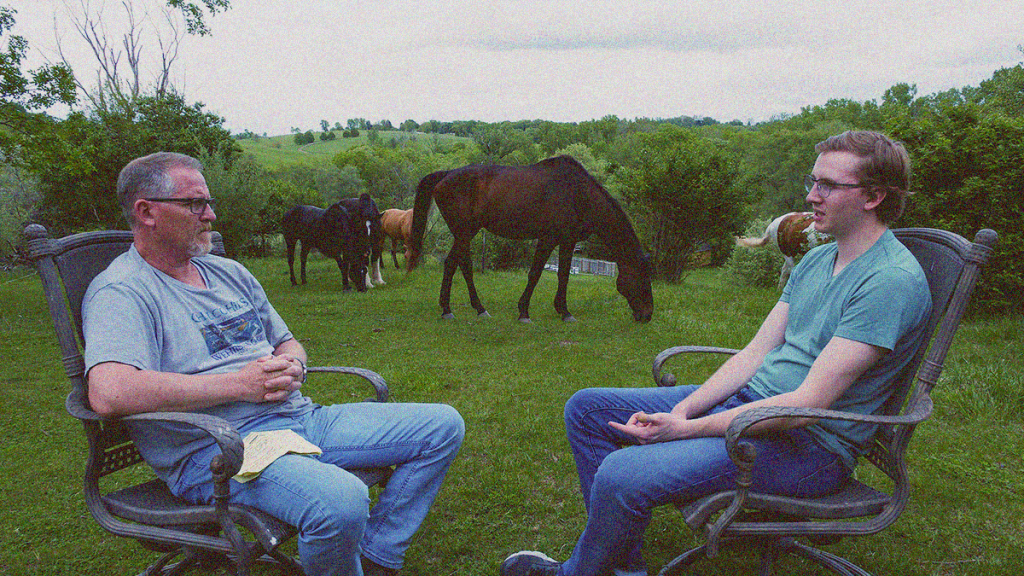
Randy Beaulieu and Nick Beaulieu in MY OMAHA.



Leave a Reply