
Rating: NR | Runtime: 111 minutes
Release Date: June 26th, 2026 (USA)
Studio: Dark Sky Films
Director(s): Avalon Fast
Writer(s): Avalon Fast
Maybe it’s time to go home.
The opening credits reveal tragedy as a teenage Emily (Zola Grimmer) drives down a darkened country road only to hit and kill a young girl who ran into traffic chasing a soccer ball. It’s a reality she’s had to come to grips with over the years since, and, in a show honesty, is the story she tells a bunch of strangers at a college party during a game of Truth or Dare: “What’s your biggest regret?” The clarity and confidence in relaying this fact proves she’s come out the other end.
So, writer/director Avalon Fast delivers another dagger to Emily’s heart by forcing her to endure yet another bleak moment of horrific nightmare via watching another soul get lost as a result of her actions—even if neither death was actually her fault. But that distinction hardly provides her any solace since it won’t bring them back or relieve her pain. It’s simply what others try to remind her when the suffering becomes unbearable.
Faced with needing to restart her life again after moving back home to avoid the stares of those who know what happened back at school, Emily’s dad (Michael Tan) suggests she take a job as a camp counselor in the mountains of Alberta to both get away from the places marred by these tragedies and work through the guilt. It’s a place for troubled youth that she can hopefully see herself in to help as someone who understands their pain while also rebalancing the scales.
This journey is thus meant to be as cathartic for Emily as the film is for Fast. They’ve delivered one of the most esoteric director’s statements I’ve read, deflecting from what they were trying to say with Camp by presenting the film itself as their statement. That this script was inspired by a story they used to tell all the time about a wound that would not heal. That the finished product has supplied a means to begin that process through the act of watching others experience it.
The sentiment couldn’t be more perfect considering how abstract and dream-like things get during the back half. Sure, maybe what occurs is exactly what you think would: Emily meets a cohort of like-minded young women dealing with their own troubles (they all attended the camp before becoming its counselors) who take her under wing to introduce a force of power and evil in the forest. Or maybe that power is less about malice than it is about escape.
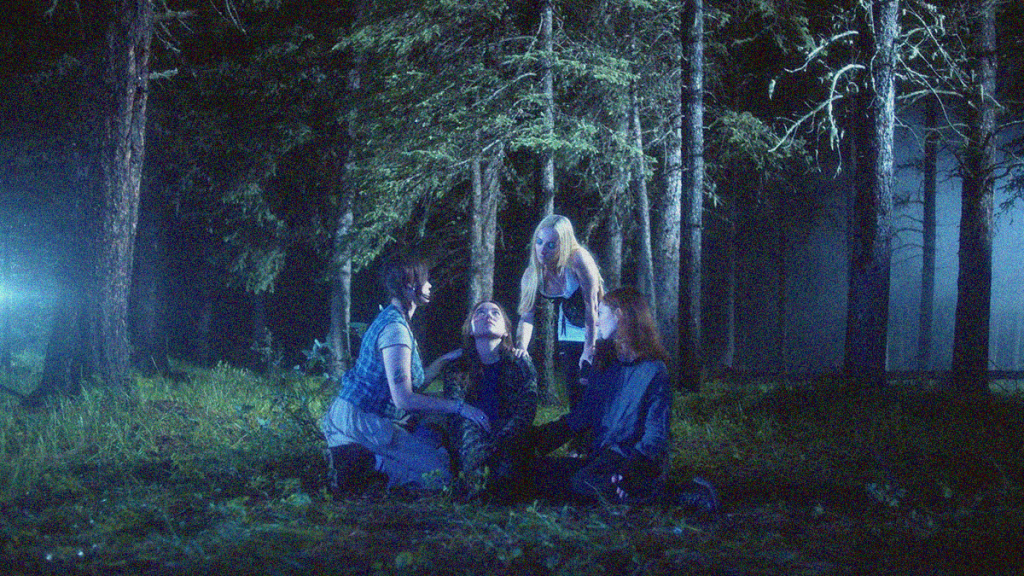
Clara (Alice Wordsworth), Rosie (Cherry Moore), Nev (Lea Rose Sebastianis), and Hope (Ella Reece) epitomize the “we saw you from across the room and liked your vibe” meme the second they see her, gushing about how great it is she’s there as though they know something Emily (and we) don’t. But the same can be said about Jo (Sophie Bawks-Smith) from the opposite direction as a force of good and God excitedly providing her an alternative path forward.
As such, the film proceeds less as two disparate ends of the spectrum cajoling Emily to their side than an encapsulation of what waits for her outside this microcosmic retreat. The path of forgiving herself and embracing God’s will in a bid to absolve herself of the guilt or the path of owning who she is and what she’s done. The latter doesn’t glorify those deaths as much as presents acceptance of them and empowerment through it. To tap into magic within the darkness.
Fast enhances Eily Sprungman’s gorgeous cinematography with a mix of animated effects that illustrate the fantastical via night scenes through windows of shooting stars and elemental control that manifest as beautiful flourishes rather than fire and brimstone. It’s not a trick either. The film isn’t presenting Emily with a filtered glimpse at what her future holds to push her over the line before revealing a nightmare. It is beautiful and hopeful and welcoming.
This is why it’s often difficult to reconcile moments in a purely objective way—intentionally so. Playing with camp leader Dan (Austyn Van de Kamp) in ways that devastate him to gain more magic doesn’t seem “hopeful.” Exuding the vibe that has one of the camper’s (Izza Jarvis’ Eden) drawing creepy versions of them isn’t necessarily akin to projecting “beauty.” Add a violent sacrifice during the climax and you start falling down a rabbit hole of potential interpretations.
Are we dealing with a God of untamed nature by way of Vulcan, also known as Mulciber (Sarah Roman plays a character named Mulci)? How much of what we see is real considering Emily awakens from dreams twice in ways that hint how they might not have been dreams at all? Has Fast given life to metaphor or is Emily truly experiencing the ritualistic supernatural events on-screen? Is it all just a manifestation of her grief dragging her down into oblivion?
The obvious visual and aesthetic touchstone throughout Camp is David Lynch with its surreal out-of-time-and-place nature. Phone calls with Emily’s dad that are barely audible. Lost time. A centering of the character’s confusion that transfers into our own once she suddenly seems fully aware and invested in the horrors to come with nothing more than a jump cut to get her there. Did I have any clue what was going on? Not really. But it’s too transfixing to care.
It’s a huge step forward for Fast after the promise of their debut Honeycomb. I don’t think the budget here is that much larger regardless of that previous work being done with friends on the cheap, but Camp looks like it was thanks to Sprungman’s eye and Fast’s increased confidence. They’re willing to take huge swings with the potential to alienate the audience, but it’s worth the risk because of their impact on those willing to truly absorb the film.
The room for conversation and interpretation that results is a major part of its appeal because it definitely skews closer to The Witch than The Craft despite what appearances might otherwise presume. It’s about finding yourself through others. Embracing your guilt and pain as a point of power rather than something to hide. Realizing that “home” might not be what it was before enduring trauma. There’s no going “back to normal” because this is normal now.
Ella Reece, Lea Rose Sebastianis, Cherry Moore, and Zola Grimmer in CAMP; courtesy of Dark Sky Films.




Leave a Reply