
Rating: NR | Runtime: 95 minutes
Release Date: April 11th, 2025 (Spain) / June 19th, 2026 (USA)
Studio: Avalon / Outsider Pictures
Director(s): Ana Asensio
Writer(s): Ana Asensio
God, don’t let the Devil get my grandma.
Elena’s (Alessandra González) parents do little beyond usher her from the room when her grandmother (Gloria Muñoz) dies. Yes, they’re dealing with their own grief in the moment, but it’s not lost on us that the first person we see tell her what happened is a babysitter while they’re away. No explanation about what comes next. No offer of support. Just a definitive, “Grandma is in Heaven now.” Children think way too literally to hear that and move on.
It’s not merely a story masking the truth. It becomes truth. How can it not when Elena is currently participating in the lead-up to her First Communion? When the entire pomp and circumstance of the latter is held as sacred to the point where the fantastical nature of the Bible is supposed to be believed without reservation, why would a child not assume the same for every story told to them by an adult? Without context and guidance, life becomes a slippery slope.
Writer/director Ana Asensio injects many such stories into her emotionally autobiographical script for Goat Girl. God and Satan where it comes to mortality (Grandma’s death), ceremony (First Communion), and mythology (the Devil in goat form). Literature via a tale Elena reads to her grandmother and One Thousand and One Nights where it concerns new best friend Serezade (Juncal Fernández). Even the ETA’s struggle for an independent Basque state.
There are the tales sparked by Elena’s imagination whether playing with her dolls or conjuring silent film-esque nightmares of her grandmother’s ascent to Heaven (and potential descent to Hell). And, of course, the stories society and her parents (Lorena López’s Marisa and Javier Pereira’s Pablo) outline to shield her from the dangers of the unknown (Elena is forbidden to befriend a “gypsy” like Serezade) and their own pain (fighting in another room doesn’t erase the fight).
The film is therefore as much a journey through these stories as it is a coming-of-age evolution. Elena is at that point in her adolescence where things cannot simply be taken at face-value. You can’t tell her that grandma’s absence means all her possessions must be thrown to the curb without a good reason. You can’t tell her what friends she’s allowed to play with when the ones they dislike are kinder than the ones they like. She sees the discrepancy. She feels the hypocrisy.
So, in a world where every adult (including Enrique Villén’s Father Carrillo) speaks in absolutes, who could blame Elena from wanting to push against those boundaries and see what’s on the other side? Especially now that the one person who told her to never be afraid of being different is gone. If you aren’t going to give her good enough answers, she’s going to find them on her own terms. If your truth is anger and oppression, she’s going to seek out joy.
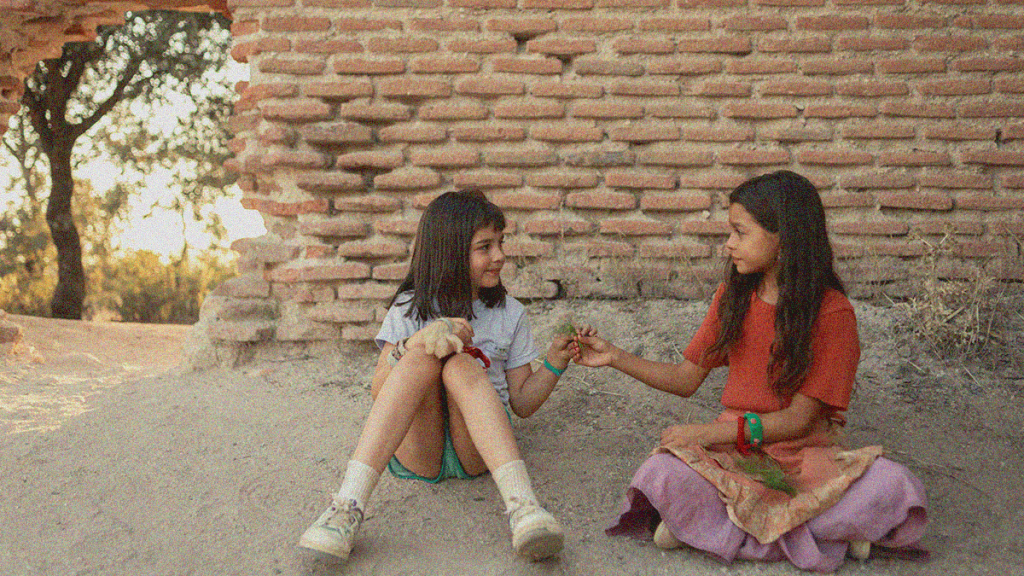
Most of what Asensio writes might therefore be familiar in its progressions, but not in its execution. I loved the quiet moments that lingered on González’s face as she works through the absurd contradictions of any given moment (what a great debut performance). The confusion when Dad pulls Elena away from a harmless and happy moment juxtaposed by the entitled jockeying for superiority between the girls at school. The fear that Serezade’s docile pet goat might be a demon.
I also appreciated the visual choice to shoot Elena’s confinement within the constraints of Madrid’s social norms as anamorphic and the freedom of the country where Serezade resides as widescreen. So often we see this dynamic move from 4:3 to 16:9 rather than 16:9 to 21:9. Yes, that wide expanse is technically losing real estate due to the black bars at top and bottom, but it’s adding to its scope. Like moving from television to the movie theater.
And while this is inherently Elena’s story, she’s not the only one who’s learning from her actions. Marisa and Pablo are also being forced to confront their own grief by acknowledging how their inability to comfort their daughter is pushing her away. The more times you tell her “No,” the greater chance that she’ll rebel. Because the reaction doesn’t fit the reality. If Elena’s truth contradicts their prejudices and the church’s fantasy, why would she lie to herself?
Just as that glimpse at the other side of the coin can free those who’ve spent too long building walls around themselves, however, it can also offer a promise of security to those roaming free. Give Asensio credit for showing this alternative through Serezade as she learns her parents want to trade in their makeshift home for a city apartment that won’t let her keep their goat. Nothing is perfect and everything is a compromise. So, try to ensure your story remains your own.
Alessandra González and Juncal Fernández in GOAT GIRL; courtesy of Outsider Pictures.



 jaredmobarak.com
Leave a comment