
Rating: NR | Runtime: 106 minutes
Release Date: January 24th, 2025 (Spain) / June 5th, 2026 (USA)
Studio: Filmax / VRC
Director(s): Galder Gaztelu-Urrutia
Writer(s): Pedro Rivero, Galder Gaztelu-Urrutia, Sam Steiner & David Desola
What’s a little giggle before the stoning begins?
Like many of the people I’ve seen talking about Galder Gaztelu-Urrutia’s Rich Flu, I too was surprised he and his co-writers (Pedro Rivero, Sam Steiner, and David Desola) chose someone like Laura (Mary Elizabeth Winstead) as their lead. Because the premise possesses the potential for some real fireworks insofar as showing the desperation on behalf of the wealthy and the satisfaction of the poor in their demise. So, why focus on a character with a foot in both worlds?
What’s revealed quite clearly by the end is the fact that the Lauras of this world are the more crucial piece to the puzzle to make one’s point. Because greed isn’t a unique impulse. As we see during the climactic montage that separates “Exodus” from “Epilogue,” humanity’s cravenness is an intrinsic quality we all must combat. Sure, the rich can purge their fortunes to try and survive, but the poor may also see filling the void as worthwhile despite knowing it will be a brief reign.
So, rather than show us the fall of billionaires like Sebastian Snail Sr. (Timothy Spall) or the rise of Third World cartels opportunistically replacing them as a block of unchecked power, we watch a woman who came from nothing (she was raised on a commune by her mother, Lorraine Bracco’s Martha) ruthlessly pursue a path towards glory (by sabotaging a co-worker’s promotion to steal it for herself) only to find her avarice exploited at the worst possible moment.
Think of Laura as your republican-voting uncle who’s made a comfortable enough living by working hard to blind himself from the reality he’s one bad break from being homeless by thinking he’s just one good break from being a millionaire. He votes against his own self-interest in the belief that the loopholes he’s gifting to the one percent at his expense will be waiting for him to exploit in some implausibly fantastical future that’s not coming.
That’s the greed we see on the daily. That’s the greed we might even have a chance to call out and fix on a ground level as opposed to the systems in place that bolster the ultra-rich—systems that will need to literally burn down to ever truly receive a course correction. Laura is that relative who still believes they have a soul and thus plays the victim to spouses (Rafe Spall’s Toni) and children (Dixie Egerickx’s Anna) they see as standing in the way of their dreams.
We know men like Snail and his son (played by Jonah Hauer-King despite Spall’s actual son also being in the film) will do whatever is necessary to save their own skin when an unknown virus begins targeting billionaires as if their bank account total is connected to their DNA. But what will Laura do? Will she worry if the hundreds of thousands in her own stock portfolio are enough to matter? Will she maliciously unload them on unsuspecting patsies if it is?
Rich Flu therefore points its spotlight on the exact type of person who still has a choice to make. Do what her boss did to her and ostensibly become a murderer? Go towards her estranged daughter out of selfish entitlement or steer clear just in case the disease is contagious? Realize her petty grievances with Toni in their divorce proceedings are just that? And, even if she chooses correctly, which version of Laura remains in the aftermath? Will greed always take over?
While the scenarios she finds herself enduring are often comical in nature, this isn’t a comedic satire. Similar to the director’s previous work on The Platform, things get dark and violent fast. All social upheavals must because ripping out the foundation doesn’t magically fix what was built upon it if you don’t have a better foundation ready to take its place. Everything inevitably just flips. The rebels become the oppressors—often worse than the ones they usurped.
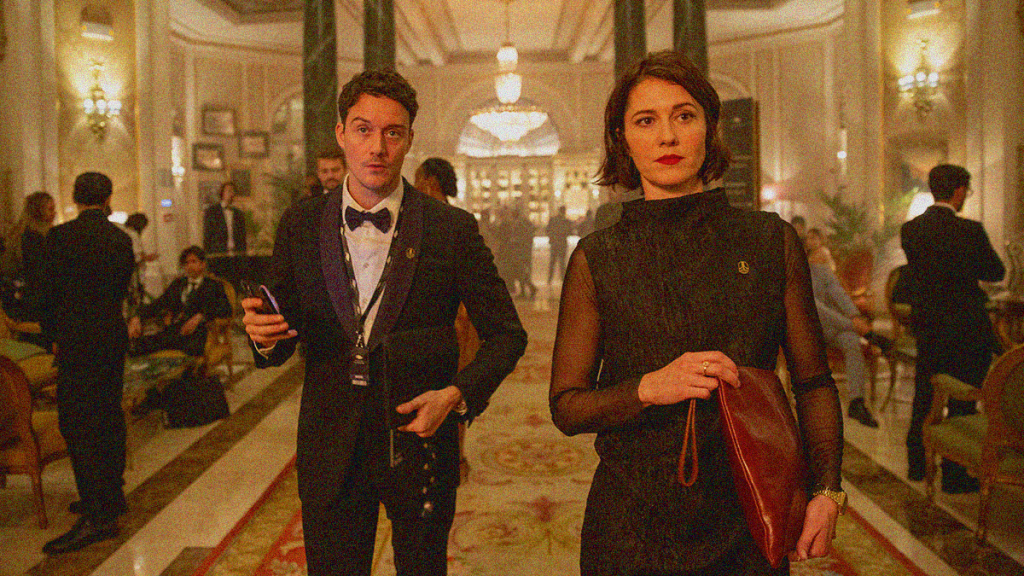
So, pay attention to the peripheral characters. Toni’s altruism. Laura’s assistant Christian’s (César Domboy) loyalty. Anna’s innocence. Pay attention to the concept of ownership and value too. I was quick to dismiss the cheap Casio watch on Laura’s wrist as a failed attempt to humanize a woman who sold her soul many years ago, but its presence actually speaks more to who she’s become than who she was when she bought it. It’s all a bit messy, but it does work.
Because, at the end of the day, this is a takedown of capitalism at its very root. Her ascribing value to that timepiece that’s well beyond the value of the materials and labor that went into making it is akin to the value we place on paper notes, binary code, and precious metals. Money and wealth are constructs. It’s an agreement. So, when we start hoarding more than we’d ever need, we’re breaking the trust of those who suddenly can’t even earn enough to simply live.
César Domboy and Mary Elizabeth Winstead in RICH FLU.



 jaredmobarak.com
Leave a comment