Rating: NR | Runtime: 129 minutes
Release Date: November 14th, 2025 (Sweden) / April 17th, 2026 (USA)
Studio: SF Studios / Cohen Media Group
Director(s): Tarik Saleh
Writer(s): Tarik Saleh
You surround yourself with people you despise.
George Fahmy (Fares Fares) just wants to act. He’s the “Pharaoh of the Screen.” Everyone adores him, he takes his craft seriously, and, as his wife tells their son, his latest girlfriend (Lyna Khoudri’s Donya) could be his daughter. George therefore knows how to play the game. He remains apolitical and tells everyone what they want to hear without actually saying anything. And his fame ensures the movies bolstering Egypt’s economy remain uncensored.
Well … that’s what used to happen. He doesn’t quite have the same sway now with a younger actor (Sherwan Haji’s Yasser Islam) poaching roles and the censor board’s three hijab-wearing arbiters demanding edits. George and longtime friend/co-star Rula Haddad (Cherien Dabis) are even being approached by government entities to bring their fame into the fold of President Abdel Fattah el-Sisi’s propaganda wing. It’s not an offer one refuses lightly.
The final chapter in writer/director Tarik Saleh’s “Cairo Trilogy”—a creative endeavor that ultimately got him exiled from Egypt due to anti-el-Sisi sentiments—Eagles of the Republic quickly ratchets up the paranoia and futility once Rula admits she’s been asked to slander George or be blacklisted and his agent (Ahmed Khairy’s Fawzy) discovers his hands are tied from stopping the studio recasting his latest role. A threat on his son’s life inevitably forces surrender.
Does George want to play the president in what is surely a hagiography? No. Of course not. He “only makes good movies.” What choice does he have, though? Give him credit for trying to elevate the script by hiring a trusted director (Tamer Singer) and constantly pushing his co-stars to understand the reality of the events depicted rather than the smoothed edges of revisionist history, but he can only go so far with the mysterious Dr. Mansour (Amr Waked) looming.
I’ve seen a lot of people calling the film a satire whether they agree with the label or not. I can kind of understand that urge since the scenario on-screen is so absurd in nature (the clearest example being when George, in full prosthetics, is told he must play the role looking like himself and not el-Sisi for a more idealized visage), but that actually happened. Yasser Galal played the leader with no artifice en route to securing a Senate seat. It’s funny, but it’s not a joke.
And that tone stands throughout. Some situations might be humorous, but they’re presented with the utmost severity since the result is often violent. This is a dictatorial regime disappearing citizens for spreading pro-democracy ideas (designated as “disinformation”). Waked is a victim himself. It’s therefore less a satire than an alternative universe. These circumstances are real, but the details are fiction. Every seemingly funny development gets hijacked by dread.
It’s also still very much a political thriller considering we never truly know who is pulling George’s strings. Is it Mansour’s secretive fixer constantly dropping nuggets that prove he has eyes and ears everywhere? The defense minister and his cronies granting political favors? An intriguing woman (Zineb Triki’s Suzanne) who presents as an el-Sisi opponent despite supposedly being the wife of a “prominent figure”? Does it matter if George is just trying to stay alive?
There are a lot of twists and turns as a result since the other shoe drops each time George appears to gain a modicum of power. All these figures are quick to pat him on the back to ensure loyalty, but even quicker to remind him that he’s nothing but a puppet they wouldn’t miss should his absence better suit their agenda. They all know George’s image is everything. They will use those he loves and protects to manipulate his decisions to their whims.
I was riveted throughout because I was desperate to find out what was actually going on. Saleh isn’t interested in delving into the big picture since he doesn’t consider his films political due to “today’s strong opinion [not being] tomorrow’s truth” and art not having the luxury of being wrong. He’s concerned with the characters and their impulses, flaws, and humanity. How far can he go before breaking George? Or will George finally sell out completely to survive?
At a certain point George must realize there’s no going back. That he made his choice to save his son even if the teenager is the one chastising him for throwing away his integrity. George starts to play with fire in his personal life too—almost as though he wants to anger the wrong person and get killed to escape the pressure. But there’s little that the men squeezing him don’t know. It’s just that they can use it to make him do whatever they want.
The payoff is worth it. The climactic moment where Saleh pulls the curtain to reveal who was doing what arrives with a bang to usher in a chaotic conclusion that further exposes just how helpless George has become. It’s almost like nothing he has done the whole movie was of his own doing. And if that is true of someone with his stature in the public consciousness, what worse things are happening to regular folk who dare to fight for their civil rights?
Most of Eagles of the Republic concerns itself with that question, but there’s also a piece that calls attention to the vocation of acting as a shield for the actor just as much as it’s a mirror for the viewer. There’s a wonderful moment between George and Rula (Fares and Dabis are only bested by Waked’s enigma) where they resign themselves to the reality that they don’t know anything besides what their director tells them. While a protective filter on set, it’s a devastating liability off it.
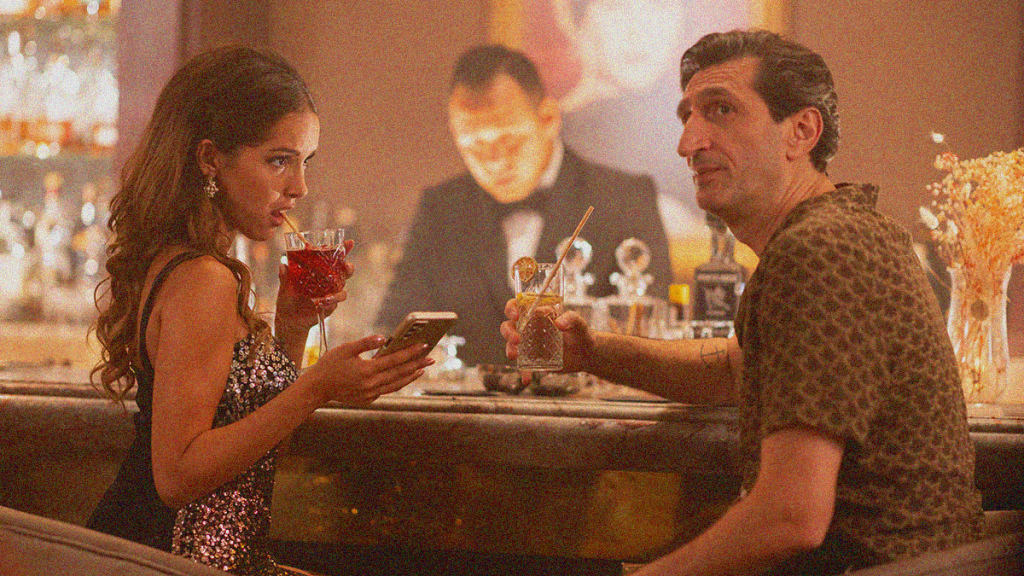
Lyna Khoudri and Fares Fares in EAGLES OF THE REPUBLIC; courtesy of Cohen Media Group.



Leave a Reply