
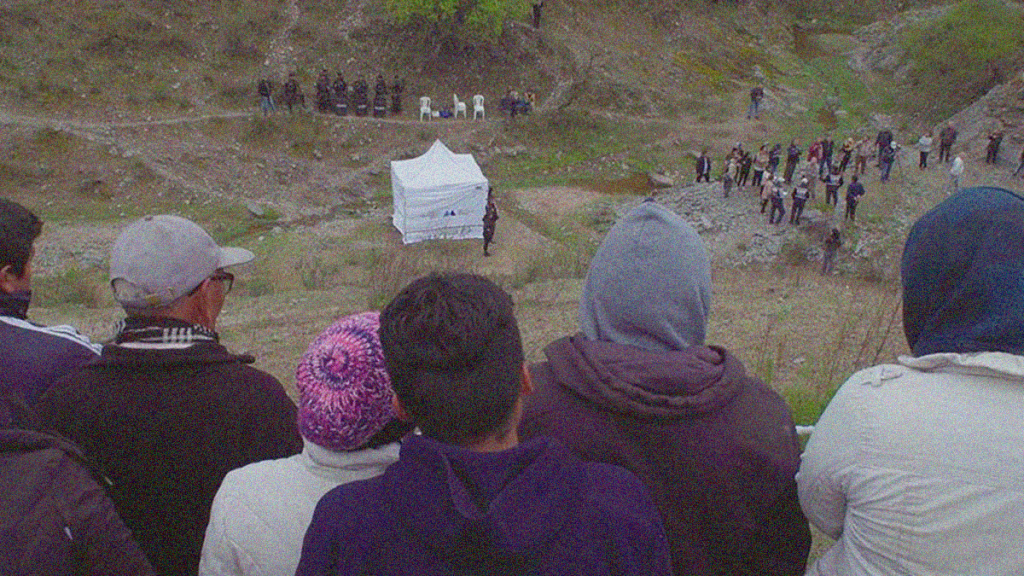
Rating: NR | Runtime: 123 minutes
Release Date: March 5th, 2026 (Argentina) / May 1st, 2026 (USA)
Studio: Moving Pics / Strand Releasing
Director(s): Lucrecia Martel
Writer(s): María Alché & Lucrecia Martel
They never taught us about our rights.
There are few better examples of the entitlement held by people in power than watching the footage captured by the defendants in the trial at the center of Lucrecia Martel’s Our Land. It depicts an incident that occurred nine years prior wherein “landowner” Dario Amin and the two former cops (Luis Humberto Gomez and Eduardo José Valvediso) he enlisted to escort him confront a group of Chuschagasta community members—an event that ends in murder.
Not only does the video show this trio as aggressors when pulling a handgun and then shooting after the men present backed away, but there’s also a moment when they are laughing with each other in their car about the absurdity of some Chuschagasta men filming them as well. The punch line is pretty much, “Why are they bothering?” since “The courts don’t listen to them anymore anyway.” The assumption is therefore that the court will agree. So, why hide it?
Sadly, in many cases they would probably be correct. When the laws and paper trails used for colonialists to steal land from indigenous inhabitants are sanctioned by the court, why wouldn’t you presume the court would simply rule in their favor regardless of evidence? It’s the same story everywhere. Look at how Israel uses its own courts to declare ownership over Palestinian land. These nations hide their corruption behind the veneer of justice.
As such, Martel and co-writer María Alché supplement their documentation of the trial itself with interviews and research that contextualizes the supposed “facts” being lobbed by the defense. First, we watch a wild courtroom debate between Valvediso and the young Chuschagasta man who disarmed him during the conflict and see how the former inherently has an upper hand via confidence and education. Then we learn why that disparity exists.
It’s a sobering dissection of erasure and control wherein we visit the church where many Chuschagasta were baptized only to see a giant wall painting depicting how God’s angels threw lightning bolts upon the “savage Indians” to get rid of them so colonialists could take over. We hear stories about how many in this community don’t even realize they are indigenous until adulthood because their school curriculum teaches that indigenous people are all gone.
Talk about an identity crisis. But that’s exactly the point. If the aggressors cannot force out the inhabitants preventing them from owning the land, they will look to erase them in plain sight instead. Because history is built on documentation. Yes, the government says the land belongs to the Chuschagasta, but what if the Chuschagasta can be tricked into letting themselves to be labeled something else? To them, nothing has changed. To the record, however, everything has.
What is therefore more important? That the documents have been skewed to label Javier Chocobar’s ancestors as gauchos? Or that Chocobar’s name is shown as a constant presence on that land for centuries? It gets to the point where Amin’s attorneys attempt to completely upend the murder trial by repackaging it as an issue of ownership. If the land is Amin’s, the shooting can be construed as self-defense because Chocobar had no rights to be there protecting it.
As a result, Our Land isn’t just a film about this case or its verdict. It’s about giving the Chuschagasta people a platform with which to reclaim their humanity and history in a country that has already taken their language and continues to paint over their heritage. It highlights their vulnerability against colonial opportunism. It showcases their struggles, joy, and pride in returning home despite success in Buenos Aries. It pokes holes in the defense via the presence of its cameras.
I love the contextual revelations that arise like discovering why the defense witnesses are all retired public officials (the people the Chuschagasta have been petitioning to uphold their rights), but the visual juxtapositions are even better. Martel uses a drone to film the land as a woman talks about property lines and says “I don’t know” to a question asking how far it is from a Chuschagasta home. The camera pans fifteen degrees to show one that’s literally twenty feet away.
Therein lies the importance of providing the disenfranchised and abused a voice to combat the louder and better financed lies of their oppressors. If the systemic violence behind Argentina’s education and courts is so insidious that it can white wash the Chuschagasta’s presence to the Chuschagasta themselves, how would they ever stand a chance fighting back alone? These countries indoctrinate their citizens at birth to rewrite reality, and it’s been working for way too long.
A scene from OUR LAND; courtesy of Strand Releasing.



Leave a Reply