
Rating: PG-13 | Runtime: 105 minutes
Release Date: March 6th, 2026 (Canada/USA)
Studio: Photon Films and Media / Well Go USA Entertainment
Director(s): Hubert Davis
Writer(s): Josh Epstein & Kyle Rideout and Seneca Aaron and Charles Officer / Peter Markle & John Whitman (characters)
Don’t let someone else’s pain change who you are.
Now that’s how you do a remake. You choose a problematic relic of its time, investigate the reasons why it no longer works, and use those findings to carve a new transformative path forward. Because Peter Markle’s Youngblood is ancient when you think about what hockey was in 1986 and what it is today. Not just as a result of a slowly changing culture and inclusion initiatives, but the talent level and speed too. The only thing that truly remains is the toxic masculinity.
Screenwriters Josh Epstein and Kyle Rideout (working off drafts originated by Seneca Aaron and the late Charles Officer before them) lean into that fact from the other direction. The journey Rob Lowe’s Dean Youngblood took was one that embraced “old school” tendencies where scoring was a by-product of toughness and toughness was less about physicality than pure violence. Ashton James’ Dean is therefore asked to reckon with the damage that thinking wrought.
So, it makes perfect sense to change the Youngbloods in Hubert Davis’ film from chip-on-their-shoulder white farmers existing on the edge of being too small to compete with the big boys on the ice to a blue-collar Black family struggling to survive a world that has taught people to fear them regardless of temperament, skill, or humanity. Some young men like Dean recognize that reality and do everything they can to become smaller. Others let the anger define them.
It shouldn’t surprise anyone that the central psychological through line becomes a battle between nature and nurture. Because Dean is a great hockey player. He skated circles around boys older than him and isn’t drawn to the fighting aspect as readily as his brother (Emidio Lopes’ Kelly) or father (Blair Underwood’s Blane) before him. When his mother dies, however, her calm voice of reason disappears and the rage filling his dad inevitably spills over into him.
Those moments from the original that make you laugh like Murray Chadwick begrudgingly picking the scorer over the brawler are now flipped on their head. This Murray (Shawn Doyle) needs offense and the two players trying out for a roster spot on his playoff-bound Mustangs both provide it. Dean’s history (he’s fresh off a suspension for swinging his stick at a player who delivered a racial slur) has Murray wanting to send him home. The owner intervenes.
The lesson taught about family and brotherhood isn’t therefore a product of murdering players via a senseless cycle of violence. No, Murray preaches a crest-before-nameplate philosophy wherein discipline trumps impulse. Why? Because he’s fallen prey to it himself. He’s not coaching this team by choice. He’s suffering the consequences of his own actions. It’s why Murray doesn’t trust Dean. Not because he’s Black or “unqualified,” but because he understands his rage.
It’s a complex web of toxicity born from insecurity that manifests itself into unforgivable actions each perpetrator refuses to believe are their own fault. Blane is tough on his boys because it’s “all he knows.” Murray is tough on Dean because he couldn’t conquer his own anger and thus doesn’t trust the teenager can either. But they aren’t alone. Every guy on the team, including Henri Richer-Picard’s Sutton, dealt with crazy hockey dads. It’s a familiarly noxious pattern.
And that leads us to the other big narrative shift from its predecessor: Murray’s daughter Jessie (Alexandra McDonald) isn’t a one-dimensional rink rat love interest. No, she’s a hockey player too. She’s fighting for her existence in this world from an even greater disadvantage as a woman with fewer prospects than Dean as a Black man in a white sport. Her ability to channel her frustration might render her a bit one-note as a sage voice of reason, but it works.
Because Murray and Dean both need to hear that truth. They need someone who understands the life to open their eyes to their own complicity to their hardships and perhaps find a way to escape the cycle. This nuance isn’t just performative in nature where it comes to propping up the good guys either. It’s also wonderfully fleshed out in its depictions of the “bad” guys too. Racki’s (Donald MacLean Jr.) scared remorse. Blane acknowledging he’s too broken to change.
So, rather than glorify the misogyny, hazing, violence, and homophobia (there is one example of the latter that goes unchallenged), this Youngblood uses it all as a reason to evolve. To be better than the past. To be vulnerable and talk about your issues to realize the people around you struggle with the same things because you are never truly alone. As Ms. McGill’s (Tamara Podemski) framed embroidery callback states: “Sports do not build character. They reveal it.”
It was also fun to recognize Leah Hextall’s voice as the ECHL color commentator and to see the NHL lend their support during a nice epilogue that features the Los Angeles Kings and Montreal Canadians (as well as Drew Doughty in the locker room and Luc Robitaille in the stands).
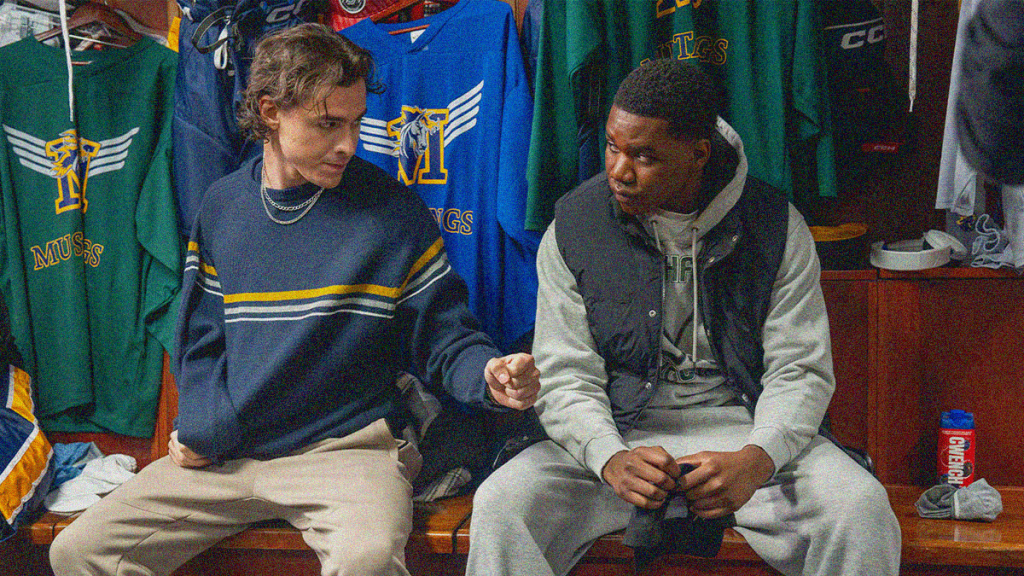
Henri Richer-Picard and Ashton James in YOUNGBLOOD; courtesy of Well Go USA Entertainment.





Leave a Reply