
Rating: PG-13 | Runtime: 117 minutes
Release Date: April 24th, 2009 (USA) / September 25th, 2009 (UK)
Studio: Universal Pictures UK / Paramount Pictures
Director(s): Joe Wright
Writer(s): Susannah Grant / Steve Lopez (book The Soloist: A Lost Dream, an Unlikely Friendship, and the Redemptive Power of Music)
You couldn’t stop that earthquake.
Director Joe Wright’s new film The Soloist seemed an odd follow-up to his great Pride and Prejudice and Atonement adaptations. To go from a period drama to a WWII romance to … the discovery of a homeless Julliard dropout on the streets of LA wasn’t quite the trajectory I envisioned him on a path towards. After watching it, however, you can’t help but see his stamp all over it. With a deft use of stunning visuals, the inclusion of a couple long takes and tracking shots, and a layered aural composition (this time to depict the voices in Nathaniel Ayers’ mind as opposed to the mesmerizing typewriter-as-instrument from Atonement), Wright proves again that he’s one of the best young directors working today.
Steve Lopez (the LA Times journalist whose story this is based upon), walked into this tale of a cellist on accident before creating a series of editorial pieces that ultimately became a novel. Was it necessarily one worthy of a big screen conversion? At first I might have said no, but life was breathed into the words courtesy of the Wright’s stewardship and stellar performances from Jamie Foxx and Robert Downey Jr. They given shape to an unexpected delight amongst the squalor of LA’s hellish Skid Row.
I absolutely loved the opening credits’ ability to keep us off-balance enough to enter the story without expectation. A voiceover narration from Downey Jr.’s Lopez is placed over imagery of him biking around the streets of LA that’s interspersed with quick cuts to a newspaper printing on the Times’ giant press. It’s a rapid-fire sequence showing Lopez as he takes a header into the street only to end up in the hospital surrounded by the craziness of his city that also slows things down (an interesting description considering the speed at which the paper flies through the press) to show the cast and crew names amongst the black and white paper vignettes.
It leads us to Lopez’s cluttered and small desk upon his return—bloodied and bruised—to an office that contains his ex-wife as his boss and the inevitable layoffs the company faces. Uninterested in a fluff piece about giving blood (his fear of needles and a freakishly goth Jena Malone causes him trepidation), he decides to take to the streets and see what other stories he can find. A self-proclaimed occupational writer, Lopez discovers that his love for the written word and reason for becoming a journalist are all but gone. The awe of an amazing yarn woven with detail that touches those who read it deeply has been replaced by a paycheck and deadlines … until he hears a violin drowning out a boisterous subway.
It’s Nathaniel Ayers and his two stringed violin playing music for his idol Beethoven via a statue that flabbergasts him by being placed in a city park. A conversation strikes up between the two men with the discovery that Ayers had been to Juilliard—a fact that perks Lopez’s ears into thinking he might have stumbled onto a story. The legwork begins as research and interviews with the musician and his family lead to a series of articles touching the city in a very real way. An arthritic woman donates her cello to Ayers upon learning the violin he owns is not his first love and the mayor even takes note by allocating 50 million dollars to helping the homeless of Skid Row.
There’s no way Lopez could have imagined the impact this story would have on the community nor its transformative powers where it concerns him. By looking into Ayers’ face as he plays to see the splendor and effect an intangible thing like music can have on such a troubled soul, Lopez’s excitement for life and his own art is reinvigorated. The shell of a man he had become (selfish, money-hungry, and out for fame) soon dissolves once he finds himself propping up this new friend. He sticks by his side no matter what problems arise—problems that might alienate a lesser man.
There are a lot of supporting roles played by recognizable faces, however, most are so small and inconsequential that you’ll wonder why they didn’t just hire newcomers. Rachael Harris and Stephen Root are barely on-screen with half of Root’s minutes spent in the background while drunkenly singing karaoke at a bar. Nelsan Ellis is the head of Lamp’s community for the downtrodden of LA, a role so unlike his wonderful turn as Lafayette in “True Blood” that it took me half the film to realize it was him.
Catherine Keener is wasted as a mirror to Downey’s Lopez that shows what he lost as the years passed. And Tom Hollander (as Ayers’ cello coach later in the film) is fun if only for his weird Jesus/Lord comments to a man who doesn’t care since Lopez has become Ayers’ living God. The one supporting role that added some depth comes from Lisa Gay Hamilton as Ayers’ sister Jennifer. She excels in some very heart-wrenching scenes opposite Foxx in startling flashbacks that reveal answers to his fractured mind while working towards a redemptive moment at the film’s conclusion.
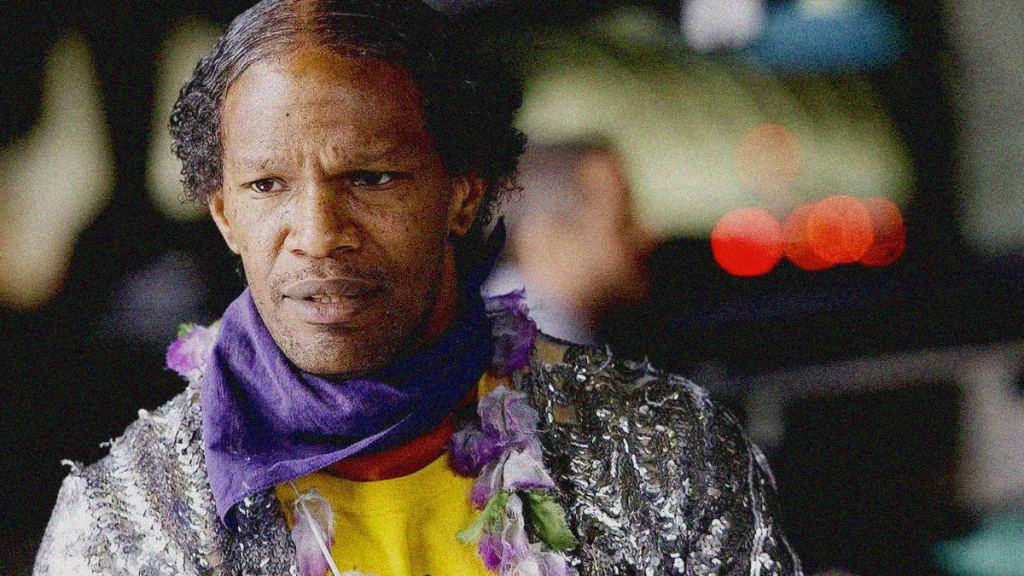
Besides Wright’s stunning visceral assault (compositions holding faces in the corners and blur unnecessary information via soft focus, close-ups of bows on instrument strings causing graphic abstractions, a Fantasia-like sequence of color bursts swelling to the music, and even the clapping of pigeons’ wings as they fly through numerous aerial shots of Los Angeles), the real story is Jamie Foxx. Downey is great as a straightforward man searching for redemption, Foxx is a troubled soul who often doesn’t know where or what he is. It’s a role that could have turned comical and degrading (see Sean Penn in the horrid I Am Sam), but Foxx instills heart and compassion instead.
His ramblings are unceasing. His ability to play is realistic. And his childlike glee when it comes to the music (those in-close moments where only his eyes and nose are visible) showing that inner sense of peace remembered from his youth. It’s a stunning portrait of a man amongst demoralized and beaten street dwellers (many of whom I assumed were non-actors—especially during a moment of Downey Jr. cracking up from a woman’s tale about chickens) in a story that truly surprised me with its messagoing and singular voice. It may not be Wright’s most captivating work, but it deserves a spot next to them on the shelf.
Jamie Foxx stars as Nathaniel Ayers in DreamWorks’ THE SOLOIST (2009) Copyright © DreamWorks Pictures. All Rights Reserved.





Leave a Reply