
Rating: NR | Runtime: 88 minutes
Director(s): Thomas Mendolia
Writer(s): Thomas Mendolia
Maybe I made you up.
I’ve been burned too many times to not assume the worst. So, I don’t blame myself for fearing that writer/director Thomas Mendolia was going to wait too long to reveal what we know in the first scene: that Ebb (Banks Repeta) isn’t real. I should blame myself considering the synopsis explains as much from the jump, but I try to go into films knowing as little as possible to see where the story takes me devoid of preconceptions. Henry’s Ebb works either way.
Because Ebb’s origins aren’t the point. Mendolia is neither playing a trick on his protagonist (Kingston Rumi Southwick’s Henry) nor his audience. These characters are fully aware of who and what they are because the actual point is portraying how our imaginations are as real to us as anything else. What Ebb coaxes Henry to do against his better judgment is real. The comfort he provides when things get tough is too. Henry created him for a reason.
Between the teen’s estranged father (Will A. Holland’s Grant) leaving when he was young and his bi-polar mother (Ashley Shelton’s Shannon) making him feel unsafe physically and emotionally, Henry needed someone on his side to talk to and understand the anguish he faced. What happens when you hold onto that “friend” as you approach adulthood, however, is that you risk losing yourself to the isolation inherent to never reaching out beyond your own mind.
And that’s where this effectively drawn drama begins to flirt with a descent into full-blown horror. Not just by way of Henry losing control to this potential alter ego, but also in the way that granting Ebb the power to impact real change might inexplicably allow him to become real himself. The line between projection and poltergeist is dissolving with every step Henry takes towards an increasingly volatile unknown. Something needs to change.
Will that shift simply be Henry escaping his torment to ride his bike for miles until reaching his father’s new home? That’s quite a roll of the dice considering dad has done nothing to prove he won’t disappoint him more in person than he has in memory. Or will it be Ebb gradually finding corporeal form to further dictate the path laid before them? That’s a dangerous proposition since his whole existence is to protect one person at the expense of everyone else.
But there is a third option too. One that ensures the film won’t drown itself in the genre trappings that make it an effective supernatural thriller by forgetting its purpose towards Henry. A path towards forgiveness. Not the act itself, but the capacity to work towards finding it. To forgive his father for choosing self-preservation (since he is too by running away). To forgive his mother for actions she cannot control (as long as she’s willing to acknowledge them too).
There’s also finding the room to forgive himself. Not for the emotions he should be feeling (whether anger, abandonment, betrayal, etc.) considering he’s the child in this scenario, but for feeling them at all. That’s where Mendolia sets Henry’s Ebb apart from others like it. Intentionally or not, many of these stories look to present parents as flawed figures that demand grace by default. This one forces them to admit their failings first before asking to earn a second chance.
It might not seem like a huge difference on the surface, but it is in practice. It’s also why you need an Ebb to inject a bit of nightmarish violence into the game so that the stakes of Henry’s turmoil can be given visible form. What’s the argument against therapy that too many still use today? “It’s all in your head, so just fix it.” Maybe watching this “figment” cause real-world damage will allow detractors a better lens through which to see the truth.
The result is engrossing from start to finish as Henry confronts his deteriorating home life and endures the consequences of living on his own with no means of sustaining himself. Whether an untrustworthy hitchhiker (Austin Willard) or a kindly stranger (Rebecca Koon), he’s given a mirror onto what might be coming next and what might have been. And Ebb is there to help him through both the only way he knows how: scorched earth.
Why meet a sweet old woman trying to help with the same violence as a drifter with ill-intent? Because Ebb is a part of Henry’s mind. He doesn’t see hope versus fear. He only sees pain. The pain that will be left once Henry is forced to leave this warm and safe home to return to the chaotic one he left. The pain of having a dream ripped from his arms only to remember he’s all alone. So, why not embrace that loneliness now and accept Ebb is all he has?
It’s an assured feature debut from Mendolia with fantastic central performances by Repeta (desperate, manipulative, opportunistic) and Southwick (optimistic, hopeful, haunted). Ebb’s on-screen evolution from no one acknowledging his presence to interacting with objects to influencing the scene itself creates some unforgettable dark moments. His actions epitomize the past horrors Henry must shake to find his voice and set his own terms moving forward.

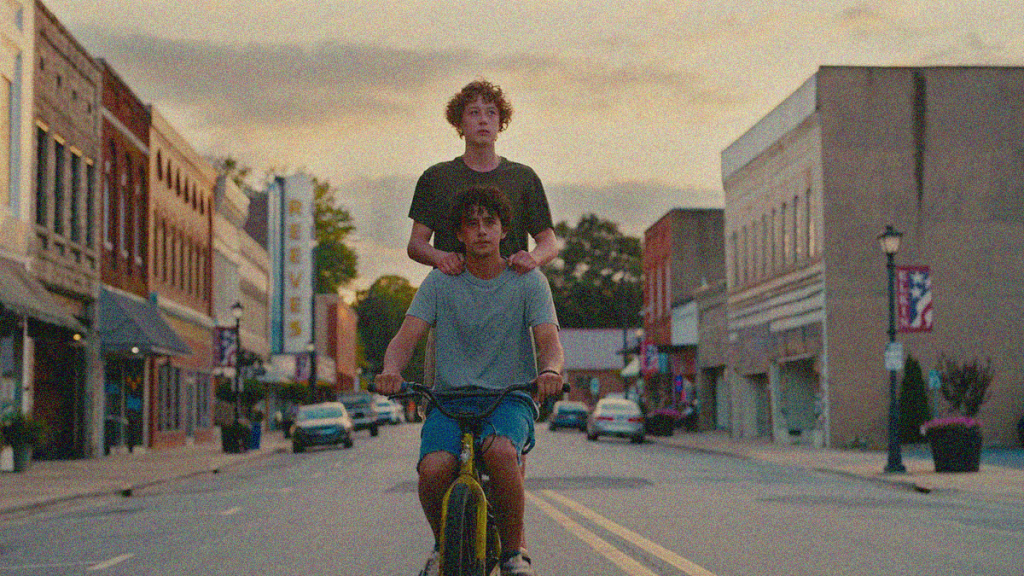
Banks Repeta and Kingston Rumi Southwick in HENRY’S EBB; courtesy of Tallinn Black Nights Film Festival.





Leave a Reply