
Rating: R | Runtime: 95 minutes
Release Date: August 28th, 2026 (USA)
Studio: Roadside Attractions / Saban Films
Director(s): Casper Kelly
Writer(s): Casper Kelly & Jamie King
You gotta be scared to be brave.
If you didn’t know Buddy director Casper Kelly was behind the viral sensation Too Many Cooks in 2014, you will after watching its opening prologue. Not because the fuzzy 4:3 framed kids show inexplicably contains a murder off-screen once one of its magical orange unicorn’s “friends” dares to stop playing along, but because the whole thing restarts after the group sings their sign-off song about love. It’s a nightmarish loop we know all too well.
In many ways it seems as though this is the film Kelly has been working towards since taking Adult Swim by storm. Between the fourth wall-breaking Cooks that plays with the science fiction manifestation of the real-world trappings behind a fictional television reality to the surreally meta zoom out of evil tidings hidden on the fringes of a Yule Log feed, his whole brand has been tapping into the inherent horror of nostalgia and presumed innocuousness.
Co-written by Jamie King, Buddy leans into this ethos from the first frame as we witness the gradual awakening of children caught within a “Barney”-meets-“Pee-wee’s Playhouse” type variety show that unfolds as if the movie theater has been transformed into our old living rooms complete with CRT monitors dialed to our favorite channel. We laugh at the detail of its pervasive optimism while relishing Josh’s (Luke Speakman) defiance to reject it.
It’s the perfect subversion of the format. Kelly is operating from a premise wherein the child actors on these shows are actually living in the fantasy that we the viewer wish could experience too. He strips away the need for scripts and cameras by treating it like a contained dream with expert comedic blocking so Buddy’s (voiced by Keegan-Michael Key) altercation with Josh occurs off-screen while Mr. Mailbox is left alone to try and pretend everything is okay.
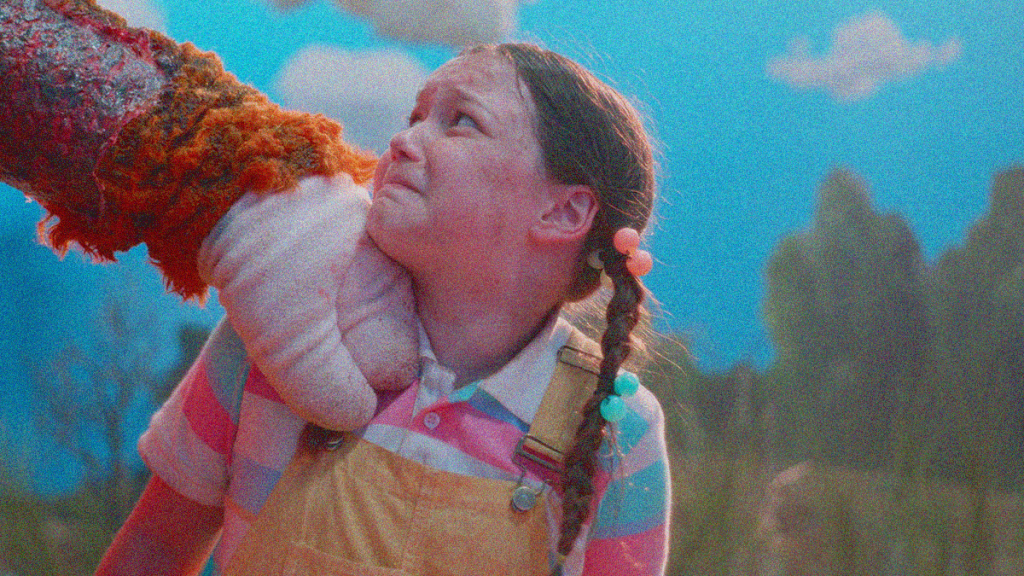
But it’s not. He knows it. We know it. Young Freddy (Delaney Quinn) knows it too. Because Buddy isn’t as careful as he should be when disposing of his crime’s evidence. Once Freddy sees the truth, it’s only a matter of time before she gets Wade (Caleb Williams) and the others on board too. Those perma-smiles turn to paranoia and fear as the curtain drops. Replacement cast members start to take on a sinister context. Eventually, survival depends on fighting back.
That’s when the perspective shifts. Much like when the sitcom credit spoof in Cooks devolves so rapidly that it demands a formal switch into real world fidelity removed from its vacuum glass tube divider, Freddy, Oliver (Tristan Borders) and Hannah (Madison Skyy Polan) suddenly find themselves in widescreen as they run through the forest beyond Buddy’s “set.” More than that, however, we also find ourselves removed completely from their world and into 16:9.
Enter Grace (Cristin Milioti), Ben (Topher Grace), and their two young sons. It’s a disorienting transition due to the aspect ratio change itself, but also because this family is obviously living in the present day. So, where is the connection? You can’t watch the “Buddy” credits three times without clocking the copyright date is 1999. So, have we been watching reruns? Is “Buddy” even a real show considering how its kids revolted? Is anything on-screen real?
Without giving too much away, there is something supernatural in play. Perhaps even demonic insofar as how Buddy’s magic works. Is it a pocket universe? Or purgatory? Kelly and King know that whatever they’ve created initially works best devoid of explanation. Their goal isn’t to impress us with their world-building. The point is to let the terror and uncertainty of those trapped within its hellscape take us on an emotionally resonant journey of survival.
So, the very cool moment where we watch someone from the real world enter this illusory soundstage is allowed to exist on its own surreally freaky merits. The introduction of two bygone souls in ventriloquist dummy Willie (voiced by Michael Shannon) and his very old friend George (Clint Howard) stands on its own psychologically messed up feet too. It’s all a provocation that seeks to dismantle the corporate sponsored safe havens we’ve been sold.
Because it’s not all true, right? All the stuff that’s come out about the turmoil and abuse that ran rampant on the sets of Nickelodeon’s hit shows of the 90s and 00s. The childish impulse to cynically turn hopeful messages into vile parodies as a means of proving you’re cooler than the babies who still watch. Our inability to separate those messages from the fascistic capitalist machine that bankrolls them and thus dictates how they’re disseminated.
Add a bit of twenty-first century frustration about screen-time siphoning off the souls of our youth and Buddy is firing on multiple levels that speak to people of all ages—those who have an unhealthy relationship with the media they consume and those who had one years ago. There’s also bloody gore for horror fiends and the heady science fiction of our devices instantly rewriting memories and identities. And a young girl finding the courage to protect those in need.
Things can feel shaky at the start as Kelly eases us into these dual worlds since the show’s artifice is often subverted by real stakes while reality is often undercut by embellished caricature, but there’s little to complain about once the narrative hits its stride. Because even apparent non sequiturs like Willie and George hold crucial historical value to what’s happening. Same with Strappy the backpack (Patton Oswalt) and Eric Bauza’s many personified objects.
Fans of Adult Swim and Kelly’s work with them will be satisfied by the ingenuity and aesthetic. I wanted to rewatch with a pause button right away to take notes comparing the multiple instances of “Buddy’s” end credits to see if they change with each new plot development. And don’t get me started on the breadth of this “fake” world once we travel through its many doors. Just because we aren’t forced to process its dense mythology now doesn’t mean it hasn’t been teased.
Delaney Quinn in BUDDY; courtesy of Roadside Attractions and Saban Films.




Leave a Reply