
Rating: NR | Runtime: 102 minutes
Release Date: November 13th, 2025 (Kazakhstan)
Director(s): Aitore Zholdaskali
Writer(s): Kazybek Orazbek & Aldiyar Zhaparkhanov
You’re not a man.
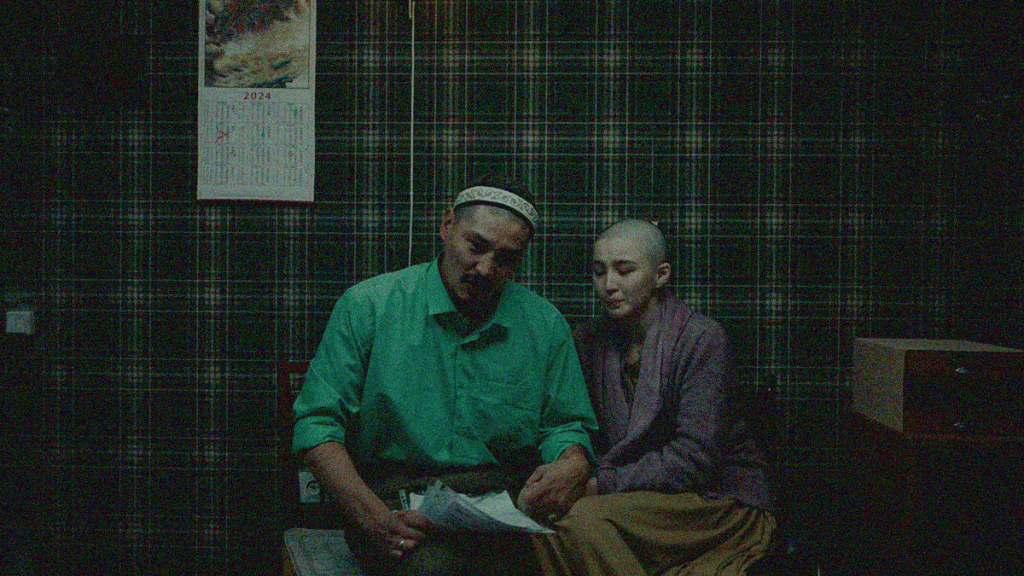
It’s a brand-new day with endless possibilities when Tancho (Dilnaz Kurmangali) wakes her husband Aza (Ayan Utepbergen). Well, that’s what she says to help them forgot their troubles. Because the only possibility that awaits is pain due to the debts they’ve accrued. To Aza’s friend Damir (Sultan Tursynbekov). To his mother (Gulshat Tutova). To creditors. So, it hurts even more when he totals their car while Ubering and Tancho discovers she’s pregnant.
What are they to do as eviction and Damir punching Aza in the face again combine to form a vision of their future? What else can they do besides run away and hoping no one finds them or turning to crime? It just so happens that an opportunity for the latter arises when Aza’s desperation leads him to steal a charity box for cancer patients and blurt out that Tancho is dying. He’s seen how lucrative fundraisers are. Why not crowdsource their way to solvency?
So, director Aitore Zholdaskali and writers Kazybek Orazbek and Aldiyar Zhaparkhanov push their characters towards fraud. Not only does it work as far as achieving their financial goals, however, but it also turns them into national celebrities. Everyone wants a piece of their feel-good story. The couple start popping up on magazine covers. And the renowned Hope foundation agrees to set-up an auction to fund Tancho’s nonexistent surgery.
The first half of Sicko therefore unfolds as a sort of comedic adventure with their scheme presenting new opportunities and forcing them to confront the guilt of what they’re doing. They know they must stop eventually. That a “miracle cure” is on the horizon and the influx of money will cease, but Aza has never presented himself as a pragmatic man who operates on logic. So, while you might assume the title describes Tancho, it’s actually pointing at her husband.
Not that he’s the only greedy figure in the film who will stop at nothing for a payday. Damir is no better as he forges medical documents from his hospital desk. There’s even a pair of young con artists (Aida Kurmangaliyeva and Azat Zhumadil) posing as charity volunteers to gain access into sick people’s homes and steal the nest eggs meant for their hospital bills. They’re all a bunch of sickos exploiting strangers through violence, lies, and thievery.
That being said, however, it’s still difficult to anticipate just how far the depravity will ultimately fall. Because it’s one thing to try and cheat your way to one more score, but another to crave it so much that you’re willing to kill to ensure you get it. That in and of itself would have moved this darkly comic drama into horror territory with its increasing body count, but Zholdaskali and company take it even further into a toxic masculine psychosis.
The final third of the film is tough to endure. Don’t get me wrong, it’s very well executed and makes perfect narrative sense all the way back to the first display of Aza’s destructive temper. It’s just also an unrelenting misogynistic nightmare that transforms the two smiling faces of a loving couple bending the truth and acknowledging the price into a dynamic of abject fear and abuse. It’s an intense series of events that depicts an utter loss of humanity.
This descent begins with a knock down drag out fight that will make you hurt just from watching. Half the time you assume someone is dead because of how physical things get only for them to pop back up to keep things going. Its appeal lies in the fact that none of the characters involved are actually murderers. Some of them are violent by nature, but nobody knows what it is to take a life until it occurs and officially shuts the door on them ever recovering.
Utepbergen and Kurmangali are great as the leads. Their Aza and Tancho have a bead on each other for a good portion of the film as far as her pushing him to do the right thing and him allowing her to choose the wrong thing … for a little while. Because there’s still a semblance of shame driving them at that point. It might not be what they want, but they’ll acquiesce to escape a predicament and improve their lot. The moment that’s gone, however, all bets are off.
Give the filmmakers credit for sticking to their guns and taking things where they do. It screeches the enjoyment factor to a halt when even murder was still conjuring a smile insofar as wanting to see how the characters would get out of their return to dire straits. Because you can appreciate a good kill—especially when it serves the plot by creating a new conflict point. You can’t enjoy what comes next. You can only accept its authentic place within the whole.
At no point does the film condone what’s occurring, though. This isn’t a case where the protagonist is an antihero you must look the other way for. No, Sicko is a brutal comment on society for allowing the circumstances that lead to these horrors. An impossible cost of living. Medical bills that demand charity just to try and survive. Aza and Tancho are good people caught in a system built to rewire brains as a means of survival. Redemption inevitably stops being an option.

Ayan Utepbergen and Dilnaz Kurmangali in SICKO; courtesy of Fantasia International Film Festival.




Leave a Reply