
Rating: NR | Runtime: 91 minutes
Release Date: December 4th, 2026 (USA)
Studio: Game Theory Films / Shudder
Director(s): Michael Gabriele
Writer(s): Michael Gabriele
Maybe she’ll also love what I did with my hair.
It’s quite the cold open. An Italian family is readying for Christmas Eve dinner as a young girl moves about the crowd passing out cookies from the large tray in her hands. She smiles as her father takes a couple extra. She watches helplessly as her mother steals one of own and puts it back onto the tray. And she’s pushed under the table once everyone screams in response to a monstrous intruder violently throwing and dismembering anyone within reach.
Writer/director Michael Gabriele doesn’t tell us how long he’s fast-forwarded when the title card donning Unholy Night disappears. (Don’t worry, you will soon find out.) We’re simply brought back to a different Christmas Eve as Gino (Marc Bendavid) readies himself to be the whipping boy once again—a job he’s never shaken as the baby brother the rest of them believe to be helpless because he’s never lived up to their expectations. Everything he does is wrong.
It’s a familiar refrain. Even Gino’s ex Rene (Shailene Garnett)—although he never publicly admitted they were dating because he feared his family’s unspoken racist opinions due to her being Black—feels that same pressure and angst. Someone is always relegated to the bottom of the totem pole because too many of us find it impossible to exist without creating a sense of superiority for themselves. Heck, they can’t even compliment Mom’s sauce without disparaging Grandma’s.
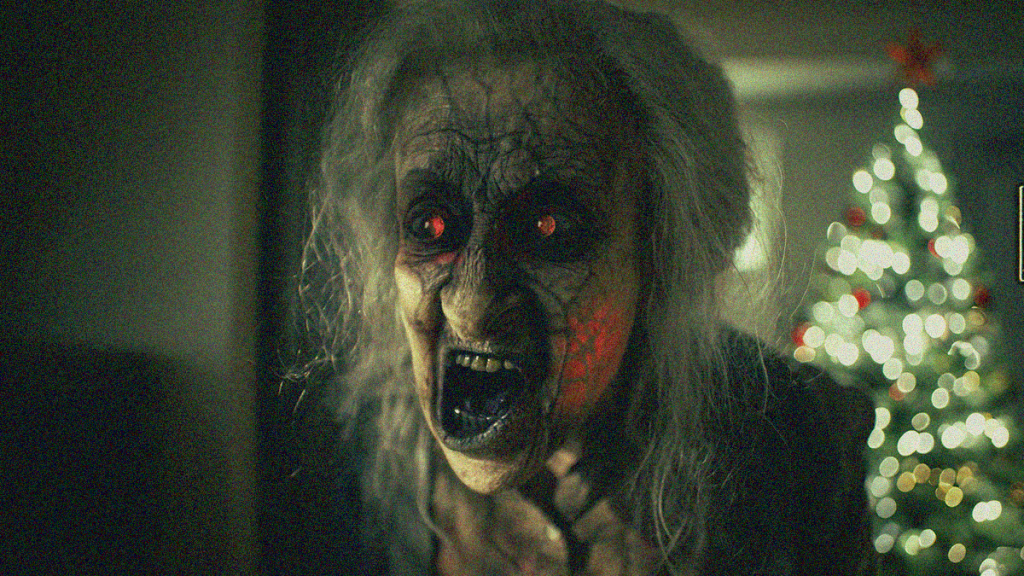
Well, while this last part is meant as a victimless crime due to Nonna (Jacqueline Robbins) being dead for a few years now, we know her corpse is inexplicably holed up in the basement with presumed ill-intent. We watched her enter the house unannounced. We braved the potential jump scares when Gino finds their cat where we think she’s ready to pounce. And we prepare ourselves for Nonna to become this family’s own monstrously violent intruder.
Blood is spilled. Bodies fall. Why now? Why them? It’s not like this is a regular occurrence since none of them are expecting the carnage that follows. They don’t even realize they aren’t alone. That the entire town is being over-run by zombies thanks to what Gino’s mother (Toni Ellwand’s Lucia) and father (Ron Lea’s Giuseppe) think is an Italian curse told to scare children into respecting their elders. “Surviving family dinner” is no longer just an expression.
Gabriele understands the inherent humor to old family squabbles being brought to light with the strict ancestors everyone was relieved to be rid of coming back for revenge. It’s not only funny (and horrifying) to see Nonna’s face contort with glowing eyes when the rage that led to a wooden spoon thwack now manifests as having that spoon shoved down your throat, but it’s also comical watching the younger generation pretend they’re tough enough to combat it.
Gino wants to protect Rene when he hears screams across the street even though he agrees with his brother Franky (Olivier Renaud) that she’d have a better time saving him instead. Franky wants to protect his family and thinks he can wield an axe to decapitate people he once knew. And their sister Angela (Cristina Rosato) is all about cheering the latter on while attempting to do so. But these aren’t just monsters. They’re also the source of real childhood nightmares.
That in and of itself is funny too once Uncle Bruno (Al Sapienza) and his ability to hear crumbs falling despite being blind arrive. So, there are as many gruesome deaths with disemboweled guts strewn across the floor as wholesome moments like Gino leveraging his great aunt’s people-pleasing nature to stop her from becoming homicidal like the rest. Not every button your family knows to push is a result of choosing violence. Sometimes they can bring peace too.
And therein lies the real message at the back of Unholy Night. Yes, it’s about acknowledging your regrets and finding forgiveness from beyond the grave (Will solving the dead’s unfinished business send them back?), but it’s also about Gino learning from their mistakes to not allow himself to make the same ones. He has a second chance with Rene to follow his heart regardless of his family’s opinions. He can stop letting them say the man he’s become is a failure.
Because Gino likes who he is. He stands by the others and deserves to have them stand by him too instead of always being the butt of their jokes. Does that mean out-Frankying Franky to save the day? No, because that’s also a refusal to be himself. It’s not about fault or heroism. It’s about accepting oneself despite the noise. It’s about being proud of what you can do rather than ashamed by what you can’t. It’s about figuring it all out without going to Hell and back.
The film is a lot of fun as a result. Gabriele leans into the tone of this genre mash-up as well as the potential to play with our expectations within it. His script lets his characters come to obvious conclusions, but he isn’t afraid to then prove them wrong … or incomplete. The emotional drama inevitably takes hold during a harrowing climax, but the epilogue leaves us with one last laugh. Sure, the “curse” is never fully explained, but it definitely serves its purpose.


Jacqueline Robbins in UNHOLY NIGHT; courtesy of Fantasia International Film Festival.





Leave a Reply