
Rating: NR | Runtime: 97 minutes
Studio: VVS Films
Director(s): Casey Walker
Writer(s): Adrian Murray & Marcus Sullivan
You are at that age.
I half thought a Remedy logo would pop up at the end of Casey Walker’s Home Bodies considering how many parallels there are between Adrian Murray and Marcus Sullivan’s script and Control. A triangle as a logo with the disembodied voice of an entity in power. Two siblings raised in a carefully orchestrated setting for experimentation. Puppet shows teaching them about the world. It’s definitely not a one-to-one mirror, but the similarities are uncanny.
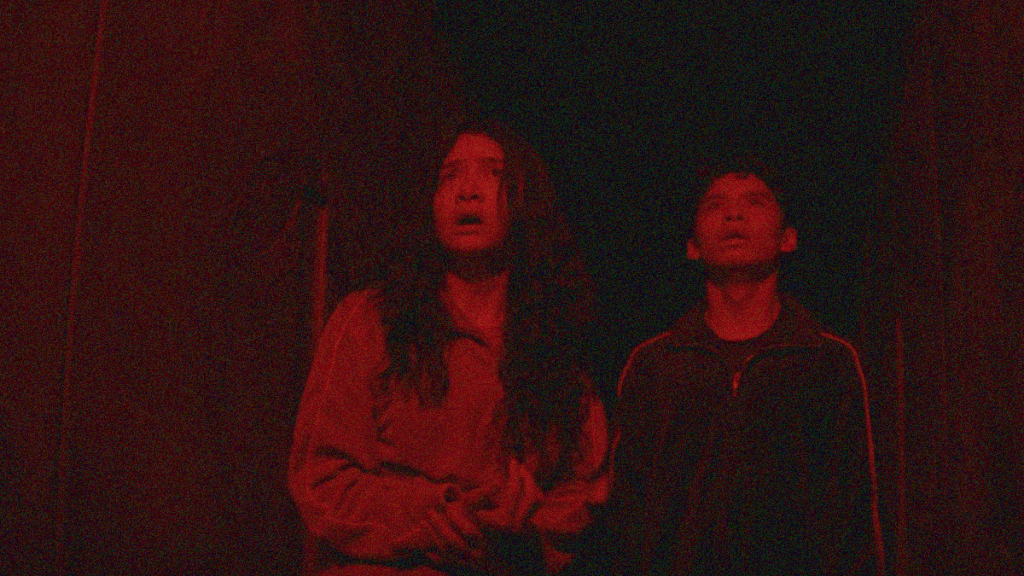
So, while things do ultimately work towards a reveal of “Old House” magnitude, don’t actually anticipate a crossover. This automated domicile that has raised Red (Emma Ho) and Blue (Ian Ho) since they were babies possesses its own mythology for them to gradually expose now that they are “of age.” What that age is (they celebrate a forty-second Noël despite being tweens) and what it signifies is left to interpretation. All we know is that change can be painful.
Stagnancy can too, though. We see that from the start with Blue’s unwavering enthusiasm for the exact same routine he’s followed for what seems like an entirety to Red. She’s desperate for something new even if that just means having a couple hours to herself without needing to entertain Blue’s whims. She doesn’t want to watch an episode of “Barn” for the umpteenth time. She doesn’t want to play “catch ball” again. She just wants some peace and quiet alone.
It’s as though “Papa” (the disembodied computer-like voice that emanates from a door they cannot open after the sound of keyboard clacking) sees this shift and wants to push things further. Because introducing a foreign entity into the equation via Pal (Ess Hödlmoser’s androgynous, robotic-like mute) is hardly a means to calm these choppy waters. No, Pal’s insertion is meant to provoke. Naturally via jealousy and unnaturally via a forbidden VHS tape.
The vibes Walker instills are impeccable. From the innocence of sibling rivalry testing resolve and patience to the horrors of the unknown when faced with realities these siblings have previously been shielded from experiencing, we can feel the tension rise as Red all but replaces Blue and Blue hatches a plan to win Red back. Give the kids a lot of credit too. Ian’s emotional reset from fear of abandonment to smiling aloofness is legitimately creepy.
Questions abound as we hypothesize Pal’s role in what had otherwise been a closed-loop system augmented by an automated home whose science-fiction infrastructure instantly replenishes the fridge, prints food in the microwave, and fills its cabinets. Is Papa trying to keep them in line? Teach them responsibility to quell their descent into boredom before they start testing this prison’s boundaries? Actively push them to find an escape?
The sheer number of possibilities creates intrigue because there’s no telling what Red and Blue will do in response. They fear Papa’s wrath despite our assumption that they’ve never “met” him, so there is a built-in system for caution. But they also fear obsolescence insofar as Red feeling trapped and Blue feeling invisible. It becomes a matter of which they’re scared of most: making Papa mad or losing whatever identity they’ve created under these regulated conditions.
I love the escalation that comes with the potential for change. We move from Red letting her anger get the best of her to break a window during a game of catch to Blue discovering the psychological trauma of committing an act he cannot take back. We are literally watching their entire worldview evolve faster than they can comprehend. With one secret screening, they go from thinking pigs and chickens are fluffy friends to being scarred by the finality of slaughter and death.
Why, though? Why are they here and who is “Papa”? Red and Blue’s interactions create the film’s central dramatic function, but the mysterious unknown at their back are what keep us engaged. Because watching how far they’re willing to go to either reclaim normalcy or erase it from ever returning is at the behest of someone or something else. We’re just as engaged in Red and Blue’s devolving equilibrium as we are in them finally opening that locked door.
I’m not familiar with Murray’s previous work alongside Sullivan (Retrograde and Withdrawn), but Walker’s position as executive producer on Jeremy Gillespie and Steven Kostanski’s The Void definitely makes sense in hindsight here. An otherworldly atmosphere, claustrophobic sensory overload, and silently malicious force are all present en route to a reveal that expands the scope of everything you thought you knew.
Just don’t expect all the answers. I won’t go so far as to say they’re banking on franchise potential since Home Bodies works well on its own despite any new questions asked once things cut to black (stay after the credits too), but the room to keep going is here. Why not? The whole point of meeting Red and Blue at this moment is to watch the inevitable awakening “Papa” orchestrates for observation. It’s not about the past or future. It’s all about right now.

Emma Ho and Ian Ho in HOME BODIES; courtesy of Fantasia International Film Festival.





Leave a Reply