
Rating: NR | Runtime: 103 minutes
Release Date: September 3rd, 2026 (Denmark)
Studio: SF Studios
Director(s): Kasper Kalle
Writer(s): Rasmus Birch / Rasmus Birch & Kasper Kalle (idea) / Karl Heinrich Ulrichs (short story Manor)
You’re not one of the widows.
Director Kasper Kalle calls Karl Heinrich Ulrichs’ 1884 short story Manor “one of the first unapologetic stories about gay love” and “a cornerstone in the history of queer people” that “few people know exists.” Well, thanks to him and writer Rasmus Birch ushering us back to the Faroe Islands circa 1862, that’s about to change as No Rest for the Wicked brings the story’s dark, forbidden sexuality to life right when its small fishing village is pushed to the brink of its piety.
The film begins with a prayer for safety uttered at the meal table by young Baldur (Egor Venned). His mother (Sofia Nolsøe’s Ásla) helps finish it with him because she knows the potential dangers that await once he goes out to sea. They’ve already lost Baldur’s father and she cannot afford to lose him too—even if he’s simply rowing through the rocks to collect a couple fish just for them. All it takes is one thick fog to change their lives forever.
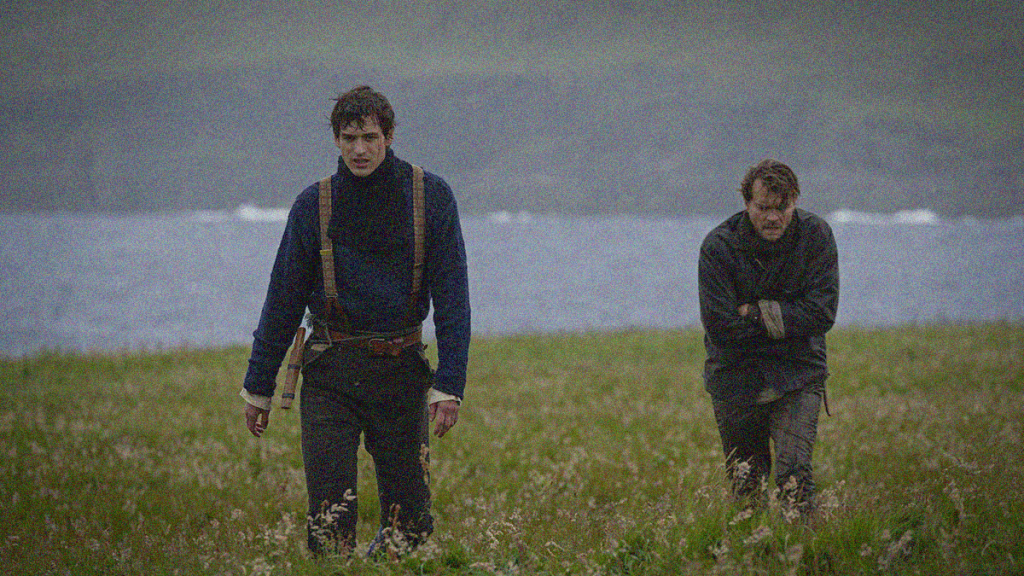
You must wonder from the atmospheric mood that brings Baldur to hear a man calling for help in the distance is already setting the stage for evil to take hold. Is the voice a ghost? A demon? Our minds wander because we know the genre and anticipate what comes next. Except that our assumption is wrong. Helge (Pilou Asbæk) is just a man. A Dane between whaling ships who lost his way in the fog. A man in need of saving who ends up saving Baldur instead.
We aren’t the only ones with expectations, though. The characters do too. We see the way Baldur looks at this newcomer, but even he knows reality will surely have Helge entering his flirtatious mother’s room. Ásla is hardly subtle and Helge volunteering to assist Baldur in repairing his boat provides the cover necessary to consummate her signals. Unless, of course, Helge is interested in someone else. But is it for love or hunger? Could it be he’s not a man after all?
The ambiguity isn’t a mistake. Kalle knows the intrigue inherent to this one-hundred-and-fifty-year-old story is the universality of the extreme isolation so many gay people endure. Baldur is quite literally alone on this island of God-fearing folk who would never accept his lifestyle as anything but a product of evil. So, the film plays with this notion. It uses the tropes of vampire and ghost tales to instill fear on the island inhabitants despite there being no ill intent.
Well, not yet at least. Because even though we can acknowledge the supernatural feedings that take place are a metaphor for consensual romance, Ásla and the town elder (Jóhannes Haukur Jóhannesson’s Jákup) surely do not. No, once tragedy strikes, the simple act of witnessing any consorting between Baldur and Helge calls your own godliness into question. To give the unspeakable life through words is akin to fanning the flames. You become a pariah too.
And therein lies the rub. That’s where the mirror to today’s world enters the fray since bigotry and hate only ever prove your own deficiencies. The more this town refuses to let Baldur and Helge’s love exist, the worse their own lives become. It’s not a punishment, though. What happens may take the same form of revenge that horror films wield, but it’s never to hurt the people affected. It’s merely to satisfy love’s undeniable force by any means possible.
The least these residents can do is mind their own business. To not let God give them the freedom to destroy love simply because they don’t understand it. I love that No Rest for the Wicked leads towards an almost begrudging allowance rather than a full embracement because it proves how someone else’s gay relationship doesn’t alter your life. No, it’s not letting them be happy that does. That hate will harden your soul to the point of distorting your faith to fit it.
That this message is delivered via impeccable performances and Jacob Møller’s gorgeous cinematography amidst the mossy rocks of this treeless country only augments it. Venned’s longing. Asbæk’s desire. Nolsøe’s love for her son overriding her church’s demands. The rest of the town might do what they do to return to normalcy, but we know Ásla does it to right a wrong. Because it doesn’t matter where or when it’s set, a parent’s acceptance transcends both.

Egor Venned and Pilou Asbæk in NO REST FOR THE WICKED; courtesy of Fantasia International Film Festival.





Leave a Reply