
Rating: NR | Runtime: 97 minutes
Director(s): Wiebke von Carolsfeld
Writer(s): Doug Taylor & Wiebke von Carolsfeld
That is not what you should feel sorry about.
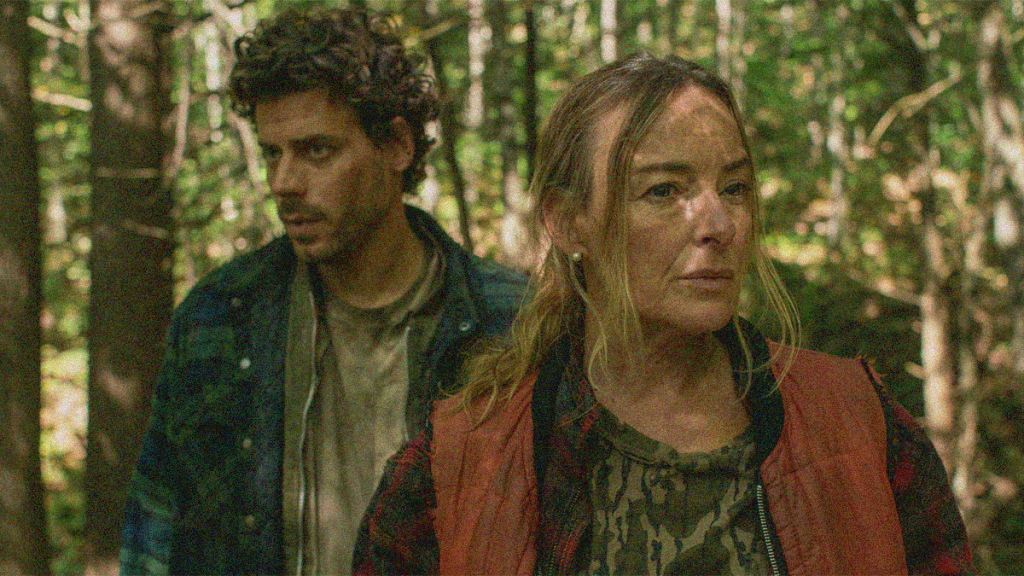
Fifteen years after earning an acquittal for her alleged rapist client (François Arnaud’s Paul), defense attorney Sam (Pascale Bussières) finds herself waking in the backseat of a vehicle with her hands tied. The driver (Peter Outerbridge’s Borden) is the father of the accuser. The latter has since died and he’s hatched a plan to desert the two people who contributed to her mental spiral into drug addiction onto a small Canadian island with nothing but a knife and gun.
Wiebke von Carolsfeld’s Someone’s Daughter (co-written by Doug Taylor) is thus set-up for us to potentially discover the truth of that crime. Sam is quick to hide behind the notion that doing her job effectively trumps any presumed guilt her clients might possess. Paul had a story that she believed she could defend. That’s all that mattered. Sure, the system can be cruel and tragedies can occur, but you can bet Sam never really thought about the trial since.
She has no choice now. The only person who can help her survive is a man she can’t trust in isolation outside the courtroom. Sam was his protector in that venue. She set the boundaries. Here? She might just become his next victim if she lets her guard down. Unless Paul has grown and this is his chance at redemption. Or that we find out he truly was innocent after all. I’m just not sure this film gets made if it’s the latter. Its suspense is born from “when” not “if.”
As such, the suspense is often lacking since consciously waiting for that shoe to drop isn’t the same as wondering what the shoe will be. von Carolsfeld more or less hopes we’ll set aside this inevitability and invest in their mutual survival first. Can they get off the island? Can they find higher ground to chart a course home? Can they procure water once they go too far ashore to turn back? Is there even a road and/or civilization within walking distance?
All these questions swirl in ways that demand we worry about their health when we really only care about whether their inherent frustration will drive one of them to act on impulse. Will Paul be able to control himself knowing there’s no one to witness what he might do? Will Sam’s benefit of the doubt run dry to force her to shoot the moment things start going south? Borden didn’t give her the gun just to kill Paul. He presented Sam with her own shot at redemption.
We never really get the sense that she’s willing to do it, though. Yes, Sam often refuses to let him carry the pack even when it’s obviously slowing her down, but it’s always presented more as a symptom of her wanting control than a lingering fear. Paul has a couple moments where his temper comes out, but nothing to make us afraid for her safety either. The first two-thirds of the film is conversely constructed for them to become genuine friends.
Why? To get us to let our guard down. To lull us into a false sense of security before pulling rug. But it’s impossible for it to hit with as much potency as hoped when the entire point of the movie is to eventually get there. It’s not that we start to forget that fact because Sam and Paul find a kinship through shared trauma. It’s that we grow tired of waiting. So, I will give the filmmakers a lot of credit for delivering the moment in a subversive way when they finally do.
Unfortunately, they don’t carry that subversion through to its mirrored outcome. Any excitement that arises from the possibility that the endgame will actually surprise us evaporates once the scene flips back to its regularly scheduled programming. Is it a disappointment? Yes. But that doesn’t also mean its orchestration isn’t effective. Someone’s Daughter does make good on the promise of its conceit. It simply isn’t quite enough for success.
Bussières and Arnaud are up to the task of knowing their roles and sticking to the present regardless of the audience’s inability to stop waiting for the future. They create normal tension from the imbalance of her being woodsy and him not having a clue, but I wonder if adding more of the tension from their past could have augmented that drama. They never really push each other’s buttons to test that history. Not until the script runs out of time.
So, it’s a serviceable thriller in that it achieves its superficial goal of surviving Mother Nature, but it leaves a lot on the table insofar as achieving its foundational goal of mining the psychology of why these two characters are forever bound together. You might even say its conclusion’s decision to turn the tables how it does proves a reductive misstep by way of creating a narratively satisfying yet no less problematic false equivalency.

François Arnaud and Pascale Bussières in SOMEONE’S DAUGHTER; courtesy of Fantasia International Film Festival.





Leave a Reply