
Rating: NR | Runtime: 100 minutes
Release Date: September, 2026 (Belgium)
Studio: Kinepolis Film Distribution
Director(s): Bob Colaers
Writer(s): Sven Huybrechts, Saïd Boumazoughe & Salahdine Ibnou Kacemi
Who’s going to call the cleaning lady?
When a medication run for his mother goes wrong after running into a couple of racist cops, Suleyman (Saïd Boumazoughe) finds himself serving seven years in prison (an inexplicable number considering neither the police force nor justice system generally take “involuntary homicide” into account when the victim is an officer of the law). A lot changes in that time with his old housing complex now being run by a notorious gangster (Achmed Akkabi’s Prince).
The only thing that’s stayed the same is Suleyman’s mother (Fatima Khanfour) still needing his assistance. Yes, to procure a shot of insulin before she passes out, but also to protect her from the violence that ensues once a full-scale SWAT assault interrupts their reunion. Because there are few civilians left in this high-rise now that Prince has populated it with his captains and foot soldiers. No one is safe from flying bullets on either side of the fight.
Created by Boumazoughe, co-written by him, Sven Huybrechts, and Salahdine Ibnou Kacemi, and directed by Bob Colaers, Attack on Paradise unfolds like the numerous other castle siege examples throughout the last couple decades. Whether Attack the Block, The Raid, or Dredd, it’s a genre format that promises high octane action amongst an easily delineated contingent of good versus evil. Whereas the hero/antihero is usually alone, however, Suleyman gains allies.
Musa (Kacemi) is the obvious one. A friend from before his stint in prison, he runs a convenience store with a backroom surveillance center that taps into the complex-wide camera network Prince has installed. He’s not the only person who recognizes Suleyman by appearance or reputation, but he is the only who hasn’t either drunk the Kool-Aid or been duped by the building’s new overlord. If you need an escape route or a Turkish care package, he’s your man.
An unlikely partner comes in the form of a rookie SWAT officer named Yasmine (Clara Cleymans). Unlikely because he’s hardly a fan of the police, but not unsurprising since we meet her and her daughter before all hell breaks loose. If only one other character besides the lead gets their own cold open intro, you can bet they will become our secondary focus. No one on the force thinks she has what it takes, so she’s ready to prove her worth regardless of who’s by her side.
Yasmine wants Prince’s head. Suleyman wants to save his mother. Both paths lead upwards to the penthouse with assault weapons, knives, and the brute force of Prince’s boxer brother “The Lion” (Jamal Ben Saddik) coming from opposite directions. A lot of blood is spilled. A lot of bodies fall. And the action is always ready to deliver in its close-cut kineticism. Most of the latter is familiar in scope, but a couple fights on the “prostitution floor” add some ingenuity.
The only real variety during the ascent is therefore connected to the disparate “bosses” on each level. The ex-lover in Niki (Imanuelle Grives), explosives psycho in Tchuko (Soroush Helali), sex trafficker Minza (Rudy Mukendi), and, of course, “The Lion”. They come with different physicality and weapons so the kills can find their own unique flavors, but there aren’t really any stakes considering the safe assumption is that Suleyman and Yasmine both make it to the top.
So, Colaers relies upon the gimmicks at his disposal. We get a scene in night vision. An elevator shaft shortcut. A pool hall arena. And … a waterbed. He’s having fun with the potential “weapons” every room holds, and it shows in the final product. You must still suspend your disbelief when it comes to the decision to give his protagonists some gnarly injuries that their adrenaline seemingly make feel like paper cuts, but that’s par for the course.
Boumazoughe and Cleymans do well selling their fatigue while finding ways to prevail, but I think both shine brightest during the downtime talking about Suleyman’s mother and Yasmine’s daughter. This partnership isn’t therefore solely based on convenience (although each inevitably saves the other) since they cultivate a shared humanity beyond the superficial assumptions that could divide them. And the film never loses focus to sloppily inject a romantic subplot either.
That isn’t to say there isn’t sloppiness involved, though. Characters are often allowed to pop-up in places with ease when the story demands it despite things seeming like a war zone with no exits the rest of the time. And I’m still wondering why Colaers spends so much effort making sure we know a young boy watches Suleyman escape through a window over his dead mother’s body for never bringing him back into the plot with a mistaken play at revenge.
It happens with these types of films. Some threads get cut and some bids for coverage allude to possibilities that don’t actually exist. You learn to let it go and enjoy the energy, violence, and unavoidable humor inherent to displays of over-charged machismo (the captains all have their cartoonish moments, but my favorite is Akkabi’s reaction whenever Ben Saddik destroys someone making it seem like he did the destroying instead). Take a seat and have fun.

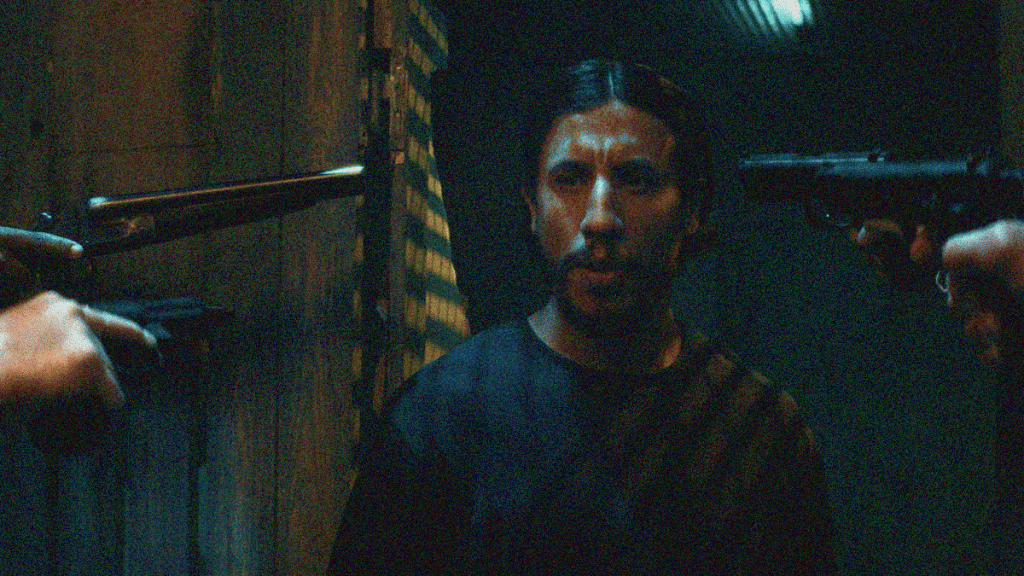
Saïd Boumazoughe in ATTACK ON PARADISE; courtesy of Fantasia International Film Festival.





Leave a Reply