
Rating: NR | Runtime: 92 minutes
Release Date: July 31st, 2026 (USA) / November 6th, 2026 (Finland)
Studio: Shudder
Director(s): Hanna Bergholm
Writer(s): Ilja Rautsi & Hanna Bergholm / Hanna Bergholm (story)
The forest takes its own.
Jon (Rupert Grint) sees the human-ish trees in the forest behind the dilapidated Finnish home he’s agreed to start a family in—the former house of his wife Saga’s (Seidi Haarla) grandmother—and decides it’s a good idea to conceive the couple’s first child in the dirt while they watch. That right there should have been a red flag as far as whether this Londoner had the survival skills for what comes next. One look at those trees and he should have run back to civilization.
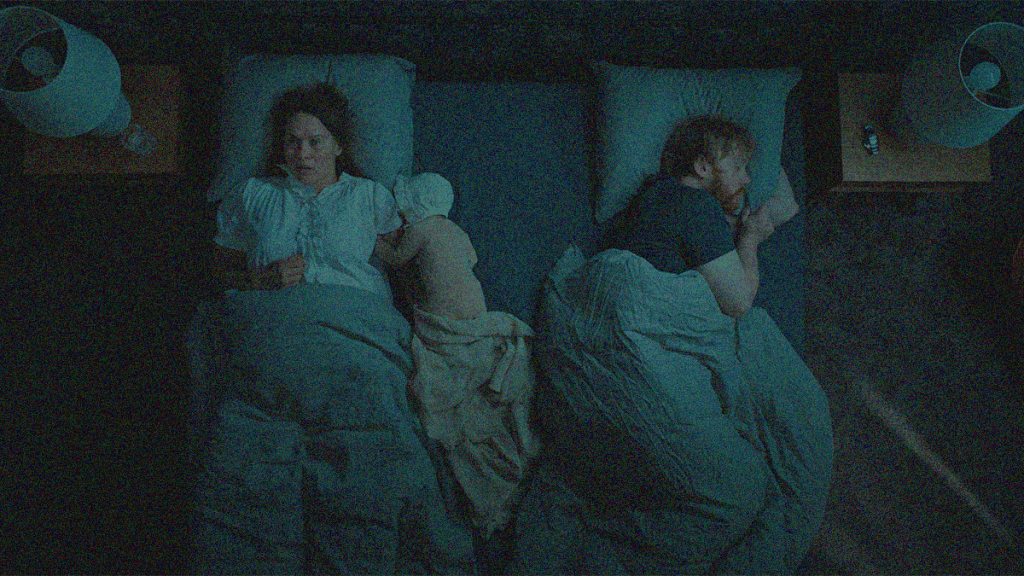
Hanna Bergholm’s Nightborn (co-written by Ilja Rautsi) fast-forwards to the birth of their son instead. So much screaming. So much blood. So much … hair. People try to tell the new parents that everything they are experiencing is normal, but we see the way children look at the baby. We see the weird tailbone growth. We realize Bergholm is intentionally shrouding the child’s face from the camera. So, we know nothing about this is normal. We just don’t know what it means.
The film isn’t looking to bludgeon you with its mythology, though. Whereas some stories about motherhood use genre trappings to serve as a metaphor of the experience by way of simply making a horror film about parents, Bergholm does the opposite. She teases notions of Finnish trolls and monsters, but never in a way that removes the potential for everything weird on-screen to simply be in Saga’s head. Parenthood is the nightmare.
All the fantastical things we see might therefore be a means with which to make it make sense. Because Jon, Saga’s sister Taru (Pamela Tola), and their mother (Pirkko Saisio) don’t interpret what she (and we) believes to be obvious in the same way. They laugh off the chaos. They look for ways to force normalcy onto these abnormal situations because they “know” a baby holds no power. It’s their job to help it get used to a healthy routine and boundaries.
Logically they’re correct in this thinking. Babies don’t crave raw meat and blood. If they end up eating those things, it’s just that those things are what’s being presented to them as food. The whole script is built on similar chicken vs egg conundrums. Is the child crying in sunlight because it truly burns or because you whisk him into the shade? Is he calling the trees to wrap themselves around the house or does your fear of him project intent upon coincidence?
The point of the narrative is therefore less about solving the mystery of what’s occurring and more about whether love’s bond can overcome that fear. When everyone tells Saga that she was just as bad when she was a child (some say she still is), they are trying to get her to exit her head and relieve pressure. But what if they are actually confirming what she thinks? That her son isn’t a troll by chance. That she’s one too. That maybe it’s time to embrace it.
Nightborn proves the opposite of most postpartum horror tales by having its dark and violent moments make mother and child closer. It turns from patronizing Saga into opening her eyes onto a rosier truth to villainizing her as a bad mother, wife, and human being. So, she stops hiding the “fixes” that quiet her son and stops being scared of the harm he appears to inflict. She allows herself to join him in escaping society’s constraints. To prove it’s the world that’s wrong.
The result is often humorous in nature merely because it chooses to filter events from an uncommon side. Rather than show a last-straw fight between Saga and Jon as an emotionally dramatic attempt to save her from herself, Bergholm shoots it like a wildlife documentary with Haarla and Grint growling as they bare their teeth. Instead of playing its supernatural implausibility as something to defeat, the film asks if Saga’s grandmother was wrong to suppress them.
Go crazy. Drink blood. Run into the woods naked. Stop trying to change who you are to fit a mold of boredom and laugh in the faces of those who cannot fathom having a unique thought of their own. Similar to Bergholm’s previous film Hatching, she seems keen on making us think one thing before pulling the rug to reveal the other. She lulls us into the comfort of yet another “Mom is losing her mind” story before coaxing us to stand and cheer Mom on further.
Haarla is fantastic throughout this transition. We feel her pain and fear at the start. We sympathize with her refusal to call the baby anything other than “it” while Grint expertly huffs to correct her each time. But we also admire her turn towards feral aggression at the end. We aren’t laughing when she growls because she’s the joke. No, those growls work to quiet the baby. It’s a legitimate form of communication. We laugh because it angers everyone else.
So, Nightborn won’t be for everyone. It’s not as polished as Hatching despite holding the same psychological depth nor as clichéd as you might expect from the straight-to-streaming marketing materials despite having those same tonal earmarks. It’s a sort of hybrid that uses its conventions as a means for subversion. Yes, its superficial packaging can hurt it at times, but the undercurrent of non-conforming empowerment still shines through.


Seidi Haarla and Rupert Grint in NIGHTBORN; courtesy of Fantasia International Film Fest.





Leave a Reply