
Rating: NR | Runtime: 107 minutes
Release Date: November 21st, 2024 (Italy) / July 10th, 2026 (USA)
Studio: Minerva Pictures / Greenwich Entertainment / Kanopy
Director(s): Eran Riklis
Writer(s): Marjorie David / Azar Nafisi (novel)
Religion and state are not the same.
The hope from revolution in Iran was for freedom from monarchic rule. Reality, however, eventually ushered in an era of even worse oppression via an iron-fisted theocracy. Should those who chose to return and see their country reborn have seen the writing on the wall? Maybe. But arguments about where to go next are part of structural change. Debate will get heated, but cooler heads should prevail. They didn’t realize how much power the Islamic extremists already held.
So, it’s not long after Azar Nafisi (Golshifteh Farahani) begins her post teaching English Literature in Tehran that the curtain falls. Hijabs become mandatory. Text and ideas deemed to be immoral are banned. Citizens daring to protest and live as they had in the past are arrested and, sometimes, executed. Everything Azar and her husband (Arash Marandi’s Bijan) thought was possible ends in an instant. Purpose and circumstances are forced to change.
Adapted by Marjorie David from Nafisi’s memoir of the same name, Eran Riklis’ Reading Lolita in Tehran begins with Azar’s return from America. Centered around her teaching The Great Gatsby at university, we watch as her optimism is tested at the airport and again in her classroom. She welcomes the challenge. She welcomes the opportunity to educate and mold minds that show a willingness to listen despite their indoctrination. She just isn’t really given that chance.
From there we move to 1995 where the title originates. This is when Azar begins her “book club” with trusted former students willing to risk their safety by leaving their husbands and/or fathers for one day a week to read classics like Lolita. We listen as these women (Zar Amir Ebrahimi’s Sanaz, Mina Kavani’s Nassrin, Lara Wolf’s Azin, and others) catch the metaphors to their own lives in the text. And we watch their persecution crosscut against those words.
Riklis takes us back to the 80s with Daisy Miller when Azar attempts to teach again despite war with Iraq and forward to the late 90s with Pride and Prejudice as an in-road to sexuality and escape. The film does its best to spotlight one main through line connecting that era’s Iran to the novel so the plot can progress in tandem with Azar’s evolution from teacher to mother to mentor to woman in need of change, but you can tell a lot of context is missing from the source.
Think of this as more companion than replacement. Its runtime demands that a choice be made between telling Nafisi’s story through her experiences with these books or a story about Iran through those shared experiences with the women trapped alongside her. David and Riklis chose the former for an uncomplicated biopic wherein the book club becomes one part of Azar’s journey. The politics become a backdrop to her personal choice about staying.
That’s not to say the film avoids the darkness inherent to those politics, though. We’re still taken inside the prison with teenage protestors to understand the PTSD Nassrin speaks about towards the end. We witness the ordeal Sanaz endures to wonder aloud whether Iranian women have been turned into “Lolitas” by the Islamic Republic. We catch glimpses of the small yet still very dangerous ways in which Azar and her professor friend (Shahbaz Noshir) rebel.
The result is a captivating if somewhat superficial account of what occurred. It latches onto the broader swaths of what Nafisi wrote to craft an easily digestible tale of rebellion and survival. The complexities remain (Azin’s inability to save herself with a daughter involved, Reza Diako’s Bahri’s conflict between the religion ruling his mind and the art ruling his heart, Azar trying to get Bijan to understand she can no longer afford hope), they just aren’t mined further.
And that’s okay when you still have the book at your disposal. The film is allowed to be just effective enough to give life to the overall journey while also sparking your interest to dig into the text and experience the historical and emotional details left behind. Farahani is great in the lead and Noshir lends a welcome air of self-aware nonchalance, but it’s Ebrahimi, Wolf, and Parvaneh who stand out. It’s probably why I wish we got more of the “club” in the process.
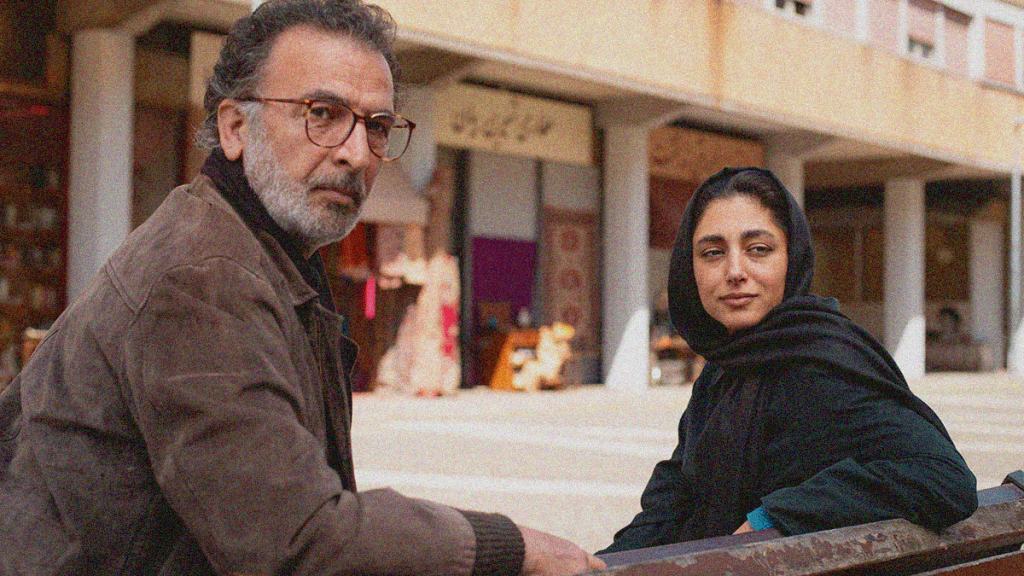
Shahbaz Noshir and Golshifteh Farahani in READING LOLITA IN TEHRAN; courtesy of Greenwich Entertainment.






Leave a comment