
Rating: NR | Runtime: 82 minutes
Director(s): Timothy Hall
Writer(s): Timothy Hall
I couldn’t ask you to watch me die.
Julie’s (Michaela Walton) wedding weekend is not going well. Her maid of honor just canceled because her father had a stroke. Her brother (Ryan Austin’s Nick) just admitted that he mentioned the event to an aunt and therefore probably gave their own estranged father a heads up to make a problematic appearance. And the groom (Zach Strum’s Patrick) has pretty much proven he can’t be trusted to follow even the simplest instructions.
Despite this implosion, however, Julie still takes the time to check in on the wellbeing of both Nick and the sole guest invited to attend (Eduardo José Paco Mateo’s Jordi). We actually meet the latter first as he wakes from a dream that leaves him (and us) disoriented considering it seems he was thinking about someone he hasn’t met yet. We can’t therefore ignore the air of destiny once he shakes Nick’s hand. Two grieving men perhaps finding a moment of joy.
Writer/director Timothy Hall uses Julie as our entry point into Jordi and Nick’s lives during the first act of Summer Lost. In order to distract herself from her own struggle, she worries about them—as much out of a desire to see them happy and to guess whether they’ll survive without her if she just calls this whole celebration off. It almost feels like she planned this wedding as a covert meet cute. Get her two favorite men in a room and watch sparks fly.
So, don’t be surprised when she disappears without a second thought. Julie is simultaneously the catalyst for the romance that follows and Hall’s device to let the film find its stride before giving us all the information necessary to fully comprehend the dynamic at play. Because there’s a version of this plot wherein we discover one of the characters is a ghost if not for her third party interacting with both potential candidates separately from the other.
The cyclical nature of the narrative and its superficially confusing shifts in perspective are therefore intentional. The doubling of names. The sorrow of loss. Jordi’s voiceovers playing atop lower fidelity footage that seem to be capturing a time that either occurred before the wedding excursion or will still after. Because the tragic fact at the center of the story is a terminal diagnosis that carries memory loss. There is no past or future for Jordi. There’s only today.
Our investment is as much about the blossoming romance as the timeline. Are we watching Jordi and Nick meet for the first time? Will we discover this has all happened before? Does it even matter? Hall is neither trying to trick us nor being withholding. He’s merely answering that third question with a resounding, “No.” He’s revealing the power of love as an emotion that transcends reason and fear. He portrays it as an inevitability.
It’s how he portrays that sense of fear too considering what a relationship with a dying man guaranteed to forget his lover means for the survivor. How he does so just might not be how you assume. Not because Jordi doesn’t battle his impulse to leave Nick and save him from the pain of what’s coming. That’s here too. I mean the care with which Hall treats Nick’s own insecurities. How it’s Nick who tries to push Jordi away before he knows of the threat.
We’re watching a man afraid of becoming a coward like his father and another who refuses to be afraid of his mother’s tragic fate with illness. The former fears living because he might let those he meets down. The latter fears not living because he knows he’s doing it on borrowed time. It’s a perfect match insofar as Jordi having the lust for adventure to coax Nick from his head and Nick knowing that true love means not running away when things get too hard.
Summer Lost isn’t just the nonlinear gimmick of its premise. It’s a romance that seeks to highlight the honesty in love’s complex and often messy drama. Hall is keen to supply external examples to do so that infer upon the main duo’s psyche (Nick’s father), add levity (a Motherboy to make Lucille Bluth proud), and foreshadow how unavoidable frustrations can be survived if you’re willing to do the work (Julie and Patrick). Each is relevant to Jordi and Nick’s coupling.
In the end, it’s the compassion, fun, and uncertainty traversed by Mateo and Austin during multiple moments upon the timeline of Jordi and Nick’s life together that rise to the top. Their performances feel authentic in their shyly awkward interactions as much as their emotionally charged heart-to-hearts. We can sense their intrinsic bond when they’ve just met as deeply as when they’ve been together for months … and when they meet for the first time again.

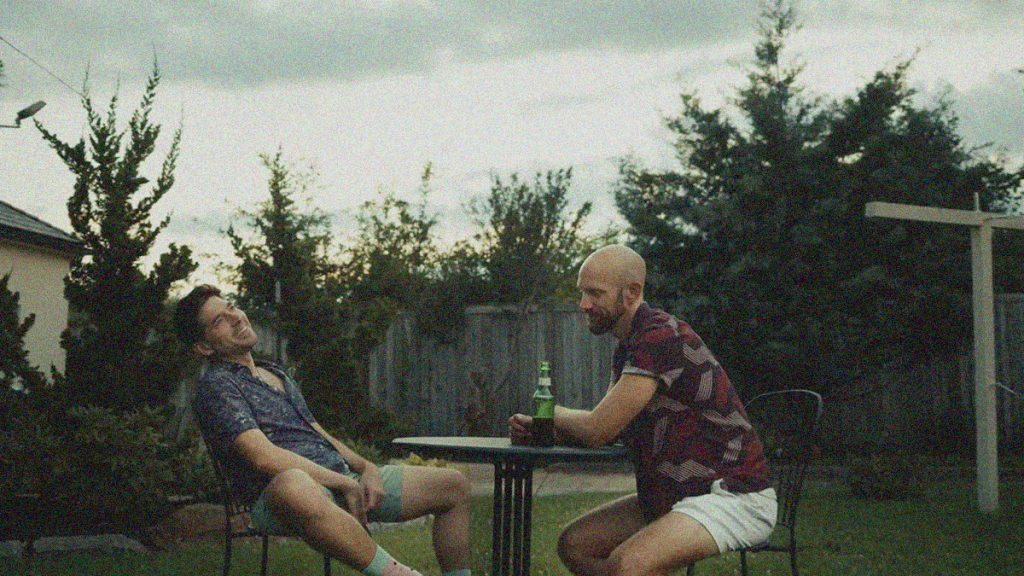
Eduardo José Paco Mateo and Ryan Austin in SUMMER LOST.


 jaredmobarak.com
Leave a comment