
Rating: NR | Runtime: 91 minutes
Release Date: February 13th, 2026 (USA)
Studio: Dread / Epic Pictures / Shudder
Director(s): Jeremiah Kipp
Writer(s): Tracee Beebe and Brian Clarke / Brian Clarke (video game)
Let me in.
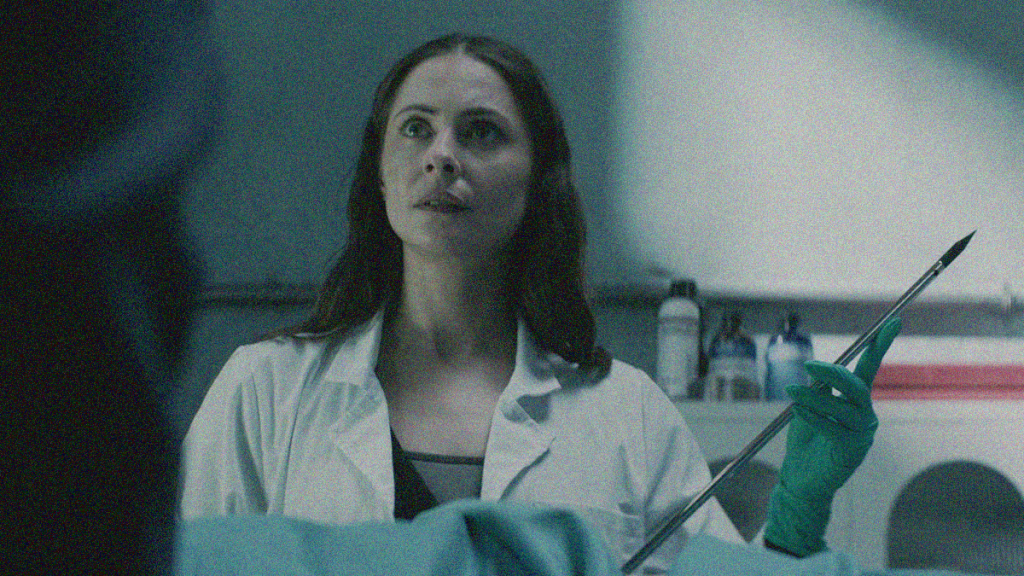
One-year sober (to the day) and finishing her apprenticeship with mortician Raymond Delver (Paul Sparks), Rebecca Owens (Willa Holland) finds herself succumbing to the dark emotions that have haunted her since her father’s (John Adams) death years ago. So much so that she’s about to risk all her hard work for a score when receiving a call that Raymond needs her to handle some late-night drop-offs at the mortuary. He can’t make it, so it’ll be her first solo assignment.
Original video game author Brian Clarke (alongside Tracee Beebe) adapts his The Mortuary Assistant to the cinematic medium as a complete entity rather than trying to blur lines by narratively working in ways to depict its multiple shifts and endings. The whole is therefore compressed into a single night wherein the horrors of discovering that a demon is attempting to possess her pushes Rebecca to both learn the means to stop it and face the trauma of her past.
Director Jeremiah Kipp stays true to the game by playing with the appearance of sigils, augmenting the inclusion of its house of invidiousness spirit known as The Mimic (Mark Steger), and even directly implementing the desktop image and reporting interface from Raymond’s computer. Add some split diopters to ensure our attention is never divided between Rebecca and her moving cadavers and the atmosphere remains sufficiently creepy throughout.
Fans of the source material are treated to these earmarks before newcomers can become fully aware of their meaning. So, seeing Raymond react to a corpse’s foot twitching may just seem like a subtle scare, but it’s actually a very specific sign of things to come. That doesn’t, however, mean everything is one-to-one. Kipp and company want their entire audience to be caught off-guard, so don’t be surprised when the hallucinations turn violent before Raymond has a chance to explain.
The script does well manipulating our inability to know what’s real and what isn’t. We can presume the woman banging on the mortuary window isn’t really Rebecca’s grandmother, but what about her sponsor (Keena Ferguson Frasier) arriving unannounced at her home? And which visions are all in Rebecca’s head as opposed to deceptive filters tricking her into hurting herself? How can she even trust that the Raymond she sees and hears isn’t another illusion?
She can’t. Neither can we. The filmmakers know this and use it to further erode our trust by overlapping fact with fantasy. I enjoyed one scene where Raymond is explaining something to Rebecca over the phone and certain words are obviously being replaced to create a more sinister variation of his instructions. It’s not just a means for the demon to break her down either. The resulting undercurrent of self-harm is also crucial to its overall metaphor for addiction.
Just as Kelly explains how holding her guilt and self-loathing at bay is a life-long process that cannot simply be conquered, the same is true when it comes to being marked for possession. The battle in her mind against drugs is the same battle as the one being waged in the mortuary—especially since the memories of her father prove integral to both. There’s a reason she was chosen and, as luck would have it (or not), she’s in the one place that’s strangely equipped to fight back.
The Mortuary Assistant might fall victim to its budget in certain aspects, but it does effectively portray the psychological war for survival at its core. That said, many of the issues people will have with the film won’t be huge issues for fans of the game considering the (mostly) single location and repetition (albeit much less since we aren’t watching Rebecca wire, exsanguinate, and embalm every single body) are intentional features of its walking simulator infrastructure.
Discovering the process behind Raymond’s mode of combating the forces of evil is just as important to the whole as Rebecca’s nightmare, but don’t expect too much of the former’s mythology to be explained alongside hers. At one point she asks about the meaning to everything and he just glosses over it with an “it doesn’t matter” … because it doesn’t. Knowing the contextual background of each demonic house isn’t necessary for the conflict at-hand.
All we need is a healthy mistrust of what we see and gnarly practical effects to ensure the prevalence of blood, organs, and sutures don’t take us out of the moment by looking too fake. With that realism, some nice cinematography to enhance the jump scares, and The Mimic’s memorable creature design, it’s easy to invest in the ride. And if you must learn more, go fire up the game and dive into its “Night Shift Database” and diaries. This is an adaptation, not a replacement.

Willa Holland in THE MORTUARY ASSISTANT; courtesy of Shudder.




 jaredmobarak.com
Leave a comment