
Rating: NR | Runtime: 98 minutes
Release Date: April 3rd, 2026 (UK) / April 24th, 2026 (USA)
Studio: Sky / Roadside Attractions / Saban Films
Director(s): David Mackenzie
Writer(s): Ben Hopkins
Don’t be shit.
Director David Mackenzie gets the opening credits out of the way as soon as we sit down to watch his latest film Fuze because a majority of the ninety-eight minutes that follow are akin to a feature-length cold open surging at breakneck speed to its own climax. It takes half that time before there’s even a brief pause in the action since the discovery of a WWII ordinance during construction in a residential English community has everyone running around.
Major Will Tranter (Aaron Taylor-Johnson) is the initial focal point as the bomb technician on-call. It’s his job to lead the team that will either diffuse the missile or set-up a perimeter to allow for a contained explosion. As such, local police, led by Chief Superintendent Zuzana (Gugu Mbatha-Raw), must coordinate a mass evacuation of the area. No one can remain behind because no one knows exactly how well-preserved the weapon will prove. It could blow at any second.
So, we know something is amiss when a dark room of men suddenly stirs without also getting up at the knock on their door. It’s almost like they knew this was coming and have been waiting for their moment to use it to their advantage. As soon as the electricity is cut for the area and alarms begin to sound, G (Theo James), X (Sam Worthington), and the rest of their gang move towards the basement to drill through the wall and into the bank vault next door.
Screenwriter Ben Hopkins ratchets up the suspense around the bomb as fresh developments arise with every attempt to surveil the situation. He’s adding more tension with the in-progress bank robbery and allowing his periphery characters to do their jobs insofar as questioning their circumstances and discovering anomalies. Zuzana’s second-in-command Clareese (Honor Swinton Byrne) notices a rogue heat signature. Tranter’s detonation tech notices a discrepancy in the bomb’s potential origins. Are either worth compromising the task at-hand?
Will the ordinance explode? Will G and X succeed in their crime? Will Rahim (Elham Ehsas) and his parents—sent to safety from the apartment building being used for the robbery—catch their flight? The score practically puts a ticking timer on the film itself while we move back and forth between each ordeal and brace for the inevitable chain reaction. Then comes the aftermath to escape the zone, survive the blast, and figure out exactly what just happened.
And that’s why I say the whole thing feels like one prolonged cold open—this exhilarating pace never ceases. Even when we finally get that pause in the action to move from the event to its consequences, the intensity increases further via a manhunt, double-crosses, and uncertain logistics. Add an epilogue that actually takes us into the past and you realize how tightly wound and meticulously constructed this script is. Nothing happens without reason. There’s no excess.
That guarantees neither the audience nor the characters can take a breathe. Even if a plot hole exists, we’ve become too many steps removed from it for it to truly matter (if it doesn’t also have its own purpose). A different crossroads has appeared with its own unique set of circumstances to alter our already expired assumptions. No one can be trusted. No one is assured of their survival. We don’t even know who we should be rooting for beyond the filmmakers themselves in hopes they stick the landing.
Not only do they succeed, but they increase our enjoyment level more. Because Fuze isn’t interested in good versus bad. It cares only about entertainment. What gets us to lean forward in our seats? What makes us question what we’ve already seen? What violent and/or genius development will earn a laugh? Every maneuver places us front of mind to surprise, reward, or confuse. It’s a highly addictive candy bar of a movie that should satisfy anyone’s sweet tooth.

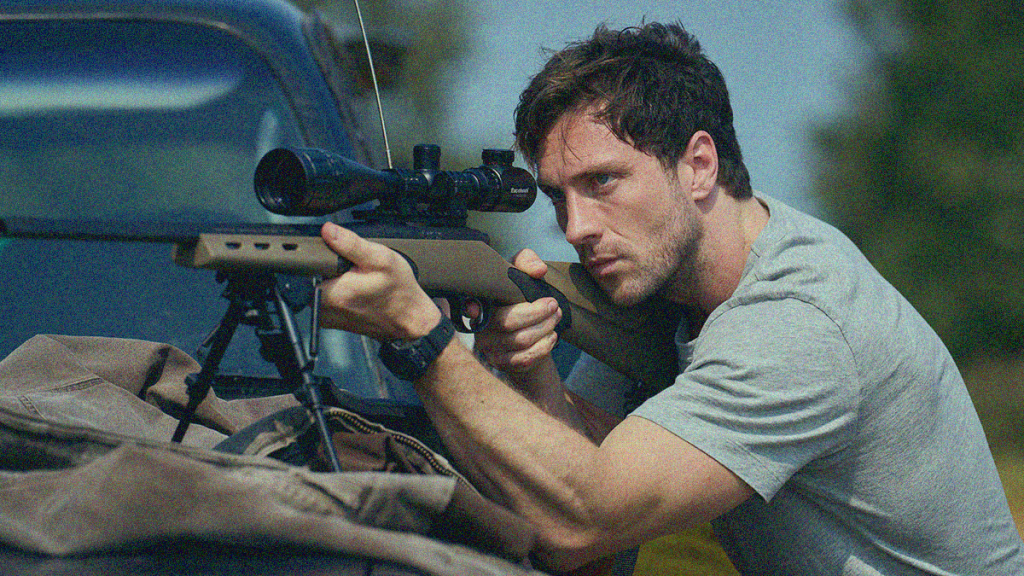
Aaron Taylor-Johnson in FUZE; courtesy of TIFF.




 jaredmobarak.com
Leave a comment